


The best jobs for people with anxiety offer predictable routines, quiet settings, clear expectations, and limited unplanned social contact. Roles like data entry, bookkeeping, library work, and groundskeeping give the nervous system fewer surprises to react to.
Anxiety does not decide what you are capable of doing for a living. The right job structure lowers your daily symptom load, while the wrong one keeps your body stuck in alarm mode from morning until closing.
Job fit also depends on which anxiety disorder you live with, because social anxiety, generalized anxiety, and panic disorder each respond to different working conditions. Knowing which features calm your symptoms turns a job search into a clinical strategy instead of a guessing game.
Key Takeaways
- Predictable schedules, written instructions, and low forced social contact reduce anxiety symptoms across the workday. Roles built around solitary or structured tasks demand less from your threat detection system.
- The National Institute of Mental Health reports that 31.1% of U.S. adults experience an anxiety disorder at some point in their lives. Treatment reduces occupational impairment for most of them.
- KFF data show 32.3% of Florida adults reported symptoms of an anxiety or depressive disorder in February 2023. KFF also reports that 23.6% of Florida adults who needed counseling in May 2022 did not receive it.
- The U.S. Equal Employment Opportunity Commission confirms that an anxiety disorder qualifies for reasonable accommodation when it substantially limits a major life activity.
- Individual Placement and Support, the model developed by Becker, Drake, and Bond, helps roughly 58% of participants obtain competitive employment according to published program research.
What Makes a Job Anxiety Friendly?
An anxiety friendly job removes unpredictability, protects your control over pace, and limits the unplanned social contact that triggers symptoms.
Anxiety Disorders That Shape Job Fit
Anxiety disorders interfere with work in different ways, and each DSM-5-TR diagnosis pushes job fit in a different direction.
- Generalized anxiety disorder: Persistent worry about performance drives constant mental rechecking of finished work. Roles with defined daily output and few open ended judgment calls shrink that rechecking loop.
- Social anxiety disorder: Fear of negative evaluation blocks meetings, phone calls, and presentations. Written communication and solo task ownership remove the trigger entirely.
- Panic disorder: Sudden surges of physical alarm make enclosed or monitored settings feel unsafe. Jobs that permit movement and unwatched breaks stop symptoms from escalating, which is why understanding what triggers panic attacks shapes smart job selection.
- Agoraphobia: Avoidance of crowds, transit, and enclosed spaces narrows commuting options first. Remote or walkable roles keep employment stable while treatment progresses.
- Specific phobia: A single feared object or situation restricts only the jobs that contain that trigger.
- Separation anxiety disorder: Distress about time away from attachment figures shortens tolerable shift length, and separation anxiety in adults often surfaces first as difficulty accepting travel or overtime.
Job Features That Lower Anxiety Symptoms
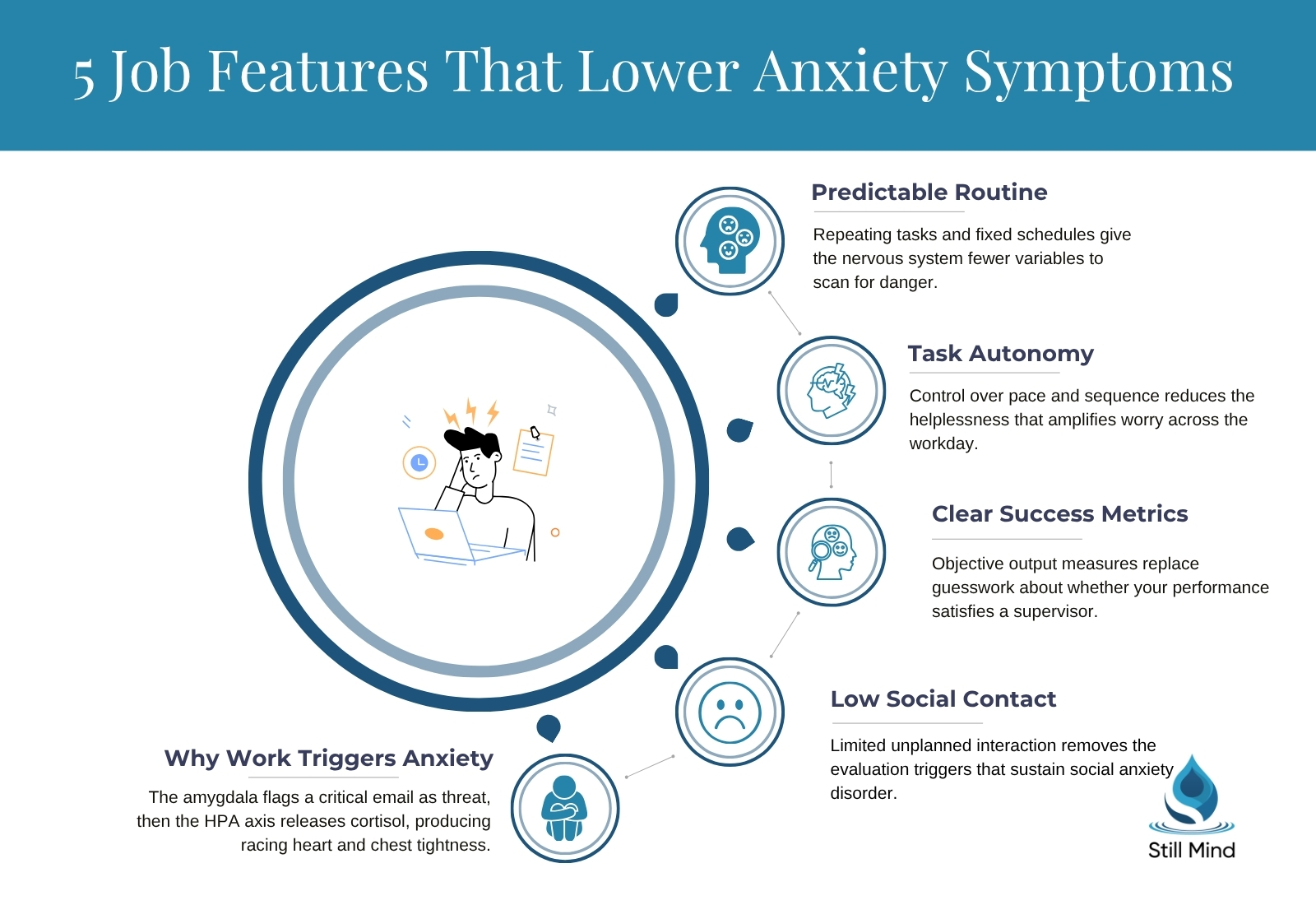
Specific workplace features lower anxiety symptoms because each one strips out the unpredictability that keeps the body’s alarm system switched on.
- Predictable routine: Repeating tasks and fixed schedules give the nervous system fewer variables to scan for danger.
- Task autonomy: Control over pace and sequence reduces the helplessness that amplifies worry.
- Low forced social contact: Limited unplanned interaction removes the evaluation triggers that sustain social anxiety.
- Sensory calm: Quiet, low traffic settings lower baseline physical arousal across an entire shift.
- Clear success metrics: Objective output measures replace guesswork about whether your performance satisfies a supervisor.
- Flexible communication channels: Written channels let you compose a response instead of reacting live under observation.
Job Features That Raise Anxiety Symptoms
Certain job features reliably intensify anxiety symptoms by combining unpredictability with public exposure.
- Shifting daily priorities: Constantly reordered tasks keep the threat system engaged for the full workday.
- Public performance demands: Presenting, pitching, or selling in front of an audience activates fear of negative evaluation directly.
- High conflict contact: Complaint facing roles deliver repeated confrontation with no recovery window between encounters.
- Continuous surveillance: Monitored keystrokes and call scoring raise self focused attention, which strengthens symptoms rather than performance.
- Deadline pressure without authority: Responsibility without decision making power intensifies worry and physical tension.
- Rotating night shifts: Disrupted sleep lowers next day emotional regulation capacity, which raises reactivity to ordinary workplace friction.
Why Work Triggers Anxiety Symptoms
Work triggers anxiety symptoms through four pathways: brain based threat processing, inherited vulnerability, early environment, and co-occurring conditions.
How the Brain Reacts to Workplace Threat
Workplace stress recruits the same brain circuits that respond to physical danger.
- Amygdala activation: The amygdala flags a critical email or an unscheduled meeting as threat, then triggers the physical alarm response within seconds.
- Weakened prefrontal control: Sustained stress suppresses prefrontal cortex regulation, which lowers your capacity to reason yourself out of a spiral.
- HPA axis output: The hypothalamic pituitary adrenal axis releases cortisol, producing the racing heart, tight stomach, and clenched jaw that workers describe as dread.
- Norepinephrine surge: The locus coeruleus floods the brain with norepinephrine, generating restlessness, hypervigilance, and the sense of being permanently on edge.
- Sleep loss feedback: Short sleep depletes next day regulation capacity, and that deficit shows up as emotional dysregulation during routine work conflict.
Genetic and Family History Factors
Inherited vulnerability sets the baseline sensitivity your job then interacts with.
- Heritable risk: Hettema and colleagues reported in the American Journal of Psychiatry that genetic factors account for roughly 30% of generalized anxiety disorder risk.
- Family patterns: A parent with an anxiety disorder raises a child’s risk through inherited temperament and through modeled avoidance of feared situations.
- Behavioral inhibition: A cautious, slow to warm temperament in childhood predicts later social anxiety disorder in adolescence and adulthood.
Childhood and Environmental Roots
Early environment calibrates how strongly your body reads ordinary workplace demands as danger.
- Adverse childhood experiences: Adverse childhood experiences elevate lifetime anxiety risk by keeping the stress response permanently calibrated for threat.
- Invalidating environments: Caregivers who dismiss distress teach children to conceal symptoms, and that training produces masking at work decades later.
- Attachment disruption: Early instability drives adult reassurance seeking, which turns every supervisor interaction into a verdict on your worth.
- Post-event processing: Clark and Wells identified this replay habit in social anxiety, where a person reviews one meeting for hours afterward and converts a neutral exchange into evidence of failure.
Co-occurring Conditions That Intensify Work Anxiety
Co-occurring conditions raise workplace anxiety through specific mechanisms rather than by coincidence.
- Major depressive disorder: Depression drains the energy that facing feared tasks requires, so avoidance grows and anxiety strengthens. The overlap often presents as high functioning depression in employees who still hit deadlines.
- Attention deficit hyperactivity disorder: Executive function gaps produce genuinely missed deadlines, which manufacture realistic performance fear on top of existing worry.
- Avoidant personality disorder: Pervasive feelings of inadequacy extend avoidance past specific situations into nearly every workplace relationship.
- Alcohol use disorder: Drinking to quiet anticipatory anxiety produces rebound anxiety the next morning, which deepens the cycle through the self medication pathway.
12 Low-Stress Jobs for People With Anxiety
These twelve occupations suit workers with anxiety disorders because each one limits unplanned social demand, supplies routine, or permits physical movement.
Comparison of Anxiety Friendly Occupations
This comparison maps each occupation to the job feature that lowers anxiety symptom load and to its typical entry requirement.
| Occupation | Feature that lowers symptom load | Typical entry requirement | Social contact level |
|---|---|---|---|
| Data entry clerk | Repetitive, solitary task flow | High school diploma | Very low |
| Bookkeeping clerk | Objective, verifiable output | High school diploma plus training | Low |
| Medical coder | Rule based decisions, remote capable | Postsecondary certificate | Very low |
| Medical transcriptionist | Independent, written only work | Postsecondary certificate | Very low |
| Library technician | Quiet setting, predictable routine | Certificate or associate degree | Low |
| Archivist | Deep focus, minimal interruption | Master’s degree | Low |
| Laboratory technician | Structured protocols, clear standards | Associate degree | Low |
| Warehouse stocker | Physical movement, defined targets | High school diploma | Low |
| Groundskeeper | Outdoor setting, solo assignments | No formal credential required | Very low |
| Landscaper | Physical output, visible completion | No formal credential required | Low |
| Veterinary assistant | Animal contact instead of client contact | High school diploma plus training | Moderate |
| Technical writer | Written communication, remote capable | Bachelor’s degree | Low |
- Wage verification: Current median pay and projected growth for every occupation above appear in the Bureau of Labor Statistics Occupational Outlook Handbook, which updates annually.
Jobs With Minimal Social Contact
These roles suit social anxiety disorder because they replace live interaction with independent, written work.
- Data entry clerk: The work runs on a queue rather than a conversation, so no interaction arrives unannounced.
- Bookkeeping clerk: Numbers either reconcile or they do not, which removes the ambiguity that fuels performance worry.
- Medical coder: Coding rules supply an external standard, and most employers permit fully remote schedules.
- Medical transcriptionist: Audio files replace meetings, letting you control pace and pause whenever arousal climbs.
Jobs With Predictable, Structured Routines
These roles suit generalized anxiety disorder because structure removes the open ended decisions that trigger rumination.
- Library technician: Cataloguing and shelving follow fixed systems inside a deliberately quiet environment.
- Archivist: Long uninterrupted focus blocks reward careful attention rather than fast verbal response.
- Laboratory technician: Written protocols define each step, which converts judgment calls into checklists.
- Warehouse stocker: Physical targets give clear proof of completion at the end of every shift.
Outdoor and Animal Focused Jobs
Outdoor and animal focused roles reduce anxiety symptoms by pairing movement with low interpersonal demand.
- Groundskeeper: Solo outdoor assignments lower baseline arousal while daylight exposure supports sleep regulation.
- Landscaper: Physical exertion burns off the muscle tension that cortisol produces during the workday.
- Veterinary assistant: Animal contact supplies connection without the evaluation that human interaction carries.
Remote Roles That Suit Social Anxiety
Remote roles remove commuting and public exposure, which are the two triggers most likely to end employment early.
- Technical writer: Written deliverables let you demonstrate competence without speaking in front of a group.
- Graphic designer: Portfolio based hiring rewards finished output rather than interview performance.
- Remote work caution: Isolation reinforces avoidance over time, and workers who already fight imposter syndrome often interpret silence from managers as disapproval.
How Long Work Anxiety Takes to Improve
Work related anxiety improves on a measurable schedule once treatment begins, with the first clear gains arriving between weeks four and six.
Weeks 1 to 2 of Treatment
The opening two weeks establish measurement and skills rather than symptom relief.
- Baseline scoring: Clinicians record a GAD-7 score and a functional impairment score to track change objectively.
- Early medication effects: SSRIs frequently produce jitteriness and disrupted sleep during this window before any anxiolytic benefit appears.
- Skill acquisition: Paced breathing and cognitive restructuring lower symptom intensity during specific work episodes.
Weeks 4 to 6 of Treatment
Weeks four through six deliver the first reliable drop in daily anxiety for most people.
- Medication onset: Sertraline, escitalopram, and fluoxetine typically reach meaningful anxiolytic effect across this range.
- Exposure progress: Graded exposure moves you from writing a difficult email to speaking in a small meeting.
- Score movement: A GAD-7 drop of five points or more signals clinically meaningful improvement.
Weeks 12 to 16 of Cognitive Behavioral Therapy
A standard cognitive behavioral therapy course for anxiety disorders runs twelve to sixteen sessions.
- Safety behavior removal: Dropping scripts, over preparation, and constant reassurance seeking retrains the brain’s threat prediction.
- Durability: Skills practiced across this span keep working after sessions end, which medication alone does not accomplish.
- Workplace testing: Real meetings and real phone calls become the exposure material rather than rehearsals.
Months 6 to 12 After a Job Change
Job changes deliver fast relief that fades unless the underlying avoidance receives treatment.
- Initial improvement: Removing a specific trigger lowers symptoms within the first month in a calmer role.
- Symptom return: Untreated anxiety commonly reattaches to new triggers within six to twelve months at the new job.
- Combined approach: Pairing a better job fit with active treatment prevents that reattachment.
When Workplace Anxiety Becomes a Clinical Concern
Workplace anxiety crosses into clinical territory once symptoms persist outside work hours and degrade your health, relationships, or job performance.
Common Signs of Work Related Anxiety
Common signs appear daily and stay tied to specific work demands.
- Anticipatory dread: Sunday evening tension and Monday morning nausea arrive before any work event occurs.
- Avoidance behaviors: You delay phone calls, skip optional meetings, and rewrite short emails repeatedly.
- Physical symptoms: Tension headaches, muscle tightness, stomach upset, and shallow breathing cluster around the workday.
- Concentration loss: Worry consumes working memory, which produces the brain fog employees mistake for burnout alone.
- Sleep disruption: Racing thoughts delay sleep onset or wake you in the early morning hours.
Severe Symptoms That Require Prompt Evaluation
Severe symptoms indicate that the disorder has outgrown self management and needs clinical care.
- Panic attacks at work: Chest pain, racing heart, and a sense of losing control demand medical evaluation to rule out cardiac causes.
- Inability to enter the building: Avoidance that blocks attendance signals significant functional impairment.
- Substance use to cope: Drinking or sedative use before shifts marks a rapidly escalating risk pattern.
- Thoughts of self harm: Any thought of suicide requires immediate professional help, and the 988 Suicide and Crisis Lifeline operates continuously.
Long-Term Consequences of Untreated Work Anxiety
Untreated work anxiety compounds into measurable career and health costs.
- Presenteeism: You attend work while functioning far below capacity, which quietly costs more output than absence does.
- Career narrowing: Repeated avoidance of promotions and public roles shrinks your options over years.
- Occupational burnout: Chronic arousal without recovery produces exhaustion and cynicism, and untreated anxiety accelerates the slide into burnout.
- Physical health decline: Sustained cortisol elevation raises cardiovascular and metabolic risk over time.
Scales Clinicians Use to Measure Work Impairment
Clinicians quantify anxiety and its effect on work using validated rating scales rather than impressions.
- Generalized Anxiety Disorder 7-item scale (GAD-7): This seven question screen scores worry severity from 0 to 21, and a score of 10 or higher indicates clinically significant anxiety.
- Work and Social Adjustment Scale (WSAS): This five item measure rates how much a condition impairs work, home management, social activity, and relationships.
- Sheehan Disability Scale (SDS): This tool scores functional impairment separately across work, social life, and family life.
- Liebowitz Social Anxiety Scale (LSAS): This clinician rated scale measures fear and avoidance across 24 social and performance situations, including workplace scenarios.
Social Anxiety Disorder vs Introversion vs Avoidant Personality Disorder
Social anxiety disorder, introversion, and avoidant personality disorder produce similar workplace avoidance for entirely different reasons.
How Social Anxiety Disorder Differs From Introversion
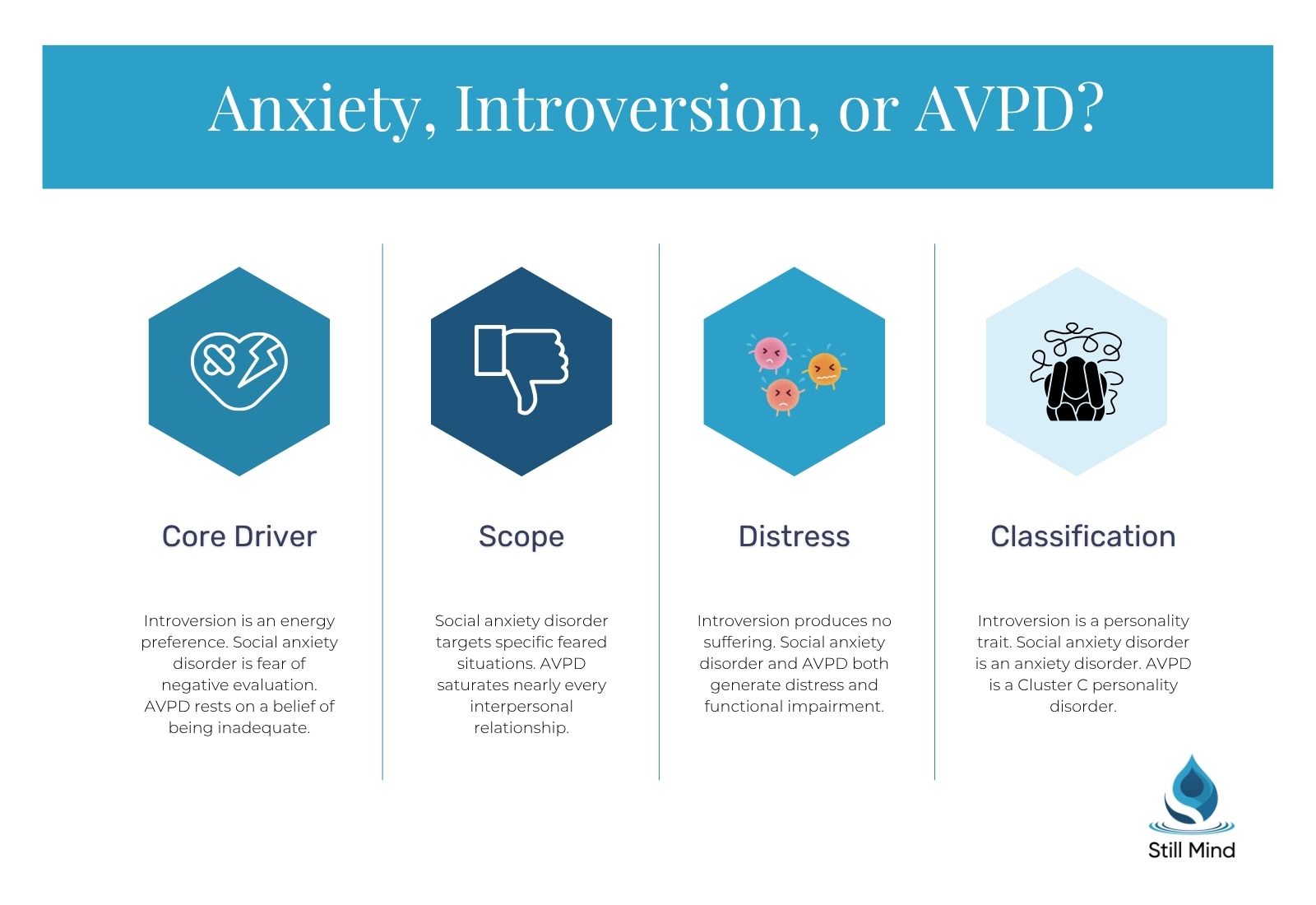
Introversion describes a preference, while social anxiety disorder describes a fear that causes distress and impairment.
- Motivation differs: Introverts choose solitude to restore energy, while people with social anxiety disorder avoid contact to escape judgment.
- Distress differs: Introversion produces no suffering, while social anxiety disorder generates dread before and shame afterward.
- Treatment need differs: Introversion requires no treatment, though introverts do develop separate conditions such as depression in introverts that warrant care.
How Social Anxiety Disorder Differs From Avoidant Personality Disorder
Avoidant personality disorder extends avoidance across nearly all relationships, while social anxiety disorder attaches to specific situations.
- Scope differs: Social anxiety disorder targets performance and evaluation settings, while avoidant personality disorder saturates every interpersonal domain.
- Self concept differs: Avoidant personality disorder rests on a stable belief of being inferior, while social anxiety disorder centers on situational fear of exposure.
- Onset differs: Personality disorder patterns stabilize by early adulthood and persist, while social anxiety symptoms fluctuate with circumstance.
Side by Side Comparison
This comparison separates the three presentations across the criteria clinicians actually use.
| Criterion | Introversion | Social anxiety disorder | Avoidant personality disorder |
|---|---|---|---|
| Core driver | Energy preference | Fear of negative evaluation | Belief of being inadequate |
| Scope | Situational choice | Specific feared situations | Nearly all relationships |
| Distress present | No | Yes | Yes |
| Classification | Personality trait | Anxiety disorder | Cluster C personality disorder |
| Workplace effect | Prefers solo work | Avoids meetings and calls | Avoids roles requiring any closeness |
| Treatment need | None | Therapy, often medication | Longer term therapy |
Workplace Rights for Employees With Anxiety Disorders
Federal law treats a qualifying anxiety disorder as a disability, which entitles you to reasonable accommodation from your employer.
When an Anxiety Disorder Qualifies as a Disability
An anxiety disorder qualifies when it substantially limits a major life activity such as concentrating, sleeping, or interacting with others.
- Legal standard: The Americans with Disabilities Act, broadened by the 2008 amendments, sets a deliberately generous threshold for qualifying conditions.
- Documentation scope: The Equal Employment Opportunity Commission states you may describe your condition generally without disclosing every clinical detail.
- Employer limits: Employers must accommodate unless the change imposes undue hardship on business operations.
Accommodations Employers Commonly Approve
Most anxiety accommodations cost nothing and change how work happens rather than what work happens.
- Schedule adjustments: Predictable start times and flexible breaks prevent arousal from accumulating unchecked.
- Written instructions: Task lists in writing remove the memory burden that worry creates.
- Workspace changes: A quieter location or noise reducing equipment lowers sensory load.
- Meeting modifications: Advance agendas and written contribution options replace unprepared public speaking.
- Telework days: Partial remote schedules preserve attendance during symptom flares.
How the Interactive Process Works
The interactive process is the required conversation between you and your employer about which accommodation actually works.
- Start in writing: A dated written request creates a record and formally triggers the employer’s obligation.
- Name the barrier: Describe the job function affected rather than listing symptoms, because employers respond to functional problems.
- Supply documentation: A treating clinician confirms the condition and recommends specific adjustments.
- Expect negotiation: Employers may propose an alternative that achieves the same result, which the law permits.
Treatment for Anxiety Disorders That Affect Work
Anxiety disorders respond to a four tier treatment sequence that begins with therapy and medication and escalates only when first line care falls short.
First-Line Therapies
First line psychotherapy targets the avoidance and thinking patterns that sustain workplace anxiety.
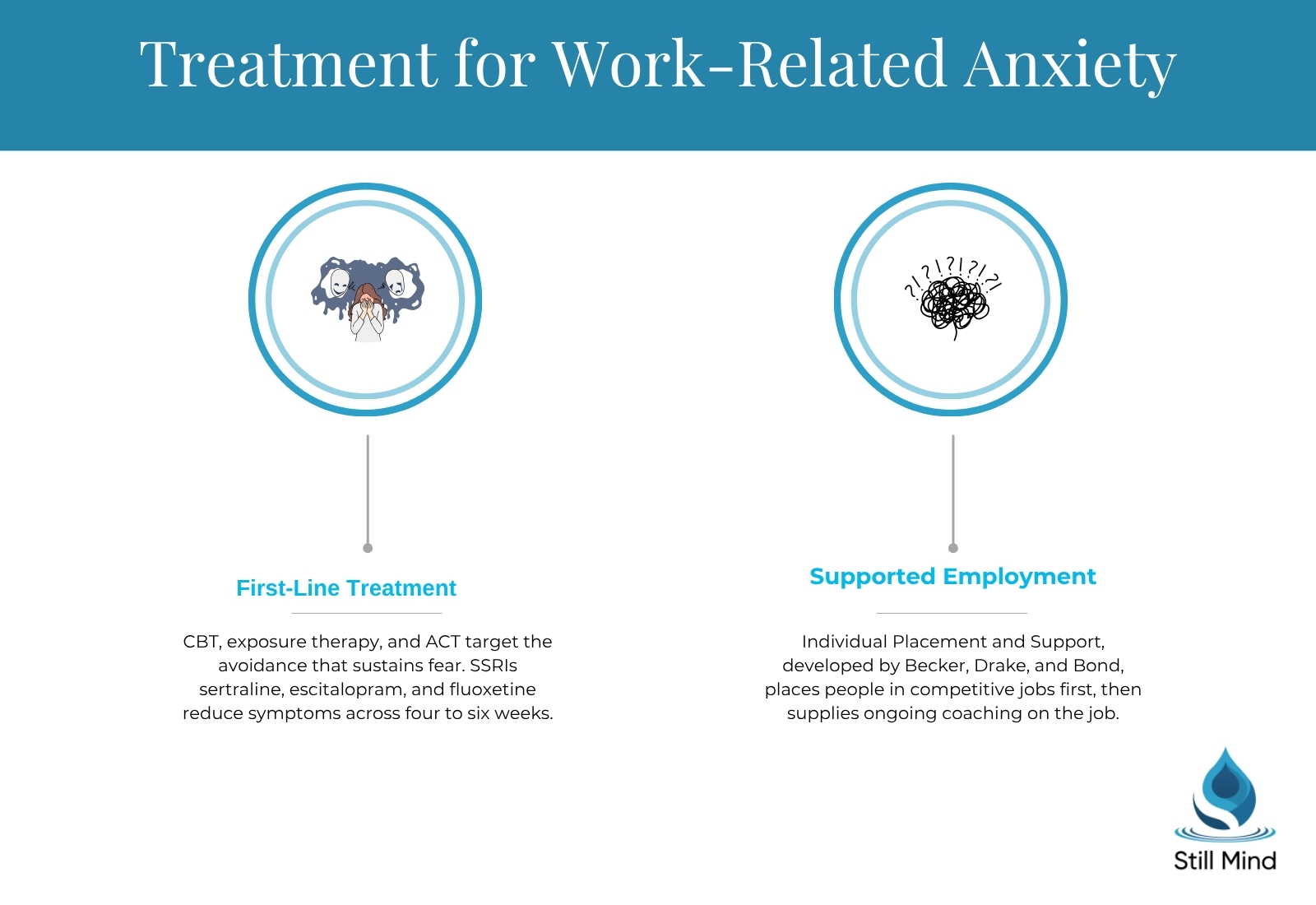
- Cognitive behavioral therapy: CBT restructures catastrophic predictions about performance and dismantles the safety behaviors that maintain fear. Structured behavioral therapy techniques convert those insights into daily workplace practice.
- Exposure therapy: Graded exposure moves through a hierarchy of feared work situations until the alarm response extinguishes.
- Acceptance and commitment therapy: Acceptance and commitment therapy builds willingness to act on career values while anxiety is still present.
- Social skills training: Structured rehearsal of meetings and phone calls raises competence, which lowers realistic performance fear in social anxiety disorder.
First-Line Medications
First line medication for anxiety disorders comes from two antidepressant classes rather than sedatives.
- Selective serotonin reuptake inhibitors: Sertraline, escitalopram, fluoxetine, and paroxetine block serotonin reuptake and reduce anxiety symptoms across four to six weeks.
- Serotonin norepinephrine reuptake inhibitors: Venlafaxine and duloxetine carry approvals across several anxiety diagnoses and suit patients who do not respond to an SSRI.
- Early activation: Both classes commonly increase jitteriness during the first two weeks, which prescribers manage by starting low rather than stopping.
Second-Line and Adjunct Options
Second line and adjunct options address residual symptoms and the employment problems anxiety already created.
- Buspirone: This non sedating anxiolytic augments an SSRI when generalized worry persists.
- Hydroxyzine: This antihistamine relieves acute anxiety without dependence risk.
- Propranolol: This beta blocker blunts tremor and racing heart before a presentation or interview.
- Individual Placement and Support: Becker, Drake, and Bond developed this supported employment model, which places people in competitive jobs first and supplies ongoing coaching rather than lengthy prevocational training.
- Vocational rehabilitation: State programs fund assessment, training, and job placement for workers whose anxiety disorder limits employment.
Emerging and Investigational Treatments
Several newer treatments target anxiety disorders, though each carries a different regulatory status.
- Virtual reality exposure therapy: Simulated meetings and presentations deliver repeatable exposure, with growing evidence in social anxiety disorder and specific phobia.
- Transcranial magnetic stimulation: TMS holds FDA clearance for depression and obsessive compulsive disorder and remains off label for anxiety disorders.
- Prescription digital therapeutics: FDA cleared app based programs deliver CBT protocols between sessions and function as adjuncts rather than replacements.
- Esketamine: This agent holds approval for treatment resistant depression and stays investigational for primary anxiety disorders.
Anxiety Treatment at Still Mind Florida
Still Mind Florida treats generalized anxiety disorder, social anxiety disorder, panic disorder, and specific phobias at its Fort Lauderdale facility using therapy and psychiatric care together.
Residential Mental Health Treatment
Residential care suits workers whose anxiety symptoms already interrupted attendance or daily functioning.
- Structured daily schedule: A fixed therapeutic routine removes the unpredictability that sustains symptoms during early recovery.
- Continuous clinical contact: On site staffing supports patients through exposure work that outpatient schedules cannot accommodate.
- Level of care matching: Clinicians assess symptom severity and functional impairment to determine whether residential treatment fits better than outpatient care.
Medication Management and Psychiatric Care
Psychiatric providers at Still Mind Florida evaluate, prescribe, and monitor medication for anxiety disorders.
- Diagnostic evaluation: A psychiatric assessment separates generalized anxiety disorder from panic disorder, social anxiety disorder, and depression before any prescription begins.
- Ongoing monitoring: Scheduled follow up tracks response and side effects across the four to six week onset window.
- Coordinated care: Combining prescribing with therapy produces better outcomes than either alone, and the distinction between psychiatry and counseling determines which provider handles which part of your care.
Evidence-Based Therapy for Anxiety Disorders
The clinical program applies cognitive behavioral therapy, dialectical behavior therapy, exposure and response prevention, and EMDR to anxiety presentations.
- Cognitive behavioral therapy: Therapists target the performance predictions that drive workplace avoidance.
- Exposure and response prevention: This protocol interrupts the checking and reassurance rituals that maintain anxiety.
- Dialectical behavior therapy skills: Distress tolerance and emotion regulation modules give workers usable tools for high pressure days.
“Most people who reach us for anxiety have already tried to fix it by changing jobs. What holds is treating the avoidance underneath, so the next job does not quietly become the next trigger.” Dr. Gladys Martinez, Clinical Director, Still Mind Florida
Frequently Asked Questions
What jobs are best for someone with severe anxiety?
Severe anxiety responds best to roles with minimal social demand and full control over pace, such as data entry, medical coding, transcription, or groundskeeping. Start with part time or contract work to rebuild tolerance gradually. Severe symptoms also warrant concurrent treatment, because job selection alone rarely resolves impairment at that level.
What jobs should people with anxiety avoid?
Roles combining public performance, hostile contact, and unpredictable demands create the worst fit. Cold call sales, emergency dispatch, air traffic control, live broadcasting, and high volume complaint handling all sit in that category. Rotating night shift work also deserves caution, because sleep disruption lowers emotional regulation and raises next day reactivity.
Do low-stress jobs pay well?
Several do. Medical coding, bookkeeping, laboratory technology, archiving, and technical writing all pay above entry level wages while keeping social demand low. Credentialed and remote capable roles generally pay more than unskilled quiet roles, so a short certificate program often raises earnings faster than changing industries entirely.
Should I quit my job if I have panic attacks?
Quitting during a panic episode usually reinforces avoidance rather than resolving it. Request accommodations first, begin treatment, and evaluate the job after symptoms stabilize. Leave sooner when the workplace itself is unsafe or abusive. Panic disorder responds well to exposure based therapy, which works better while you remain employed.
Can I get a job with anxiety and no degree?
Yes. Data entry, warehouse stocking, groundskeeping, landscaping, and veterinary assisting all hire without a degree. Short certificate programs in medical coding or transcription take months rather than years and open remote work. Employers cannot legally ask about a diagnosis during hiring, so disclosure remains your choice.
Are remote jobs better for anxiety?
Remote work removes commuting, office noise, and constant observation, which reduces symptoms for many people with social anxiety disorder. The tradeoff is isolation, which strengthens avoidance over months. Hybrid schedules preserve the benefits while keeping enough exposure to prevent your comfort zone from shrinking further.
Do I have to tell my employer about my anxiety disorder?
No. Disclosure is voluntary, and no law requires you to name a diagnosis. You must disclose only enough to request an accommodation, and the Equal Employment Opportunity Commission permits general description rather than clinical detail. Medical information you provide stays confidential and separate from your personnel file.
Can changing jobs cure an anxiety disorder?
No. A better job lowers your daily trigger load, which reduces symptoms quickly, but untreated anxiety commonly reattaches to new triggers within six to twelve months. Lasting change requires treating the avoidance pattern itself. Combining a better job fit with therapy produces durable improvement in both symptoms and work functioning.
References
- American Psychiatric Association. (2022). Diagnostic and statistical manual of mental disorders (5th ed., text rev.). American Psychiatric Association Publishing.
- Hettema, J. M., Neale, M. C., & Kendler, K. S. (2001). A review and meta-analysis of the genetic epidemiology of anxiety disorders. American Journal of Psychiatry, 158(10), 1568–1578.
- Clark, D. M., & Wells, A. (1995). A cognitive model of social phobia. In R. G. Heimberg, M. R. Liebowitz, D. A. Hope, & F. R. Schneier (Eds.), Social phobia: Diagnosis, assessment, and treatment. Guilford Press.
- Spitzer, R. L., Kroenke, K., Williams, J. B. W., & Löwe, B. (2006). A brief measure for assessing generalized anxiety disorder: The GAD-7. Archives of Internal Medicine, 166(10), 1092–1097.
- Bond, G. R., Drake, R. E., & Pogue, J. A. (2019). Expanding Individual Placement and Support to populations with conditions and disorders other than serious mental illness. Psychiatric Services, 70(6).
- Substance Abuse and Mental Health Services Administration. (2025). Individual Placement and Support (IPS) supported employment model (Publication No. PEP25-01-002). U.S. Department of Health and Human Services.
- National Institute of Mental Health. (2024). Any anxiety disorder. U.S. Department of Health and Human Services, National Institutes of Health.
- U.S. Equal Employment Opportunity Commission. (n.d.). Depression, PTSD, and other mental health conditions in the workplace: Your legal rights.
- KFF. (2023). Mental health and substance use state fact sheets: Florida.
- Florida Department of Health. (2022). Behavioral Risk Factor Surveillance System: Adults who have ever been told they had a depressive disorder. FLHealthCHARTS.
- U.S. Bureau of Labor Statistics. (2025). Occupational Outlook Handbook. U.S. Department of Labor.