



AVPD stands for avoidant personality disorder, a Cluster C personality disorder defined in the DSM-5-TR by a pervasive pattern of social inhibition, profound feelings of inadequacy, and hypersensitivity to negative evaluation that impairs functioning across multiple areas of daily life.
AVPD differs from shyness or social anxiety in one critical way: it does not improve with familiarity or positive experiences alone. The avoidance is driven by a deeply held core belief of fundamental inadequacy, not by situational nervousness.
Without treatment, avoidant personality disorder tends to worsen over time rather than resolve.
Key Takeaways
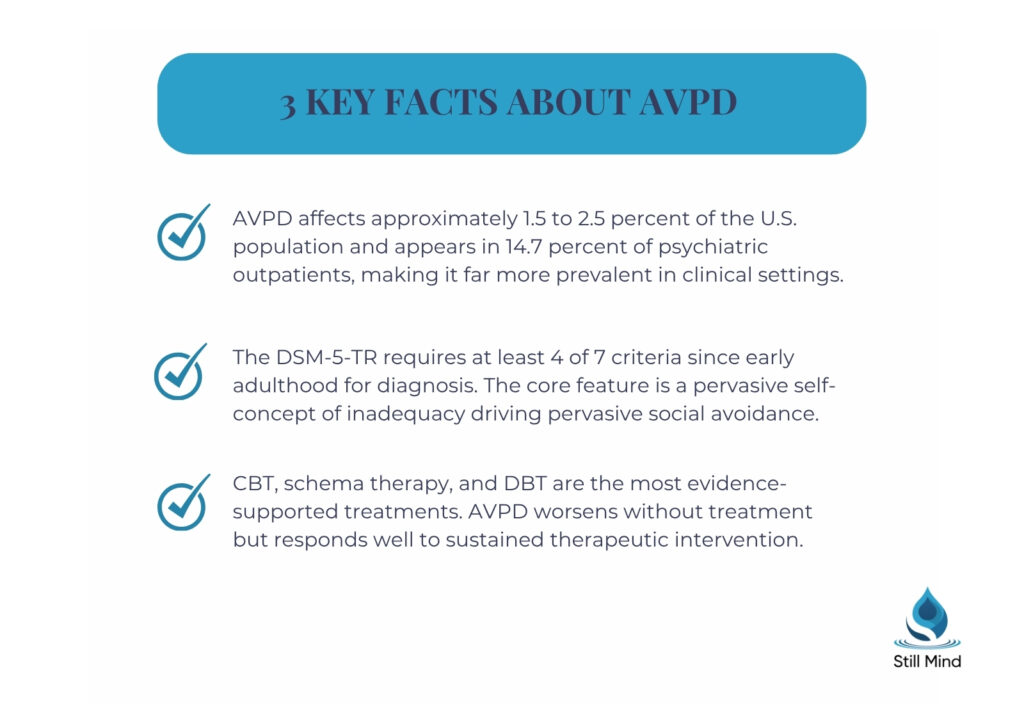
- According to Cleveland Clinic, researchers estimate that approximately 1.5 to 2.5 percent of the U.S. population has avoidant personality disorder, with equal prevalence in men and women.
- The DSM-5-TR requires at least four of seven specific criteria to be present since early adulthood before an AVPD diagnosis can be made, distinguishing it from social anxiety disorder, which does not require the same pervasive self-concept of inadequacy.
- Research published in PMC indicates that AVPD appears in 14.7 percent of psychiatric outpatients, making it significantly more prevalent in clinical settings than in the general population.
- AVPD is classified as a Cluster C personality disorder alongside dependent personality disorder and obsessive-compulsive personality disorder, the cluster characterized by anxious and fearful behavioral patterns.
What Is AVPD (Avoidant Personality Disorder)?
Avoidant personality disorder is a chronic, pervasive mental health condition classified under Cluster C personality disorders in the DSM-5-TR, characterized by relentless social inhibition rooted in a core self-concept of inferiority and an overwhelming fear of rejection.
How AVPD Differs from Shyness
AVPD extends far beyond ordinary introversion or social discomfort, producing functional impairment across occupational, romantic, and social domains that shyness alone does not.
Key distinctions between AVPD and shyness:
- Shyness improves with exposure: Shyness typically diminishes as individuals gain familiarity and positive social experiences, while AVPD persists and worsens without clinical intervention regardless of objectively positive social outcomes.
- Core self-concept: A person with shyness may feel nervous in social situations while still believing themselves fundamentally likeable. A person with AVPD holds an entrenched belief of personal unattractiveness, inferiority, and social ineptitude that no amount of positive feedback consistently overrides.
- Functional impairment: AVPD produces measurable impairment in occupational functioning, with affected individuals declining career advancement opportunities, avoiding job interviews, and refusing promotions specifically to avoid interpersonal contact.
AVPD vs. Social Anxiety Disorder
AVPD and social anxiety disorder share significant symptom overlap, and both can co-occur in the same individual, but their core pathology, scope, and severity differ in clinically meaningful ways.
Clinical distinctions:
- Generalization of avoidance: Social anxiety disorder typically involves anxiety restricted to identifiable social performance situations, while AVPD produces avoidance across virtually all social contexts regardless of the specific demand.
- Self-concept pathology: Social anxiety disorder primarily involves situation-specific fear of humiliation. AVPD involves a pervasive, global belief of fundamental personal inadequacy that drives avoidance beyond any specific situational trigger.
- Diagnostic overlap: According to DSM-5-TR, AVPD and social anxiety disorder are considered so closely related that they may represent different conceptualizations of the same underlying condition, though approximately two-thirds of people with AVPD do not meet the full criteria for social anxiety disorder.
What Causes Avoidant Personality Disorder?
AVPD develops through the interaction of genetic predisposition, early attachment disruption, childhood adversity, and temperamental traits that shape the individual’s core self-concept and behavioral patterns before early adulthood.
Genetic and Temperamental Factors
Biological contributors to AVPD:
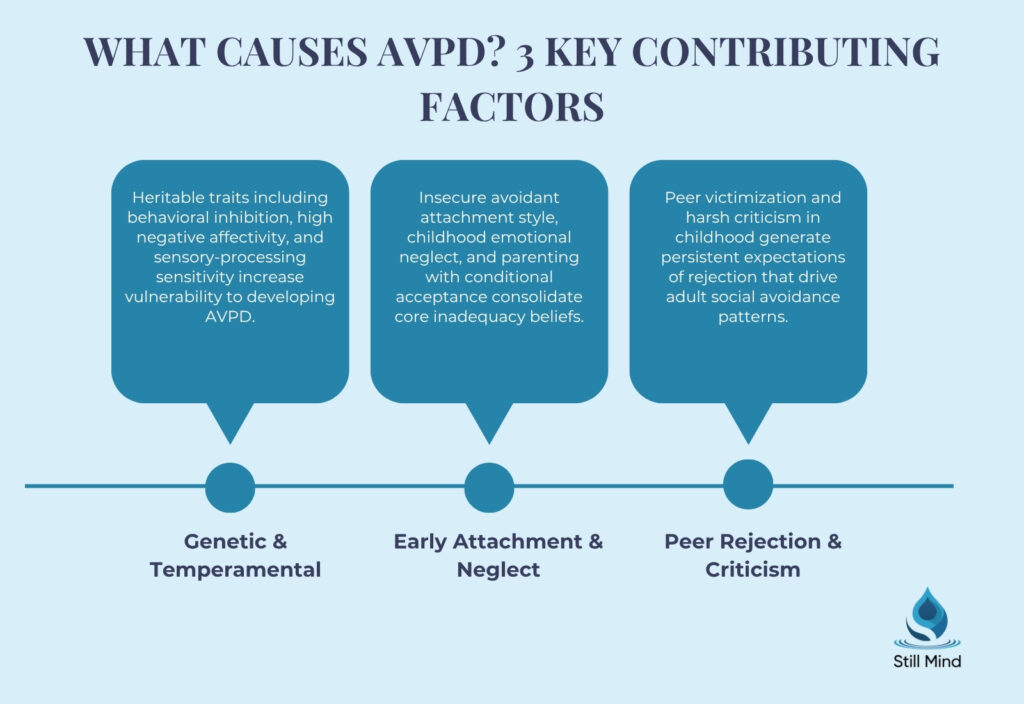
- Heritable temperament: A 2012 Norwegian twin study demonstrated that AVPD has a measurable genetic component, with heritable traits including high behavioral inhibition, negative affectivity, and low extraversion each contributing independently to the risk of developing the disorder.
- High sensory-processing sensitivity: Individuals with elevated baseline sensory sensitivity show heightened physiological reactivity to social rejection cues, increasing the likelihood that early adverse interpersonal experiences will consolidate into the chronic avoidance patterns that define AVPD.
Early Attachment and Childhood Experiences
Environmental contributors to AVPD:
- Childhood emotional neglect: Emotional neglect and peer group rejection in childhood are both independently associated with elevated AVPD risk, with peer victimization experiences generating the chronic expectation of rejection that drives adult social avoidance.
- Insecure avoidant attachment style: An avoidant attachment style, characterized by negative self-concept and fear of emotional intimacy developed in response to emotionally unavailable caregiving, is among the most consistently identified developmental risk factors for AVPD across the research literature.
- Parental criticism and conditional acceptance: Parenting environments characterized by harsh criticism, inconsistent approval, or conditional acceptance teach the developing child that their worth depends on performance and that expressing needs exposes them to rejection, directly consolidating the core inadequacy beliefs central to AVPD.
The 7 Signs of AVPD (DSM-5-TR Criteria)
The DSM-5-TR specifies seven diagnostic criteria for avoidant personality disorder, requiring at least four to be present since early adulthood to meet the threshold for diagnosis.
1- Avoidance of Occupational Activities Involving Interpersonal Contact
Individuals with AVPD systematically decline jobs, promotions, leadership roles, and professional opportunities that require regular interaction with colleagues, supervisors, or clients, citing the anticipated fear of criticism or disapproval as the primary barrier.
What this looks like in practice:
- Refusing promotions despite strong performance reviews because the new role involves managing others.
- Declining to present in meetings, join group projects, or participate in team-based work environments.
2- Unwillingness to Engage with Others Without Certainty of Being Liked
People with AVPD require near-certain assurance of acceptance before initiating or deepening any social or professional relationship, a threshold that effectively prevents most new connections from forming.
What this looks like in practice:
- Waiting for repeated, unambiguous signals of acceptance before agreeing to social invitations or romantic pursuit.
- Interpreting neutral social responses as evidence of rejection and withdrawing preemptively.
3- Restraint in Intimate Relationships Due to Fear of Shame or Ridicule
Even in established relationships, individuals with AVPD withhold vulnerability, personal disclosure, and emotional intimacy because they anticipate that revealing their authentic self will result in rejection, mockery, or abandonment.
4- Preoccupation with Being Criticized or Rejected in Social Situations
Avoidant personality disorder generates persistent, intrusive anticipatory anxiety about evaluation in social settings, consuming significant cognitive resources before, during, and after social interactions.
5- Inhibition in New Interpersonal Situations Due to Feelings of Inadequacy
New social environments activate acute feelings of inferiority and social ineptitude in individuals with AVPD, producing visible social inhibition, limited verbal output, and rapid disengagement that others frequently misinterpret as aloofness or disinterest.
6- Self-Perception as Socially Inept, Personally Unappealing, or Inferior
The core cognitive distortion of AVPD is a stable, deeply held belief that one is fundamentally less capable, attractive, and worthy of connection than others, a self-concept that resists correction even in the presence of objective evidence to the contrary.
Co-occurring features:
- Hypervigilance to micro-expressions, tone of voice, and brief pauses in conversation interpreted as evidence of disapproval or rejection.
- Fantasizing about idealized close relationships while simultaneously believing oneself unworthy of them.
7- Unusual Reluctance to Take Personal Risks or Try New Activities
Individuals with AVPD avoid new activities, hobbies, and experiences they associate with potential embarrassment or failure, resulting in an increasingly restricted lifestyle that reinforces social isolation and limits opportunity for disconfirming experiences.
How AVPD Affects Daily Life
Avoidant personality disorder produces functional impairment across occupational, relational, and psychological domains that compounds progressively without clinical intervention.
Occupational and Financial Impact
AVPD systematically suppresses career advancement by generating avoidance of job interviews, professional networking, workplace collaboration, and leadership responsibilities, producing income and career trajectory outcomes significantly below the individual’s actual capability.
Functional consequences:
- Underemployment in roles beneath educational or skill level to avoid interpersonal demands.
- Avoidance of performance reviews, salary negotiations, and promotion discussions due to anticipated criticism.
- Occupational isolation that reduces access to professional mentorship, skill development, and advancement opportunities.
Relational and Social Impact
The avoidance patterns of AVPD produce profound social isolation despite the individual’s genuine desire for close, meaningful relationships, creating a chronic conflict between the longing for connection and the terror of exposure to rejection.
Relational consequences:
- Extreme difficulty initiating romantic relationships, maintaining friendships, or sustaining social networks despite actively wanting to.
- Pattern of preemptive withdrawal from relationships at the first perceived sign of criticism, which others experience as unpredictable rejection.
- Co-occurring anxiety disorder symptoms that intensify social avoidance and impair the ability to remain regulated during interpersonal interactions.
Co-Occurring Mental Health Conditions
Conditions commonly co-occurring with AVPD:
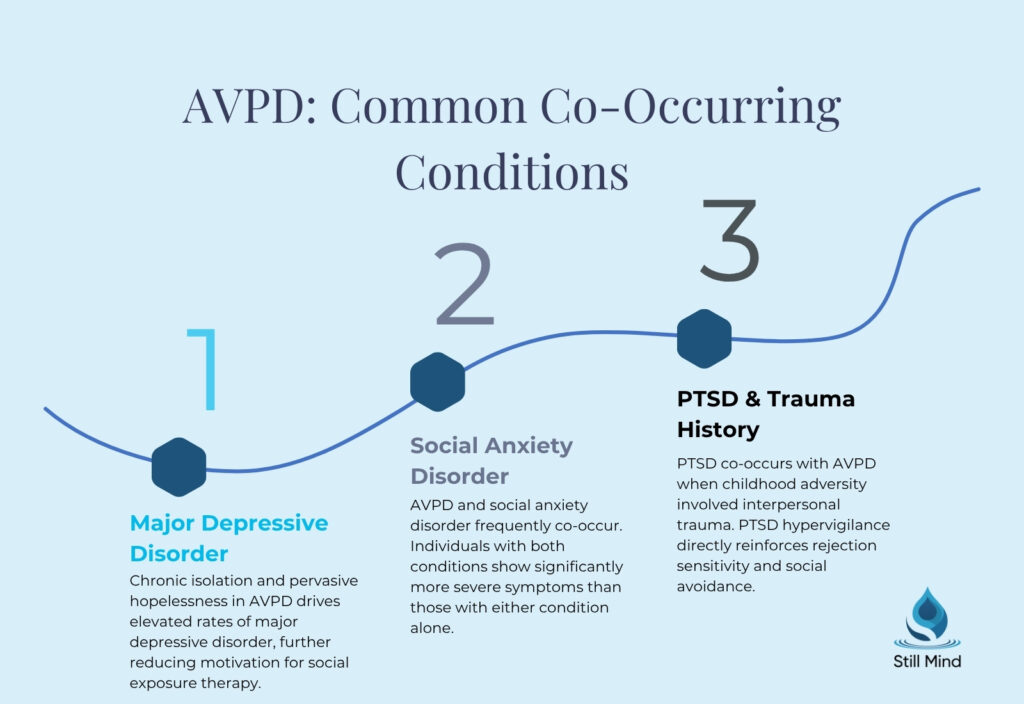
- Major depressive disorder: The chronic isolation and pervasive hopelessness of AVPD drives elevated rates of major depressive disorder, with the depression itself further reducing motivation to engage in social exposure exercises central to treatment.
- Borderline personality disorder overlap: Borderline personality disorder and AVPD both involve extreme sensitivity to rejection, though the emotional dysregulation, impulsivity, and unstable self-image of borderline personality disorder distinguish it from the consistent social inhibition of AVPD.
- PTSD: Post-traumatic stress disorder co-occurs with AVPD in individuals whose childhood adversity involved interpersonal trauma, with PTSD hypervigilance and avoidance symptoms reinforcing the social withdrawal and rejection sensitivity of the personality disorder.
Treatment for Avoidant Personality Disorder
Avoidant personality disorder is treatable, and individuals with AVPD are often strongly motivated for treatment because the condition produces significant subjective distress and a genuine desire for connection.
Psychotherapy Approaches
Psychotherapy is the first-line and most evidence-supported treatment for AVPD, with the therapeutic relationship itself serving as a corrective interpersonal experience that directly targets the core rejection-fear mechanism.
Evidence-based therapy for AVPD:
- Cognitive behavioral therapy: Cognitive behavioral therapy for AVPD targets the distorted core beliefs of inferiority and unlovability through cognitive restructuring, behavioral exposure to feared social situations, and social skills training that builds the specific competencies individuals with AVPD have avoided developing.
- Schema therapy: Schema therapy addresses the early maladaptive schemas of defectiveness and shame that form the deep structural foundation of AVPD, targeting the developmental origins of the disorder rather than only its current behavioral manifestations.
- Dialectical behavior therapy: Dialectical behavior therapy builds the distress tolerance, interpersonal effectiveness, and emotional regulation skills that allow individuals with AVPD to remain engaged in feared social situations long enough to obtain disconfirming evidence against their rejection-based predictions.
Social Skills and Graduated Exposure
Behavioral treatment components:
- Graduated exposure: Systematic, hierarchical exposure to progressively challenging social situations reduces anticipatory anxiety and builds the evidence base that the individual is capable of managing social interactions without catastrophic rejection.
- Social skills training groups: Group-based social skills training provides both direct competency building and a safe, monitored interpersonal environment in which individuals with AVPD can practice engagement with the immediate feedback of a supportive clinical setting.
Mental Health Treatment at Still Mind Florida
Still Mind Florida provides individualized outpatient care for adults navigating avoidant personality disorder, social anxiety, and co-occurring mood and trauma conditions.
CBT and Skills-Based Outpatient Programs
Outpatient therapy at Still Mind Florida:
- Evidence-based individual and group therapy aligned with DSM-5-TR diagnostic criteria for Cluster C personality disorders, building social engagement capacity through graduated exposure and cognitive restructuring targeted specifically at inadequacy-based core beliefs.
- Skills development groups that address the interpersonal effectiveness deficits central to AVPD, supporting clients in building real-world connection capacity alongside their individual therapy work.
Holistic and Integrated Mental Health Support
Additional clinical services:
- Holistic therapy approaches integrated with evidence-based care address the somatic anxiety, chronic stress activation, and emotional dysregulation that compound AVPD severity and reduce engagement with social exposure work.
- Clinical intake assessments for avoidant personality disorder and related Cluster C conditions are available, with individualized treatment planning developed from comprehensive DSM-5-TR evaluation.
Frequently Asked Questions
What are the 7 signs of avoidant personality disorder?
The DSM-5-TR lists seven criteria: avoiding occupational contact due to fear of criticism, unwillingness to engage without certainty of being liked, restraint in intimacy due to shame fears, preoccupation with rejection in social situations, inhibition in new situations due to inadequacy, viewing oneself as socially inept or inferior, and reluctance to take personal risks. Four or more must be present for diagnosis.
What is an example of avoidant personality disorder?
A person with AVPD might decline a promotion that would require managing a team, avoid initiating friendships despite genuinely wanting connection, withdraw from a promising relationship after one ambiguous text response, and limit social activities to a single safe relationship, all driven by the conviction that others will ultimately reject or ridicule them.
How does someone get AVPD?
AVPD develops through a combination of genetic predisposition toward behavioral inhibition and negative affectivity, early insecure or avoidant attachment patterns, childhood emotional neglect, and peer rejection experiences. These factors consolidate into a stable self-concept of inferiority and an entrenched expectation of rejection that persists without appropriate clinical treatment.
Is AVPD on the autism spectrum?
AVPD and autism spectrum disorder are distinct conditions with different etiologies, though they share surface-level features like social withdrawal and difficulty forming relationships. Autism involves social communication differences and sensory sensitivities rooted in neurodevelopmental differences. AVPD involves anxiety-driven avoidance rooted in rejection fear and learned inadequacy beliefs, not social communication impairment.
References
- American Psychiatric Association. (2022). Diagnostic and Statistical Manual of Mental Disorders, Fifth Edition, Text Revision (DSM-5-TR). American Psychiatric Publishing.
- National Institutes of Health, National Library of Medicine. (2024). Avoidant personality disorder. https://www.ncbi.nlm.nih.gov/books/NBK559325/
- National Institutes of Health. (2018). Avoidant personality disorder: Current insights. Journal of PMC. https://pmc.ncbi.nlm.nih.gov/articles/PMC5848673/
- Cleveland Clinic. (2024). Avoidant personality disorder. Cleveland Clinic Medical.
- Merck Manual Professional. (2026). Avoidant personality disorder. Merck Manual.
- Substance Abuse and Mental Health Services Administration. (2023). Key substance use and mental health indicators in the United States. https://www.samhsa.gov/data/report/2023-nsduh-annual-national-report
- American Psychiatric Association. (2022). DSM-5-TR. pp. 764-768.