



BPD in relationships shows up as intense closeness, a sharp fear of abandonment, and fast swings between idealizing and devaluing a partner, which are patterns the criteria for borderline personality disorder (BPD) name directly.
BPD symptoms improve with time, and a 16-year study of former psychiatric inpatients found lasting symptom remission in 78% to 99%, depending on how long remission had to last. Understanding the BPD push-pull cycle, and when that cycle turns unsafe, is the first step toward steadier relationships.
Key Takeaways
- Two of the nine diagnostic criteria for borderline personality disorder describe relationships directly: frantic efforts to avoid abandonment, and unstable relationships that swing between idealization and devaluation.
- In a study of 35 couples in which the woman had BPD, Bouchard and colleagues (2009) found that 68.7% went through frequent breakups and reconciliations, and nearly 30% separated within 18 months.
- A 16-year study of 290 former inpatients with BPD by Zanarini and colleagues (2012) found that 78% to 99% reached symptom remission and 40% to 60% reached full social and work recovery. Symptoms returned for 10% to 36% of those who remitted.
- Psychotherapy is the treatment of choice for BPD, and no medication has approval from the U.S. Food and Drug Administration (FDA) for BPD itself.
- Partners and family members benefit from their own support, and the Family Connections program reduced grief and burden for relatives of people with BPD.
How Does BPD Show Up in Relationships?
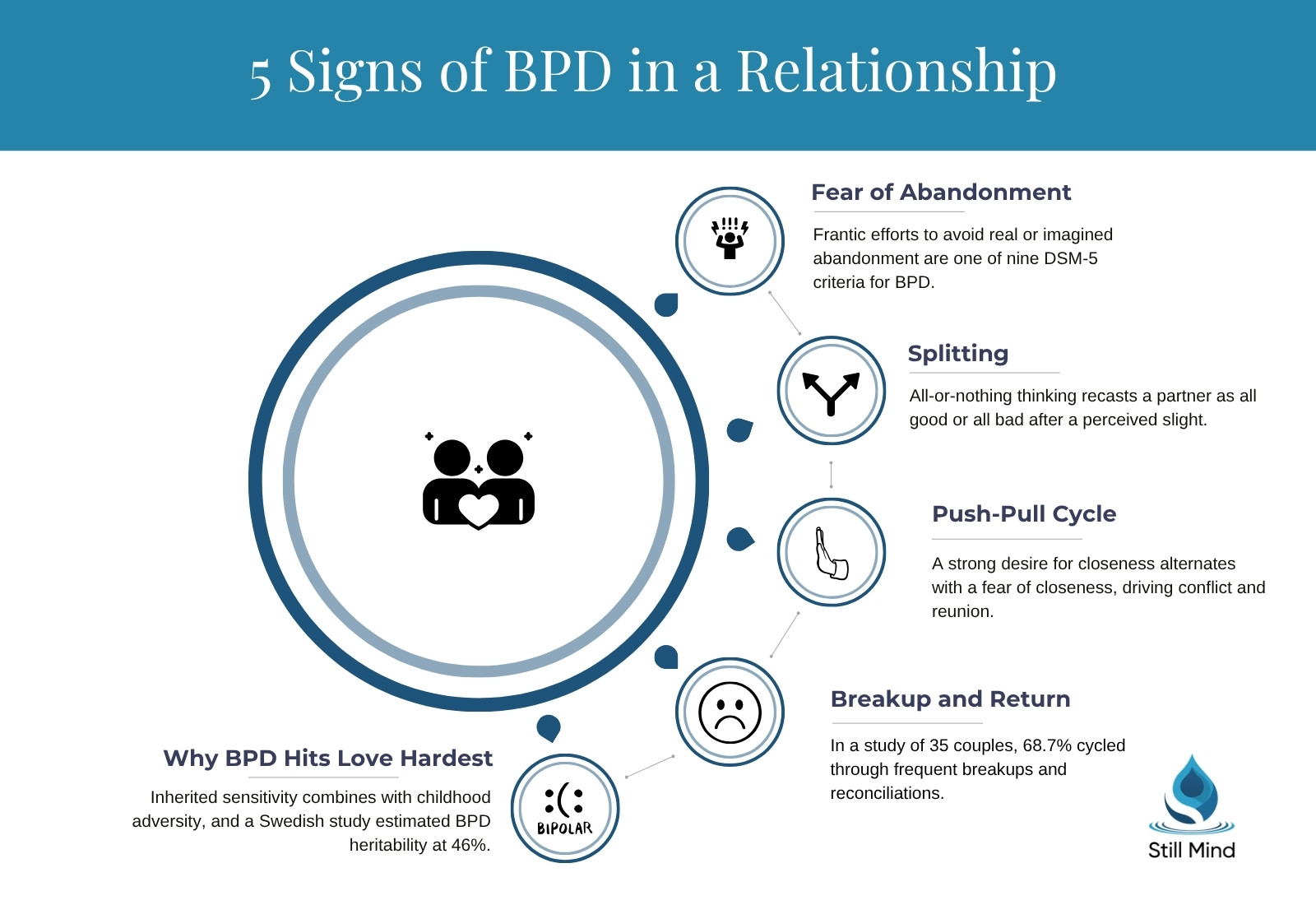
Borderline personality disorder shows up in relationships as intense and unstable bonds, strong fear of abandonment, high sensitivity to rejection, and rapid shifts between seeing a partner as all good or all bad, according to the National Institute of Mental Health (NIMH).
NIMH reports that 1.4% of U.S. adults had borderline personality disorder in the past year, based on 2001 to 2003 survey data. A 2017 review of 30 studies by Navarro-Gómez and colleagues places unstable, chaotic romantic relationships at the core of interpersonal difficulty in BPD.
Structured borderline personality disorder treatment targets these relationship patterns through skills-based therapy rather than willpower alone.
Which BPD Criteria Describe Relationships?
A BPD diagnosis requires five or more of nine criteria, as reproduced from the DSM-5 in a 2024 World Psychiatry review by Leichsenring and colleagues. There are 2 criteria that describe relationships directly:
- Frantic efforts to avoid real or imagined abandonment.
- A pattern of unstable and intense interpersonal relationships characterized by alternating between extremes of idealization and devaluation.
The ICD-11, the World Health Organization classification, uses a borderline pattern specifier that describes relationships marked by both a strong desire for and a fear of closeness and intimacy.
What Is Splitting in a BPD Relationship?
Splitting in BPD is all-or-nothing thinking that labels a partner as entirely good or entirely bad. NIMH describes BPD social interactions that swing from extreme closeness to extreme dislike, producing unstable relationships and emotional pain.
The Substance Abuse and Mental Health Services Administration (SAMHSA) gives a plain example of splitting: a person with BPD looks up to someone one day and looks down on that same person the next day.
Psychiatrist Otto Kernberg’s concept of borderline personality organization places splitting among the primitive defense mechanisms, shifting between all-good and all-bad views of people, as summarized by Leichsenring and colleagues (2024).
What Is a Favorite Person in BPD?
A favorite person (FP) is the one individual a person with BPD becomes heavily emotionally attached to and dependent on, as described in a 2022 Psychiatry Investigation study by Jeong and colleagues. Online BPD communities shorten the term to “FP.”
A 2025 Harvard Review of Psychiatry paper by Mermin and colleagues argues that wider social networks, relying less on one romantic partner, target the relationship instability of BPD more directly.
How Is BPD Screened For?
The McLean Screening Instrument for Borderline Personality Disorder (MSI-BPD) is a 10-item questionnaire, and a score of 7 or more is the recommended cutoff for BPD, according to Zanarini and colleagues (2003). A free borderline personality disorder test gives a starting point, and a licensed clinician confirms the diagnosis.
Why Do People With BPD Struggle in Relationships?
People with BPD struggle in relationships because inherited emotional sensitivity combines with childhood adversity and invalidating environments, producing intense emotions, rejection sensitivity, and fear of abandonment that surface most strongly with the people they love.
Leichsenring and colleagues (2024) state that the interaction between genetic factors and adverse childhood experiences plays a central role in the origin of BPD.
Does BPD Run in Families?
BPD runs in families, and a Swedish population study by Skoglund and colleagues (2021) estimated BPD heritability at 46%. Individually unique environmental factors explained the remaining variance in that study.
What Is Linehan’s Biosocial Model of BPD?
Marsha Linehan’s biosocial model explains BPD as early emotional vulnerability that environmental risk factors intensify across development. Crowell, Beauchaine, and Linehan (2009) describe early impulsivity followed by heightened emotional sensitivity, which later grows into more extreme emotional and behavioral dysregulation.
That pattern of emotional dysregulation helps explain why a partner’s late text or distracted tone triggers a reaction that feels far larger than the event.
How Do Childhood Experiences Shape BPD Relationships?
Adverse childhood experiences combine with inherited sensitivity to shape how a person with BPD reads closeness in adult relationships. Leichsenring and colleagues (2024) report strong rejection sensitivity in BPD, with much stronger negative emotions after perceived social exclusion, which makes ordinary relationship distance register as a threat of abandonment.
Which Conditions Co-Occur With BPD?
NIMH reports that 84.5% of U.S. adults with BPD in the past year also had at least one other mental disorder, based on 2001 to 2003 survey data. A full psychiatric assessment therefore looks beyond BPD, because an untreated co-occurring condition keeps relationship stress high even when BPD skills improve.
What Does the BPD Relationship Cycle Look Like?
The BPD relationship cycle is a repeating loop of intense early closeness, rising fear of abandonment, conflict and devaluation, separation, and reconciliation, and 68.7% of couples in one BPD study showed frequent breakups and reconciliations.
The stages below are an informal description, not a research-validated model or a diagnosis. There are 6 stages in the cycle:
- Idealization: the partner feels perfect, and the relationship moves fast.
- Fear of distance: small signs of distance trigger worry about being left.
- Reassurance-seeking: the person with BPD checks the partner’s commitment again and again.
- Devaluation: splitting recasts the partner as uncaring or cruel after a perceived slight.
- Separation: one partner ends the relationship.
- Reconciliation: longing and relief pull the couple back together, and the loop restarts.
Knowing what a BPD episode looks like helps both partners recognize emotional peaks during the devaluation stage early.
What Does Research Show About BPD Couples?
Bouchard and colleagues (2009) followed 35 couples in which the woman had BPD. There are 3 findings from that study and related research:
- Frequent breakups and reconciliations appeared in 68.7% of the couples, and nearly 30% separated within 18 months.
- Nearly half of the male partners met criteria for one or more personality disorders themselves, so both partners shape the cycle.
- More romantic relationships of shorter length marked people with BPD or BPD traits, according to the Navarro-Gómez review (2017).
Beeney and colleagues (2019) observed 130 couples and found that people with more BPD symptoms criticized more, while their partners defended and stonewalled more. That two-person pattern shows that both partners’ behavior feeds the cycle.
When Does a BPD Relationship Become Unsafe?
A BPD relationship becomes unsafe when conflict includes threats of self-harm, suicidal statements, physical aggression from either partner, or reckless behavior, because NIMH reports that people with BPD have a significantly higher rate of self-harm and suicidal behavior than the general population.
Common Relationship Signs
There are 5 common signs of BPD in a relationship:
- Fear of abandonment that turns a short delay in a reply into panic.
- Quick moves into or out of relationships, a pattern NIMH lists as abandonment avoidance.
- Black-and-white views of the partner that change within hours.
- Intense anger after a perceived slight or rejection.
- A feeling partners describe as “walking on eggshells.”
Severe Warning Signs
There are 4 severe warning signs that call for immediate help:
- Talk of suicide, or saying life is not worth living, especially after a breakup or argument.
- Self-harm, or threats of self-harm during conflict.
- Physical violence or intimidation from either partner.
- Dangerous impulsive behavior, such as reckless driving or heavy substance use after a fight.
In a 24-year follow-up of former psychiatric inpatients, summarized by Leichsenring and colleagues (2024), 5.9% of people with BPD died by suicide, compared with 1.4% of people with other personality disorders. Every suicidal statement deserves a serious response.
Call 911 when you or your partner is in immediate danger. For suicidal thoughts or emotional crisis, call or text 988, or chat at 988lifeline.org, to reach the 988 Suicide and Crisis Lifeline. The 988 Lifeline offers support in Spanish and through ASL videophone for Deaf and hard-of-hearing callers.
Long-Term Effects on Relationships
Untreated BPD patterns wear down trust, intimacy, and the partner’s own mental health over time. NIMH lists unintentional family responses that worsen BPD symptoms as a real risk, which is why partners need their own support.
Lazarus and colleagues (2020) found that women with BPD had more relationships that changed sharply or were “cut off” during their study, showing that the instability reaches friendships and family, not only romance.
Is It BPD, Bipolar Disorder, or Quiet BPD?
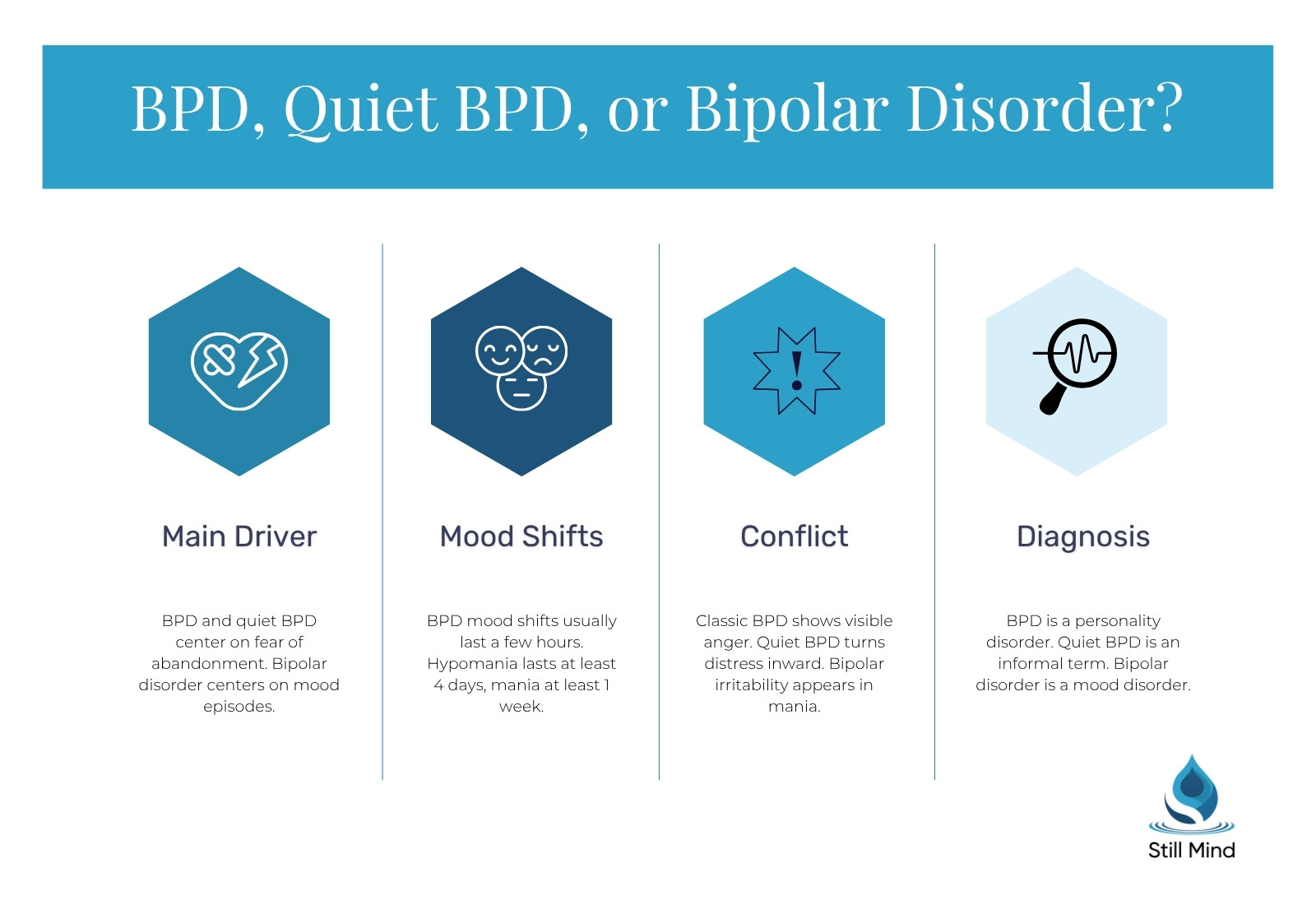
BPD relationship patterns differ from bipolar disorder because the DSM-5 describes BPD mood shifts as usually lasting a few hours, while bipolar manic or hypomanic episodes last at least 4 days, and quiet BPD, an informal term, describes distress turned inward.
| Feature | Classic BPD | Quiet BPD | Bipolar disorder |
|---|---|---|---|
| Main relationship driver | Fear of abandonment and splitting | Fear of abandonment hidden behind withdrawal | Mood episodes that change energy and judgment |
| How conflict looks | Visible anger and accusations | Silence, self-blame, pulling away | Irritability during mania, withdrawal during depression |
| Duration of mood shifts | A few hours, rarely more than a few days | Same BPD criteria; shifts less visible to the partner | At least 4 days for hypomania, at least 1 week for mania |
The BPD duration comes from the DSM-5 affective instability criterion reproduced by Leichsenring and colleagues (2024), and the bipolar durations come from the American Psychiatric Association. Quiet BPD is not a DSM-5-TR diagnosis, so the quiet BPD column reflects clinical description rather than research criteria.
The quiet BPD relationship cycle is harder for a partner to spot because the partner sees withdrawal rather than conflict.
A fuller comparison of borderline personality disorder vs. bipolar disorder covers mood timing, medication, and diagnosis.
Can Someone With BPD Have a Healthy Relationship?
Healthier relationships are possible for people with BPD, because BPD symptoms improve substantially over time, and a 16-year study found lasting symptom remission in 78% to 99% of former psychiatric inpatients with BPD.
Zanarini and colleagues (2012) followed 290 former psychiatric inpatients with BPD for 16 years. Full recovery, meaning good social and work functioning as well as symptom remission, reached 40% to 60%, which shows that social and work functioning takes longer to rebuild than symptoms take to settle.
Symptoms returned for 10% to 36% of the people who reached remission in the Zanarini study, which is why ongoing skills practice matters after treatment ends.
Common Misconception: People With BPD Are Always the Hostile Partner
What the evidence shows: A 2025 couples study by Lauzon and colleagues found that people with BPD did not communicate in a more hostile or conflictual way than their partners. That finding challenges a stigma common in healthcare and community settings. The study was small, with 18 couples, and the finding supports treating the relationship as a shared system.
How Can Partners Cope With BPD in a Relationship?
Partners cope with BPD in a relationship by learning about the disorder, offering validation and patience, supporting the treatment plan, taking every mention of self-harm seriously, and getting their own counseling, according to guidance from the National Institute of Mental Health.
NIMH lists 7 ways partners and family members support a loved one with BPD:
- Learn about BPD to understand what a loved one is experiencing.
- Offer emotional support, validation, understanding, patience, and encouragement.
- Encourage family therapy and treatment for any co-occurring mental or physical conditions.
- Support medication taken as prescribed, and encourage a talk with the provider before any change.
- Learn the treatment plan and find ways to support its goals.
- Encourage structure through daily scheduling and a healthy lifestyle.
- Take comments about self-harm or suicide seriously, and encourage prompt contact with a mental health professional or the 988 Lifeline.
Why Do Partners of People With BPD Need Their Own Support?
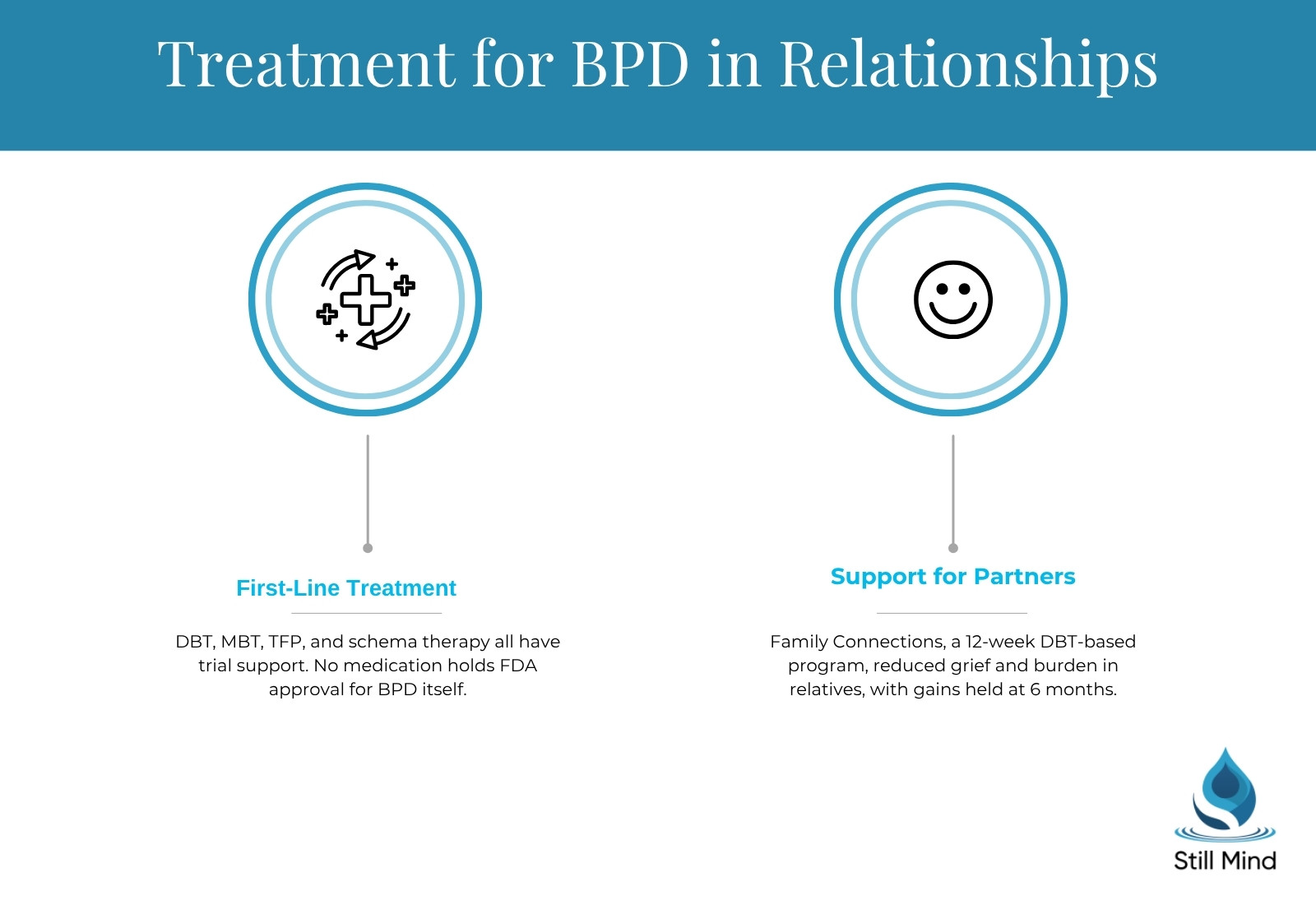
Partners carry real strain, and NIMH advises loved ones to choose a different therapist than the one the person with BPD sees. Family Connections, a 12-week DBT-based program studied by Hoffman and colleagues (2005) in 44 relatives without a control group, reduced grief and burden and increased their sense of mastery, with gains holding at 6 months.
Partner burnout in BPD relationships matches the grief and burden that Family Connections reduced, which shows that a partner’s own care belongs inside the treatment plan.
How Is BPD Treated When Relationships Are Affected?
BPD is treated first with psychotherapy, including dialectical behavior therapy (DBT), mentalization-based therapy (MBT), transference-focused psychotherapy (TFP), and schema therapy, while partners and families benefit from their own skills-based support programs.
Which Therapies Help BPD Relationships?
There are 4 psychotherapies with support from randomized controlled trials, according to Leichsenring and colleagues (2024), and no single approach has proved superior:
- Dialectical behavior therapy (DBT) uses mindfulness and teaches skills to control intense emotions, reduce self-destructive behaviors, and improve relationships.
- Mentalization-based therapy (MBT) strengthens mentalizing, the capacity to understand yourself and a partner in terms of thoughts, feelings, and intentions.
- Transference-focused psychotherapy (TFP) extends psychoanalytic therapy and works through relationship conflicts as they appear with the therapist.
- Schema therapy draws on cognitive-behavioral, psychodynamic, attachment, and emotion-focused methods to change patterns such as the abandoned child mode.
NIMH states that DBT was developed specifically for people with BPD. Linehan and colleagues (2006) ran a trial with 101 women who had BPD and recent suicidal behavior. Women receiving DBT were half as likely to make a suicide attempt as women treated by non-behavioral therapy experts.
Does Medication Help BPD?
No medication has FDA approval for BPD, and NIMH states that medication is not a first-line BPD treatment. NIMH lists medication as an add-on to psychotherapy for specific symptoms or co-occurring conditions, such as mood swings or depression.
What Emerging Treatments Are Being Studied for BPD?
There are 3 investigational medication approaches for BPD, and none has FDA approval:
- Brexpiprazole, an antipsychotic, did not meet the primary endpoint of a randomized trial reported by Rothman and colleagues (2024).
- Ketamine produced no significant difference in suicidal thoughts in a small 2023 pilot trial by Fineberg and colleagues.
- Oxytocin, a bonding hormone, has produced inconsistent and paradoxical effects in BPD studies, according to Leichsenring and colleagues (2024).
How Does Still Mind Treat BPD?
Still Mind treats BPD in adults through inpatient residential care that stabilizes sleep, mood, and daily routines first, with a formal DBT track, behavioral goals, and weekly family therapy when family involvement is clinically appropriate.
Still Mind provides one level of care, residential mental health treatment, for adults 18 and older rated at LOCUS level 5, the highest level of voluntary psychiatric need. That level of care serves adults with the highest voluntary psychiatric need, including people at risk of self-harm or suicide, under physician-directed safety protocols.
DBT and Behavioral Modification for BPD
Still Mind runs a formal DBT track, and the whole staff is trained in behavioral approaches for BPD. Treatment plans set measurable daily goals, and a client with BPD earns a reward for 5 consecutive days of independent self-care, such as making the bed, taking medication, and logging mood.
Family Therapy and Stabilization First
Still Mind offers family therapy weekly when family members are willing and involvement is clinically appropriate. Family members who aggravate symptoms stay out of early treatment, and trauma processing waits until a client is medically and psychiatrically stable.
“By the time a client with BPD reaches us, the relationship crisis is what everyone wants to talk about first. We start smaller: sleep, medication, making the bed, logging mood. Five days of doing that independently earns a reward, and that steady structure is what makes the harder conversations about partners and family possible later.”
Shannon Wagner, Clinical Director, Still Mind
Daily Structure and Safety
Each Still Mind client receives 6 hours of group therapy daily and a 60-minute individual session every week, with an average stay of about 42 days. A physician starts and ends one-on-one monitoring for clients at risk of suicide or self-harm, and a psychiatrist is available 7 days a week.
Frequently Asked Questions
Can people with BPD really love their partners?
People with BPD are capable of deep love for their partners, and the ICD-11 borderline pattern describes a strong desire for closeness alongside a fear of it. The fear of losing that closeness, not a lack of love, drives much of the conflict in BPD relationships.
Why do people with BPD push partners away?
People with BPD push partners away because the same closeness they want also feels dangerous. The ICD-11 pairs the desire for intimacy with a fear of intimacy, so pulling back protects against an abandonment that feels certain to come.
How long do BPD relationships last?
No reliable average length exists for BPD relationships, and we found no peer-reviewed source for figures such as one to three years. A 2017 review found that people with BPD have more romantic relationships of shorter length, and therapy such as DBT targets the patterns behind that instability.
Does the BPD cycle happen in friendships too?
The BPD cycle happens in friendships and family relationships as well as romance. NIMH describes the swing from extreme closeness to extreme dislike across social interactions in general, not only with romantic partners.
Should I leave a partner who has BPD?
Leaving a partner with BPD is a personal decision, and safety comes first. Violence, threats, or intimidation mean a partner needs a safe exit plan, while a partner in active treatment and willing to build skills gives the relationship a real chance to improve.
What boundaries help in a BPD relationship?
Helpful boundaries in a BPD relationship name a specific behavior and a calm, consistent response, such as pausing an argument that turns to shouting and returning to it later. Boundaries work best alongside validation of feelings, a skill DBT-based programs like Family Connections teach relatives.
How do you tell someone they might have BPD?
Raising possible BPD works best as a conversation about specific moments and your own feelings rather than a label. Suggesting an evaluation with a licensed clinician, who uses screening tools such as the MSI-BPD, keeps the focus on accurate help.
References
-
- Bouchard, S., Sabourin, S., Lussier, Y., & Villeneuve, E. (2009). Relationship quality and stability in couples when one partner suffers from borderline personality disorder. Journal of Marital and Family Therapy, 35(4), 446-455. https://pubmed.ncbi.nlm.nih.gov/19785701/
- American Psychiatric Association. (2024). What are bipolar disorders? https://www.psychiatry.org/patients-families/bipolar-disorders/what-are-bipolar-disorders
- Beeney, J. E., Hallquist, M. N., Scott, L. N., Ringwald, W. R., Stepp, S. D., Lazarus, S. A., Mattia, A. A., & Pilkonis, P. A. (2019). The emotional bank account and the four horsemen of the apocalypse in romantic relationships of people with borderline personality disorder: A dyadic observational study. Clinical Psychological Science, 7(5), 1063-1077. https://pubmed.ncbi.nlm.nih.gov/32670673/
- Crowell, S. E., Beauchaine, T. P., & Linehan, M. M. (2009). A biosocial developmental model of borderline personality: Elaborating and extending Linehan’s theory. Psychological Bulletin, 135(3), 495-510. https://pubmed.ncbi.nlm.nih.gov/19379027/
- Fineberg, S. K., Choi, E. Y., Shapiro-Thompson, R., Dhaliwal, K., Neustadter, E., Sakheim, M., Null, K., Trujillo-Diaz, D., Rondeau, J., Pittaro, G. F., Peters, J. R., Corlett, P. R., & Krystal, J. H. (2023). A pilot randomized controlled trial of ketamine in borderline personality disorder. Neuropsychopharmacology, 48(7), 991-999. https://pubmed.ncbi.nlm.nih.gov/36804489/
- Hoffman, P. D., Fruzzetti, A. E., Buteau, E., Neiditch, E. R., Penney, D., Bruce, M. L., Hellman, F., & Struening, E. (2005). Family connections: A program for relatives of persons with borderline personality disorder. Family Process, 44(2), 217-225. https://pubmed.ncbi.nlm.nih.gov/16013747/
- Jeong, H., Jin, M. J., & Hyun, M. H. (2022). Understanding a mutually destructive relationship between individuals with borderline personality disorder and their favorite person. Psychiatry Investigation, 19(12), 1069-1077. https://pubmed.ncbi.nlm.nih.gov/36588441/
- Lauzon, C., Di Bartolomeo, A. A., Varma, S., Boritz, T., Liebman, R., Monson, C., & Fitzpatrick, S. (2025). Communication between individuals with borderline personality disorder and their partners. Personality and Mental Health, 19(1), e70013. https://pubmed.ncbi.nlm.nih.gov/39980084/
- Lazarus, S. A., Beeney, J. E., Howard, K. P., Strunk, D. R., Pilkonis, P. A., & Cheavens, J. S. (2020). Characterization of relationship instability in women with borderline personality disorder: A social network analysis. Personality Disorders: Theory, Research, and Treatment, 11(5), 312-320. https://pubmed.ncbi.nlm.nih.gov/31804129/
- Leichsenring, F., Fonagy, P., Heim, N., Kernberg, O. F., Leweke, F., Luyten, P., Salzer, S., Spitzer, C., & Steinert, C. (2024). Borderline personality disorder: A comprehensive review of diagnosis and clinical presentation, etiology, treatment, and current controversies. World Psychiatry, 23(1), 4-25. https://pmc.ncbi.nlm.nih.gov/articles/PMC10786009/
- Linehan, M. M., Comtois, K. A., Murray, A. M., Brown, M. Z., Gallop, R. J., Heard, H. L., Korslund, K. E., Tutek, D. A., Reynolds, S. K., & Lindenboim, N. (2006). Two-year randomized controlled trial and follow-up of dialectical behavior therapy vs therapy by experts for suicidal behaviors and borderline personality disorder. Archives of General Psychiatry, 63(7), 757-766. https://pubmed.ncbi.nlm.nih.gov/16818865/
- Mermin, S. A., Steigerwald, G., & Choi-Kain, L. W. (2025). Borderline personality disorder and loneliness: Broadening the scope of treatment for social rehabilitation. Harvard Review of Psychiatry, 33(1), 31-40. https://pubmed.ncbi.nlm.nih.gov/39761443/
- National Institute of Mental Health. (2025). Borderline personality disorder. U.S. Department of Health and Human Services. https://www.nimh.nih.gov/health/publications/borderline-personality-disorder
- National Institute of Mental Health. (n.d.). Personality disorders. Retrieved September 24, 2026, from https://www.nimh.nih.gov/health/statistics/personality-disorders
- Navarro-Gómez, S., Frías, Á., & Palma, C. (2017). Romantic relationships of people with borderline personality: A narrative review. Psychopathology, 50(3), 175-187. https://pubmed.ncbi.nlm.nih.gov/28521314/
- Rothman, B., Brewer, C., Chang, D., Hobart, M., Hefting, N., McQuade, R. D., & Grant, J. E. (2024). A randomised study and an extension study of brexpiprazole in patients with borderline personality disorder. Acta Neuropsychiatrica, 37, e39. https://pubmed.ncbi.nlm.nih.gov/39558901/
- Skoglund, C., Tiger, A., Rück, C., Petrovic, P., Asherson, P., Hellner, C., Mataix-Cols, D., & Kuja-Halkola, R. (2021). Familial risk and heritability of diagnosed borderline personality disorder: A register study of the Swedish population. Molecular Psychiatry, 26(3), 999-1008. https://pubmed.ncbi.nlm.nih.gov/31160693/
- Substance Abuse and Mental Health Services Administration. (2023). What is borderline personality disorder (BPD)? https://www.samhsa.gov/mental-health/what-is-mental-health/conditions/borderline-personality-disorder
- Zanarini, M. C., Frankenburg, F. R., Reich, D. B., & Fitzmaurice, G. (2012). Attainment and stability of sustained symptomatic remission and recovery among patients with borderline personality disorder and axis II comparison subjects: A 16-year prospective follow-up study. American Journal of Psychiatry, 169(5), 476-483. https://pubmed.ncbi.nlm.nih.gov/22737693/
- Zanarini, M. C., Vujanovic, A. A., Parachini, E. A., Boulanger, J. L., Frankenburg, F. R., & Hennen, J. (2003). A screening measure for BPD: The McLean Screening Instrument for Borderline Personality Disorder (MSI-BPD). Journal of Personality Disorders, 17(6), 568-573. https://pubmed.ncbi.nlm.nih.gov/14744082/