


Anhedonia means losing the ability to feel pleasure or interest in things you used to enjoy, such as food, music, hobbies, or time with people you love. Clinicians describe 4 forms of anhedonia, physical, social, anticipatory, and consummatory, and anhedonia appears most often in major depressive disorder.
How long anhedonia lasts depends on the condition driving it, and treating that condition is the main route back to feeling pleasure. The sections below explain what happens in the brain when life feels flat, gray, or empty, and which treatments help.
Key Takeaways
- A 2025 review in Translational Psychiatry by Wu and colleagues found that about 70% of people with major depressive disorder show clinical features of anhedonia.
- The Diagnostic and Statistical Manual of Mental Disorders, Fifth Edition, Text Revision (DSM-5-TR), the American Psychiatric Association’s diagnostic manual, lists markedly diminished interest or pleasure as one of the two core symptoms of major depressive disorder, alongside depressed mood.
- A 2018 meta-analysis by Ducasse and colleagues in Depression and Anxiety found that anhedonia raises the risk of suicidal thoughts independently of overall depression severity.
- Clinicians measure anhedonia with questionnaires such as the 14-item Snaith-Hamilton Pleasure Scale (SHAPS), because no blood test or brain scan detects it directly.
- The 2025 Wu review found SSRIs limited for anhedonia and named vortioxetine, agomelatine, and ketamine as more promising, while cognitive behavioral therapy and behavioral activation helped only partly.
What Does Anhedonia Mean?
Anhedonia means a reduced or absent capacity to feel pleasure, and the word comes from Greek roots meaning “without pleasure.” French psychologist Théodule Ribot introduced the term in 1896 to describe patients who had lost the capacity to enjoy life.
The Clinical Definition of Anhedonia
The clinical definition of anhedonia describes a breakdown in the brain’s reward system, which normally makes enjoyable things feel worth seeking and satisfying to experience.
3 parts of the clinical anhedonia definition:
- Anhedonia removes the pleasure from activities that once felt rewarding, even when the person still performs those activities out of habit or duty.
- The DSM-5-TR describes the depression form as markedly diminished interest or pleasure in all, or almost all, activities most of the day, nearly every day.
- Everyday descriptions of the experience include emotional numbness, feeling empty, and going through the motions.
Is Anhedonia a Disorder or a Symptom?
Anhedonia is a symptom rather than a standalone disorder, and the DSM-5-TR gives anhedonia no separate diagnostic code.
3 reasons anhedonia still carries clinical weight:
- A diagnosis of major depressive disorder requires either depressed mood or anhedonia, so anhedonia alone anchors the entire diagnosis.
- Anhedonia also appears in schizophrenia, bipolar disorder, PTSD, and substance use disorders, which leads researchers to treat it as a transdiagnostic symptom.
- The 2018 Ducasse meta-analysis linked anhedonia to suicidal ideation even after accounting for depression severity, which makes anhedonia a safety signal in its own right.
How Anhedonia Differs From Depression and Apathy
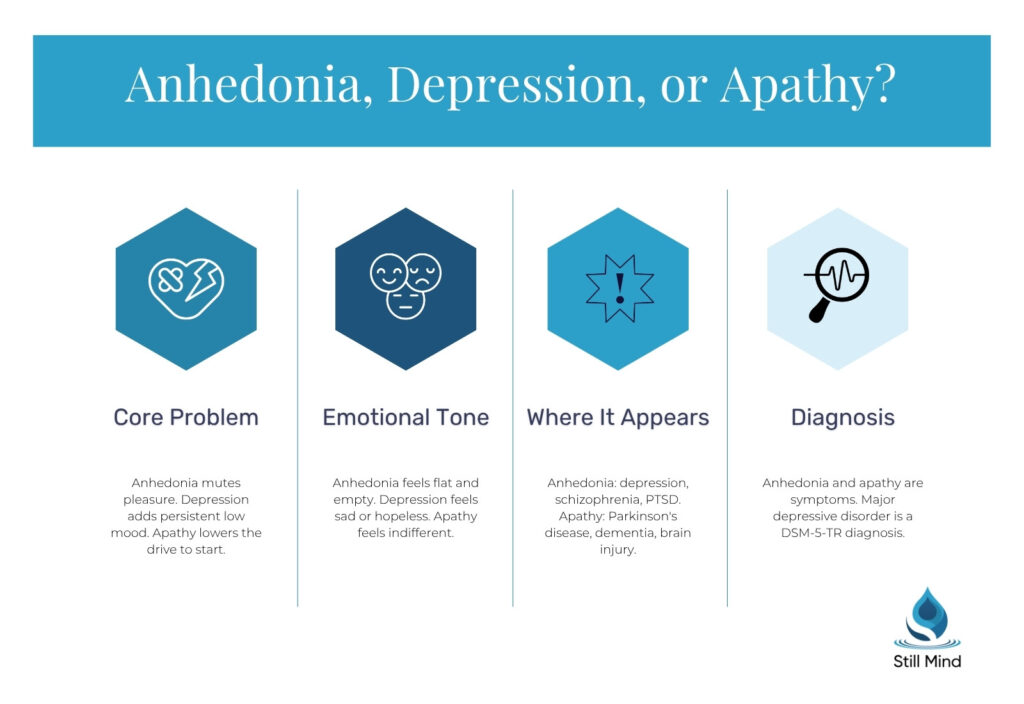
Anhedonia overlaps with depression and apathy, but each term describes a different problem, and the difference shapes which treatment fits.
| Feature | Anhedonia | Depression | Apathy |
|---|---|---|---|
| Core problem | Pleasure feels absent or muted | Persistent low mood plus changes in sleep, appetite, energy, and concentration | Motivation to start or keep going is low |
| Emotional tone | Flat, empty, numb | Sad, hopeless, tearful, or irritable | Indifferent, even when pleasure capacity remains |
| Formal status | A symptom | A diagnosis (major depressive disorder) | A symptom |
| Typical settings | Depression, schizophrenia, PTSD, early recovery | Major and persistent depressive disorders | Parkinson’s disease, dementia, brain injury |
3 distinctions between anhedonia, depression, and apathy:
- Anhedonia without visible sadness matches the pattern described as smiling depression, an informal term rather than a DSM-5-TR diagnosis.
- Apathy blocks the starting of activities, while anhedonia blocks the reward that normally comes during or after them.
- Clinicians measure anhedonia with pleasure scales such as the SHAPS, while apathy shows up as reduced goal-directed behavior.
What Are the Types of Anhedonia?
The 4 types of anhedonia are physical, social, anticipatory, and consummatory anhedonia. Physical and social anhedonia describe where pleasure is lost, while anticipatory and consummatory anhedonia describe when pleasure is lost, before or during an experience.
Physical Anhedonia
Physical anhedonia removes pleasure from bodily and sensory experiences while the senses themselves keep working normally.
2 signs of physical anhedonia:
- Favorite foods taste ordinary, music sounds like background noise, and touch or warmth no longer feels comforting.
- Exercise, sex, and time outdoors lose the satisfying feeling they once delivered.
Social Anhedonia
Social anhedonia removes the pleasure of being with other people, which gradually pulls a person away from friends and family.
2 signs of social anhedonia:
- Conversations feel effortful, and invitations get declined because the visit offers nothing to look forward to.
- Withdrawal in social anhedonia comes from an absence of pull toward people, which separates it from social anxiety and its fear of judgment.
Anticipatory Anhedonia
Anticipatory anhedonia blocks the pleasure of looking forward to future events, plans, or goals.
2 signs of anticipatory anhedonia:
- Future trips, holidays, or weekends spark no excitement, so planning them feels pointless.
- Repetitive negative thinking, known as rumination, deepens anticipatory anhedonia by filling the future with expected disappointments.
Consummatory Anhedonia
Consummatory anhedonia blocks the pleasure felt in the moment, while an activity is happening.
2 signs of consummatory anhedonia:
- A meal, a song, or a hug produces little or no enjoyment even while the activity is happening.
- The Temporal Experience of Pleasure Scale (TEPS), developed by Gard and colleagues in 2006, measures anticipatory and consummatory pleasure as separate scores for this reason.
What Does Anhedonia Feel Like?
Anhedonia feels like emotional flatness, ranging from a quiet loss of enjoyment to a complete shutdown of interest. The severity of that flatness, from common signs to severe warning signs, determines how urgently a person needs care.
Common Signs of Anhedonia
Common anhedonia signs build slowly, so the flatness goes unnoticed for weeks before a person names it.
4 everyday signs to watch for:
- Hobbies, shows, and meals that once felt rewarding now feel dull or neutral.
- Good news produces little reaction, and compliments or achievements fail to register as wins.
- Low energy, disrupted sleep, and appetite changes accompany the emotional flatness, especially when depression drives the symptom.
- Exhaustion from burnout adds to the flatness and makes rewarding activities harder to start.
Severe Signs of Anhedonia
Severe anhedonia signs show that the reward system has shut down far enough to threaten safety or basic self-care.
3 severe signs that need prompt clinical attention:
- Thoughts of death or suicide, including the belief that life will never feel worthwhile again.
- Loss of basic self-care, such as skipping meals, bathing, or prescribed medication.
- Complete withdrawal from work, school, and every close relationship.
Long-Term Effects of Anhedonia
Long-term anhedonia wears down the parts of life that normally rebuild motivation, which keeps the cycle going.
3 areas persistent anhedonia erodes over time:
- Relationships strain when partners and friends read the emotional flatness as rejection or lack of care.
- Work and school performance drops as rewarding feedback stops reinforcing effort.
- Daily life shrinks through withdrawal, and a smaller life delivers fewer chances for the reward system to recover.
What Causes Anhedonia?
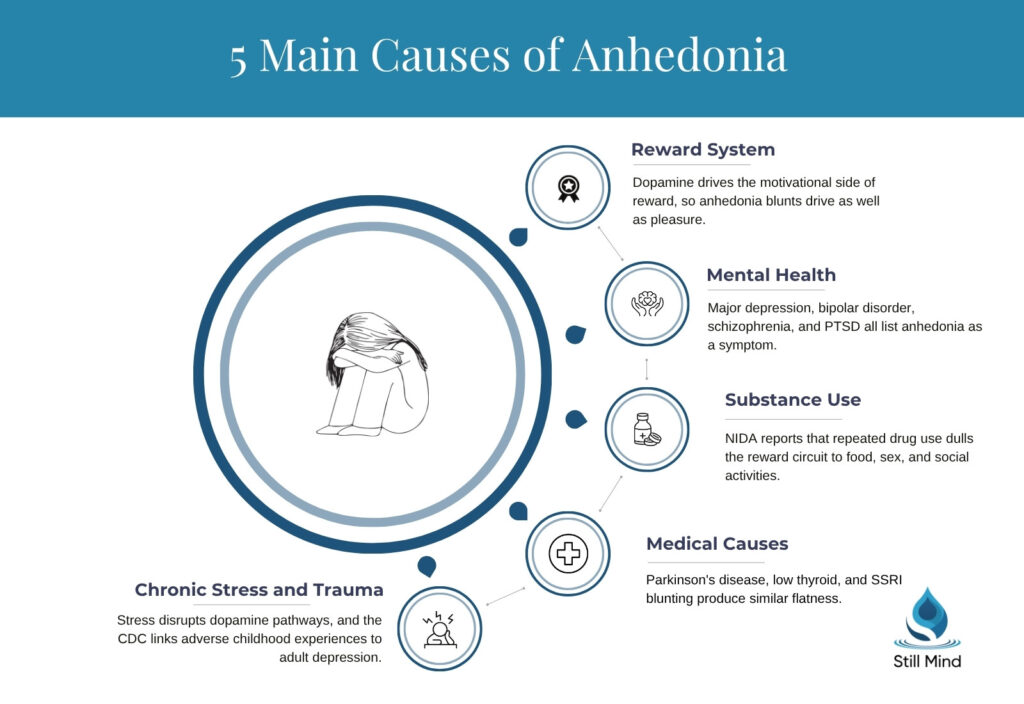
The 5 main causes of anhedonia are reward-system changes, mental health conditions, substance use, medical illness or medication, and chronic stress or trauma. The specific cause shapes the treatment plan, so clinicians identify the cause before choosing therapy or medication.
Changes in the Brain’s Reward System
The brain’s reward system relies on the chemical messenger dopamine and on areas such as the ventral striatum and the nucleus accumbens, the brain’s reward center.
2 reward-system findings behind anhedonia:
- Researchers Michael Treadway and David Zald argued in 2011 that dopamine drives the motivational “wanting” side of reward more than in-the-moment pleasure, so anhedonia in depression includes a motivation deficit as well as a pleasure deficit.
- The 2025 Wu review found serotonin-focused SSRIs limited against anhedonia, a gap that keeps reward-targeted treatment on the research agenda.
Mental Health Conditions That Produce Anhedonia
Four mental health conditions list anhedonia, or loss of positive emotion, among their DSM-5-TR symptoms.
4 conditions that include anhedonia:
- Major depressive disorder lists anhedonia as one of its 2 core criteria, alongside depressed mood.
- Bipolar disorder produces anhedonia during depressive episodes, which share the core symptoms of major depression.
- Schizophrenia includes anhedonia among its negative symptoms, alongside reduced motivation and emotional expression.
- PTSD lists a persistent inability to feel positive emotions among its DSM-5-TR symptoms, a pattern known as emotional numbing.
Substance Use and Early Recovery
Repeated alcohol, opioid, or stimulant use trains the reward system to respond mainly to the substance, which dulls everyday pleasures.
2 points on substance use and anhedonia:
- The National Institute on Drug Abuse (NIDA) reports that repeated drug use reduces the reward circuit’s sensitivity, so food, sex, and social activities bring less pleasure.
- Integrated care for co-occurring mental health and substance use disorders treats mood symptoms and substance use in the same program.
Medical Causes and Medications
Medical illnesses and SSRI antidepressants produce anhedonia or anhedonia-like blunting without any other psychiatric condition present.
3 physical causes clinicians check:
- Parkinson’s disease destroys dopamine-producing neurons, and dopamine is the chemical messenger behind reward motivation.
- An underactive thyroid (hypothyroidism) produces fatigue and depression-like symptoms that a blood test identifies.
- A 2009 qualitative study by Price and colleagues described emotional blunting in people taking SSRIs, a dulled range of both good and bad feelings.
Chronic Stress and Trauma
Chronic stress and childhood trauma feed anhedonia through their effects on the brain’s reward pathways and on lifetime depression risk.
2 ways stress and trauma feed anhedonia:
- Diego Pizzagalli’s 2014 review in the Annual Review of Clinical Psychology summarized animal studies showing that stress disrupts the dopamine pathways behind motivation.
- The Centers for Disease Control and Prevention (CDC) reports that adverse childhood experiences (ACEs), such as abuse, violence, or a parent with a substance use problem, increase the risk of depression in adulthood.
How Long Does Anhedonia Last?
Anhedonia lasts as long as its underlying cause stays active, so the timeline depends on the cause and on how quickly treatment starts. The table below shows what keeps each form of anhedonia going and what shortens it.
| Cause of anhedonia | What keeps anhedonia going | What shortens anhedonia |
|---|---|---|
| Major depressive disorder | Untreated depression and social withdrawal | Therapy, medication review, and behavioral activation |
| Substance use | Continued use or early relapse | Sustained sobriety with co-occurring mental health care |
| PTSD and trauma | Unprocessed trauma and ongoing emotional numbing | Stabilization followed by trauma-focused therapy |
| Medication side effect | Staying on a blunting medication without review | A prescriber-led dose change or switch |
Depression-Related Anhedonia
Depression-related anhedonia improves as the depressive episode is treated, but pleasure does not always return at the same pace as mood.
2 points to know about depression-related anhedonia:
- Pleasure deserves its own tracking, because Wu and colleagues (2025) identify anhedonia as one of the most common residual symptoms of major depressive disorder.
- Leftover flatness reported to a prescriber or therapist lets the clinician target the remaining reward deficit directly.
Anhedonia in Addiction Recovery
Anhedonia in addiction recovery follows from the reduced reward sensitivity that repeated drug use produces, which makes early sobriety feel flat.
2 supports that help substance-related anhedonia ease:
- Regular exercise, steady sleep, and structured daily activity add natural rewards back into each day.
- Treatment of co-occurring depression or PTSD runs at the same time as substance use care in an integrated model.
Trauma-Related Anhedonia
Trauma-related anhedonia persists while emotional numbing continues to protect a person from painful memories.
2 stages in resolving trauma-related anhedonia:
- Stabilization of sleep, mood, and safety comes first, the order the Still Mind clinical team follows before any trauma-focused work.
- Trauma-focused therapy, such as trauma-focused cognitive behavioral therapy, then reduces the need for numbing.
Is Anhedonia Permanent?
No, anhedonia is not a fixed trait, and anhedonia eases as the underlying condition responds to treatment. Anhedonia also lingers as one of the most common residual symptoms of major depressive disorder (Wu et al., 2025), so recovery needs tracking, and 3 warning signs mean help is needed right away.
What Recovery From Anhedonia Looks Like
Recovery from anhedonia arrives in small steps rather than one sudden return of joy.
3 early signs that anhedonia is lifting:
- Brief moments of interest appear, such as wanting to finish a show or noticing that a meal tastes good.
- Small plans start to feel worthwhile again, which signals that anticipatory pleasure is returning.
- Time with trusted people begins to feel restful rather than draining.
Warning Signs That Need Immediate Help
Anhedonia becomes an emergency when thoughts of suicide or a collapse in basic functioning accompany the anhedonia.
3 warning signs that need help now:
- Thoughts of suicide or self-harm: call or text 988, or chat at chat.988lifeline.org, to reach the 988 Suicide and Crisis Lifeline, which offers Spanish and ASL options, or call 911.
- Loss of eating, sleep, or self-care that keeps getting worse instead of better.
- A belief that nothing will ever matter again, combined with withdrawal from everyone close to you.
How Is Anhedonia Diagnosed?
To diagnose anhedonia, clinicians use a clinical interview and validated questionnaires such as the SHAPS, because no blood test or brain scan measures anhedonia directly. A full evaluation also rules out physical illness and medication side effects.
Anhedonia Questionnaires Clinicians Use
Anhedonia questionnaires ask how much pleasure a person gets from specific everyday experiences.
4 common anhedonia assessment tools:
- The Snaith-Hamilton Pleasure Scale (SHAPS) is a 14-item questionnaire on pleasure from food, hobbies, social contact, and senses, and higher scores mean less pleasure.
- The Temporal Experience of Pleasure Scale (TEPS) separates anticipatory pleasure from consummatory pleasure, which helps clinicians identify the type of anhedonia.
- The Dimensional Anhedonia Rating Scale (DARS) asks about a person’s own hobbies, foods, social activities, and sensory experiences.
- The Patient Health Questionnaire-9 (PHQ-9) is a nine-item depression screen whose first item asks directly about little interest or pleasure in doing things.
A free depression self-assessment offers a starting point, and a licensed clinician confirms the cause of anhedonia through a full evaluation.
Ruling Out Medical Causes
Ruling out medical causes is part of every thorough anhedonia evaluation, because physical illness produces the same flatness.
3 checks in a full evaluation:
- A physical exam and blood tests check for thyroid problems and other medical conditions.
- A medication review checks for antidepressant blunting or other side effects.
- A substance use history checks whether alcohol or drug use is suppressing the reward system.
How Is Anhedonia Treated?
Anhedonia is treated with 5 approaches: talk therapy, medication, add-on therapies, newer interventions, and daily coping habits. Each approach works alongside treatment of the condition that caused the anhedonia.
Talk Therapies That Target Pleasure
Talk therapies for anhedonia rebuild the link between action and reward through structured practice.
3 first-line therapies for anhedonia:
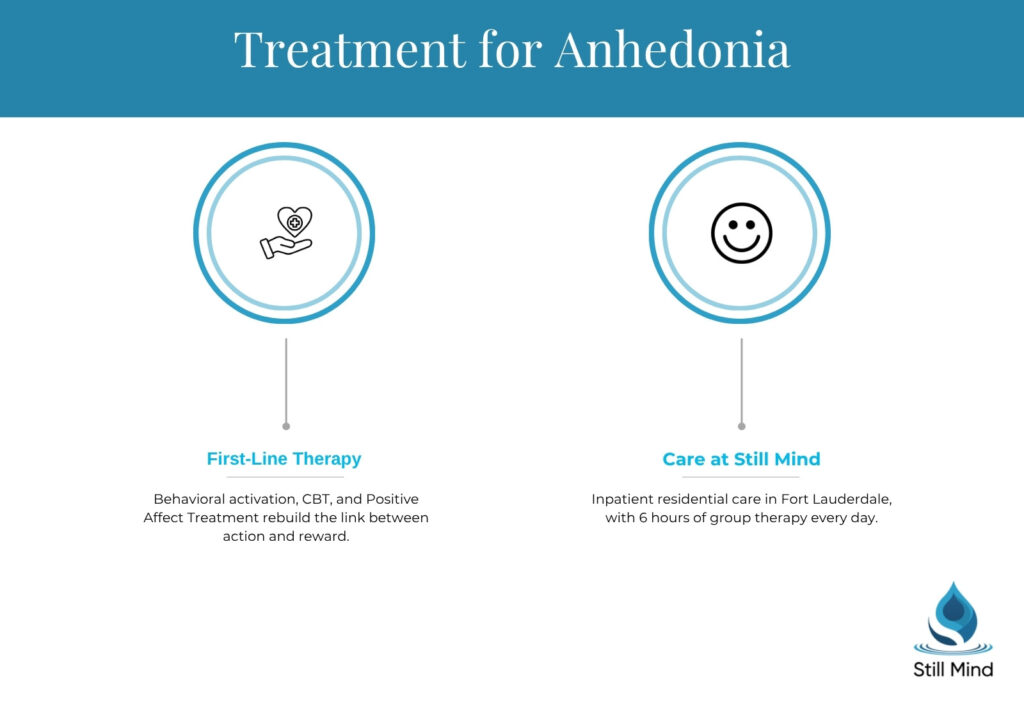
- Behavioral activation (BA) schedules small rewarding activities on purpose, so the reward system receives input before motivation returns.
- Cognitive behavioral therapy challenges thoughts such as “nothing will feel good anyway” that keep a person from trying.
- Positive Affect Treatment (PAT), developed by Michelle Craske’s team at UCLA, trains people to notice and savor positive moments, and a 2019 trial found larger gains in positive emotion than with a therapy focused on negative emotion.
Medications for Anhedonia
A psychiatrist selects anhedonia medication based on the underlying condition and on how the person responded to earlier treatment.
3 medication options clinicians weigh:
- SSRIs such as sertraline and escitalopram remain first-line for depression, although the 2025 Wu review found their benefit for anhedonia limited.
- Bupropion, a norepinephrine-dopamine reuptake inhibitor (NDRI), acts on dopamine and norepinephrine rather than serotonin.
- Vortioxetine, agomelatine, and ketamine looked more promising for anhedonia than standard SSRIs in the 2025 Wu review, and agomelatine is not FDA-approved in the United States.
Add-On and Second-Line Approaches
Add-on approaches strengthen anhedonia treatment when first-line therapy or medication helps only partly.
3 second-line and adjunct options:
- Acceptance and commitment therapy reconnects people with personal values, which gives activities meaning before pleasure fully returns.
- Group therapy supplies regular, structured social contact in a low-pressure setting.
- A 2024 BMJ network meta-analysis by Noetel and colleagues found that walking or jogging, yoga, and strength training reduced depression.
Newer and Investigational Treatments
Newer treatments for depression-related anhedonia include fast-acting medications and brain stimulation.
3 emerging options and their current status:
- Esketamine nasal spray (Spravato), taken with an oral antidepressant, has been FDA-approved for treatment-resistant depression since 2019, and researchers continue to study how ketamine for depression acts on anhedonia.
- Transcranial magnetic stimulation (TMS) has been FDA-cleared for major depressive disorder since 2008 and stimulates the dorsolateral prefrontal cortex, a brain area that helps regulate mood.
- Kappa-opioid receptor antagonists, drugs that block a stress-linked receptor in the reward system, remain investigational and have not been approved as anhedonia treatments.
Coping With Anhedonia Day to Day
Coping with anhedonia day to day means acting before the pleasure arrives, because waiting to feel like it keeps the cycle going.
4 daily habits that support recovery:
- Schedule one small activity each day, such as a short walk or a call with a friend, and rate the enjoyment from 0 to 10 afterward.
- Slow down during a pleasant moment and name three details you notice, a savoring skill used in Positive Affect Treatment.
- Keep sleep and wake times steady, the first stabilization goal in Still Mind’s treatment plans.
- Choose short, low-pressure social contact over avoiding people entirely.
How Does Still Mind Treat Anhedonia?
Still Mind treats anhedonia within its inpatient residential mental health program in Fort Lauderdale, where adults with major depressive disorder, persistent depressive disorder, and bipolar I disorder receive round-the-clock care. The Still Mind program runs 7 days a week, with an average stay of about 42 days.
Stabilization Comes First
Stabilization is the first goal of anhedonia treatment at Still Mind.
3 features of the first weeks:
- Each client receives an individualized treatment plan within the first week of admission.
- Early goals are measurable daily-living targets: normalizing sleep, taking medication consistently, and keeping a daily mood log.
- Deeper processing work begins once sleep, mood, and behavior have stabilized.
A Full Day of Structured Therapy
Structured therapy fills each day at Still Mind, 7 days a week.
4 parts of the therapy schedule:
- Six hours of group therapy every day, including psychoeducation, CBT-based, psychodynamic, and art therapy groups.
- A 60-minute individual therapy session each week, plus informal mid-week check-ins on journaling and mood logs.
- Formal CBT and dialectical behavior therapy tracks, along with acceptance and commitment therapy and mindfulness-based CBT.
- Weekly family therapy when family members are involved and the clinical team judges it appropriate.
Measuring Progress at Still Mind
Progress at Still Mind is tracked with standard clinical tools rather than estimated.
4 ways the clinical team tracks recovery:
- The PHQ-9 depression screen runs at intake and again during treatment, including its item on loss of interest and pleasure.
- The Level of Care Utilization System (LOCUS) is reassessed every two weeks.
- A psychiatrist is on site on weekdays and on call seven days a week for medication adjustments.
- Discharge planning begins once sleep, mood, and behavior have improved, with step-down care arranged before the client leaves.
Frequently Asked Questions About Anhedonia
How do you fix anhedonia?
Anhedonia improves through treating its cause and retraining the reward system. Behavioral activation, cognitive behavioral therapy, and Positive Affect Treatment rebuild the link between action and reward, and a psychiatrist adjusts medication when an SSRI blunts emotions.
What is an example of anhedonia?
One example of anhedonia is a person who loved cooking now making dinner and feeling nothing while eating. Another example is canceling plans with close friends because the evening offers no anticipation.
What is the main cause of anhedonia?
Major depressive disorder is the main cause of anhedonia, and Wu and colleagues found in 2025 that about 70% of people with major depressive disorder show anhedonia. Schizophrenia, PTSD, substance use, and Parkinson’s disease also produce anhedonia.
What does anhedonia feel like?
Anhedonia feels like emotional numbness. People with anhedonia describe going through the motions, feeling empty at happy events, and losing the urge to make plans, without feeling sad.
What does anhedonia mean in psychiatry?
In psychiatry, anhedonia means a clinically significant loss of pleasure or interest. Anhedonia is one of the 2 core symptoms of major depressive disorder in the DSM-5-TR, and psychiatrists measure anhedonia with the SHAPS and the PHQ-9.
Is anhedonia dangerous?
Persistent anhedonia is dangerous because anhedonia raises the risk of suicidal thoughts, as the 2018 Ducasse meta-analysis found. Call or text 988, chat at chat.988lifeline.org, or seek emergency care right away when anhedonia comes with thoughts of suicide.
Is anhedonia a sign of schizophrenia?
Anhedonia is a negative symptom of schizophrenia in the DSM-5-TR, but anhedonia alone does not indicate schizophrenia. Depression is a more common source, and about 70% of people with major depressive disorder show anhedonia (Wu et al., 2025).
Can medication cause anhedonia?
Yes, SSRIs produce anhedonia-like emotional blunting, a dulling of both positive and negative feelings that Price and colleagues documented in 2009. Never stop a medication alone; report the change so the prescriber adjusts the dose or switches medication.
References
- American Psychiatric Association. (2022). Diagnostic and statistical manual of mental disorders (5th ed., text rev.). American Psychiatric Publishing.
- Craske, M. G., Meuret, A. E., Ritz, T., Treanor, M., Dour, H., & Rosenfield, D. (2019). Positive affect treatment for depression and anxiety: A randomized clinical trial for a core feature of anhedonia. Journal of Consulting and Clinical Psychology, 87(5), 457–471.
- Ducasse, D., Loas, G., Dassa, D., Gramaglia, C., Zeppegno, P., Guillaume, S., Olié, E., & Courtet, P. (2018). Anhedonia is associated with suicidal ideation independently of depression: A meta-analysis. Depression and Anxiety, 35(5), 382–392.
- Gard, D. E., Gard, M. G., Kring, A. M., & John, O. P. (2006). Anticipatory and consummatory components of the experience of pleasure: A scale development study. Journal of Research in Personality, 40(6), 1086–1102.
- Noetel, M., Sanders, T., Gallardo-Gómez, D., et al. (2024). Effect of exercise for depression: Systematic review and network meta-analysis of randomised controlled trials. BMJ, 384, e075847.
- Pizzagalli, D. A. (2014). Depression, stress, and anhedonia: Toward a synthesis and integrated model. Annual Review of Clinical Psychology, 10, 393–423.
- Price, J., Cole, V., & Goodwin, G. M. (2009). Emotional side-effects of selective serotonin reuptake inhibitors: Qualitative study. British Journal of Psychiatry, 195(3), 211–217.
- Snaith, R. P., Hamilton, M., Morley, S., Humayan, A., Hargreaves, D., & Trigwell, P. (1995). A scale for the assessment of hedonic tone: The Snaith-Hamilton Pleasure Scale. British Journal of Psychiatry, 167(1), 99–103.
- Treadway, M. T., & Zald, D. H. (2011). Reconsidering anhedonia in depression: Lessons from translational neuroscience. Neuroscience & Biobehavioral Reviews, 35(3), 537–555.
- Wu, C., Mu, Q., Gao, W., et al. (2025). The characteristics of anhedonia in depression: A review from a clinically oriented perspective. Translational Psychiatry, 15, 90.