



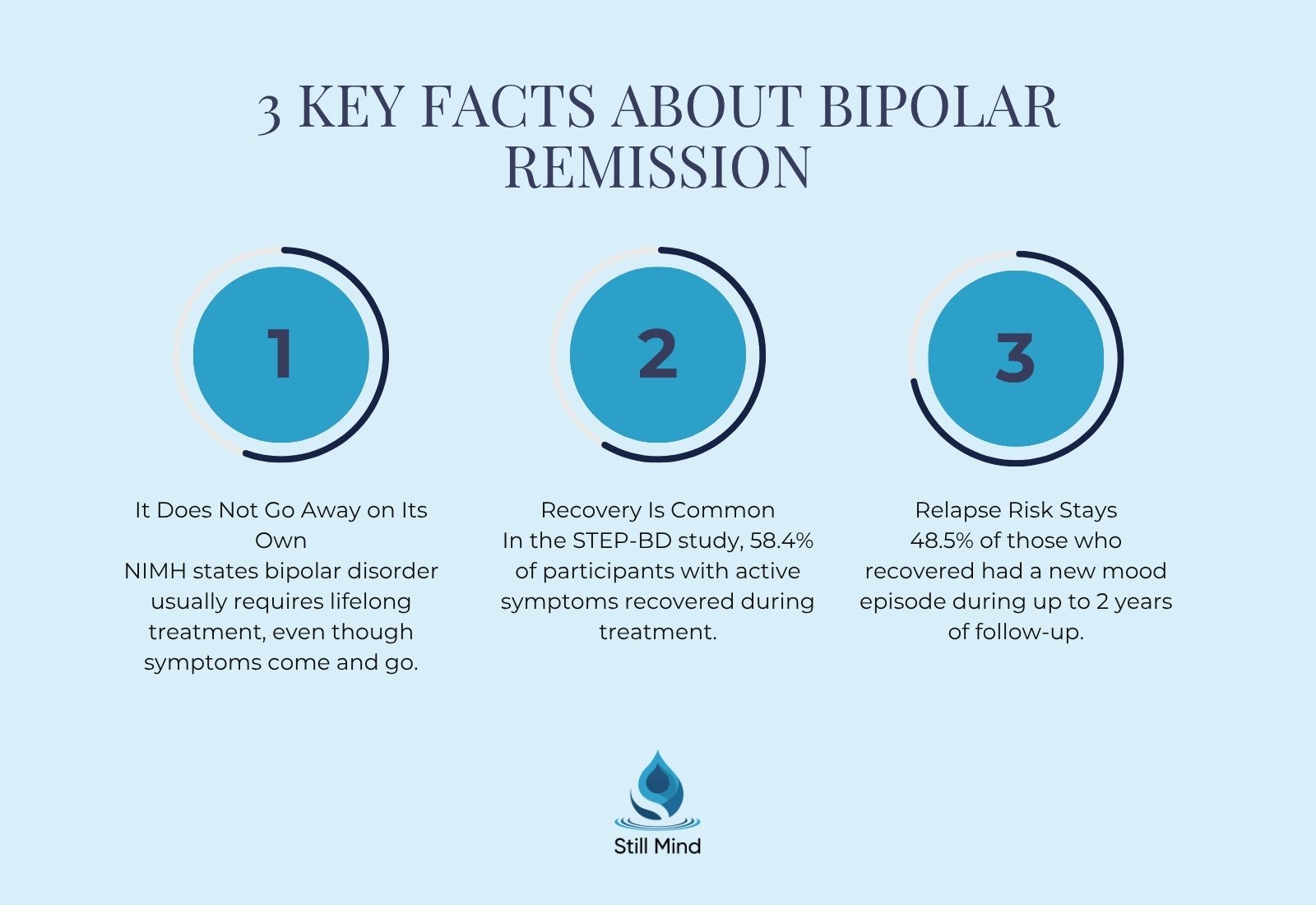
Bipolar disorder does not go away on its own, but consistent treatment brings long stretches of remission, and the National Institute of Mental Health (NIMH) states that bipolar disorder usually requires lifelong treatment.
In the large STEP-BD study, 58.4% of participants with active symptoms recovered during treatment, and 48.5% of that group had a new mood episode during up to 2 years of follow-up. Remission, relapse triggers, age, and treatment each shape that bipolar course.
Key Takeaways
- NIMH states that bipolar disorder usually requires lifelong treatment and does not go away on its own, even though symptoms come and go.
- In the STEP-BD study by Perlis and colleagues (2006), 58.4% of symptomatic participants recovered, and 48.5% of those who recovered had a recurrence during up to 2 years of follow-up.
- Leftover residual symptoms at the point of recovery predicted recurrence in STEP-BD, and the authors identify residual symptoms as a target for maintenance treatment.
- Lithium reduces the risk of suicide in people with mood disorders, according to a 2013 BMJ meta-analysis by Cipriani and colleagues.
- NIMH estimates, from 2001 to 2003 survey data, that 2.8% of U.S. adults had bipolar disorder in the past year and 4.4% experience bipolar disorder at some point in life.
Can Bipolar Disorder Go Away on Its Own?
Bipolar disorder does not go away on its own, because bipolar disorder is a chronic, recurring mood condition, but bipolar symptoms come and go, and periods of relative wellness called euthymia separate mood episodes, according to StatPearls and NIMH.
NIMH states that bipolar disorder “does not go away on its own” and that an effective treatment plan improves quality of life. Bipolar disorder belongs to the mood disorders, and NIMH reports that 82.9% of people with bipolar disorder have serious impairment, the highest share among mood disorders.
What Are the Types of Bipolar Disorder?
The American Psychiatric Association (APA) groups bipolar disorder into 3 main diagnoses:
- Bipolar I disorder: diagnosed after at least one manic episode, a period of at least one week of high or irritable mood with more energy than usual.
- Bipolar II disorder: at least one hypomanic episode lasting at least four days in a row and at least one major depressive episode lasting at least two weeks.
- Cyclothymic disorder: a milder form of bipolar disorder with frequent hypomanic and depressive symptoms that stay below full episode severity.
What Is the Difference Between Remission and Recovery?
Remission means bipolar symptoms have settled, and researchers measure recovery at 3 levels:
- Syndromal recovery: no longer meeting full criteria for a mood episode.
- Symptomatic recovery: becoming largely symptom-free.
- Functional recovery: regaining work and living roles.
The McLean-Harvard First-Episode Mania Study by Tohen and colleagues (2003) found syndromal recovery in 98% of patients with bipolar disorder within 2 to 4 years, symptomatic recovery in 72%, and functional recovery in only 43%.
Remission is not a cure, and the diagnosis stays in place during remission because the underlying vulnerability to new episodes remains.
How Is Bipolar Disorder Screened and Measured?
There are 2 widely used bipolar measures:
- Mood Disorder Questionnaire (MDQ): a screening questionnaire, and a score of 7 or more items showed a sensitivity of 0.73 and a specificity of 0.90 in the validation study by Hirschfeld and colleagues (2000).
- Young Mania Rating Scale (YMRS): an 11-item clinician-administered scale that rates the severity of mania, introduced by Young and colleagues (1978).
Why Does Bipolar Disorder Keep Coming Back?
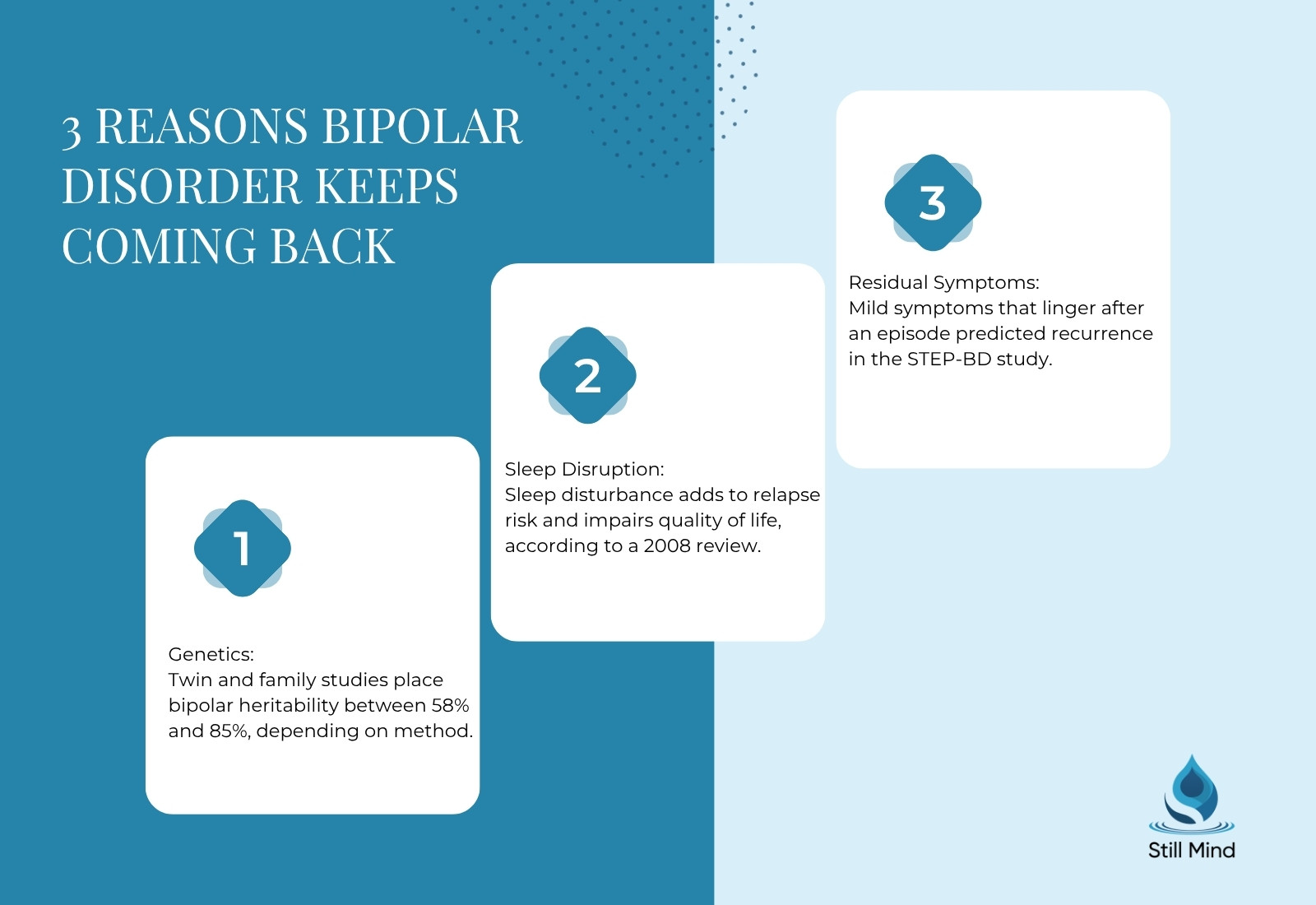
Bipolar disorder keeps coming back because strong genetic vulnerability, sleep disruption, substance use, and leftover residual symptoms each lower the threshold for a new mood episode, and each repeated episode raises the vulnerability to the next one.
Is Bipolar Disorder Genetic?
Bipolar disorder is strongly genetic, and a twin study by McGuffin and colleagues (2003) estimated bipolar heritability at 85%. A Swedish family-register study by Song and colleagues (2015) estimated heritability at 58%, so these two studies place heritability between 58% and 85%, depending on method.
What Is the Kindling Theory of Bipolar Disorder?
Psychiatrist Robert Post’s kindling theory explains why bipolar episodes need less of a trigger over time. Post (1992) reviewed studies showing that psychosocial stress plays a greater role in the first episode of a major mood disorder than in later episodes.
Post (2020) adds that repeated bipolar episodes raise the vulnerability to further episodes, until spontaneous episodes begin to occur without a clear trigger. In the 1992 paper, Post called early intervention critical for preventing rapid cycling, spontaneous episodes, and resistance to medication.
How Does Sleep Trigger Bipolar Relapse?
Sleep disturbance adds to the risk of bipolar relapse and impairs quality of life, according to a 2008 American Journal of Psychiatry review by Allison Harvey. NIMH advises people with bipolar disorder to keep a routine for eating, sleeping, and exercising.
How Do Alcohol and Drugs Change the Course of Bipolar Disorder?
Substance use worsens the course of bipolar disorder, and Post (2020) states that co-occurring substance use makes the illness more difficult through added stressors and episodes. Sonne and Brady (2002), citing the Epidemiologic Catchment Area (ECA) study, report that 60.7% of people with bipolar I disorder had a lifetime substance use disorder.
Sonne and Brady summarize studies suggesting that drinking during manic episodes serves to prolong the high or sedate agitation, a pattern described as self-medication. Sonne and Brady also describe integrated therapy that addresses bipolar disorder and alcohol use disorder (AUD) together in the same sessions.
Why Do Residual Symptoms Matter?
Residual symptoms, meaning mild mood symptoms that linger after a bipolar episode ends, predicted recurrence in the STEP-BD study by Perlis and colleagues (2006). Perlis and colleagues identify residual symptoms as a target for maintenance treatment.
How Long Does Bipolar Remission Last?
Bipolar remission length varies from person to person, and in the STEP-BD study, 48.5% of people who recovered had a new mood episode within 2 years, while no recurrence was recorded for the remaining participants during follow-up.
| Study | Who was followed | Follow-up | Key finding |
|---|---|---|---|
| Perlis et al. (2006), STEP-BD | 1,469 participants aged 15 and older with active symptoms | Up to 2 years | 58.4% recovered; 48.5% of those had a recurrence |
| Kessing et al. (2018), meta-analysis | Adults after a single manic or mixed episode | 1 year | 35% had a recurrence |
| Tohen et al. (2003) | 166 patients after a first hospitalization for a manic or mixed episode | 2 to 4 years | 98% syndromal recovery; 72% symptomatic recovery; 43% functional recovery; 57% had a new episode or switch |
| Judd et al. (2002) | 146 patients with bipolar I disorder in the NIMH Collaborative Depression Study | Mean of 12.8 years | Symptomatic during 47.3% of weeks |
Depression drives most recurrences, and STEP-BD recorded depressive recurrences in 34.7% of recovered participants compared with 13.8% for manic, hypomanic, or mixed episodes. Nierenberg and colleagues (2023) report that approximately 75% of symptomatic time in bipolar disorder consists of depressive episodes or symptoms.
Rapid cycling, defined as four or more bipolar mood episodes within a year, marks a less stable course, and Dunner and Fieve defined the pattern in 1974, as described by Xu and colleagues (2024).
Does Bipolar Disorder Get Worse With Age?
Bipolar disorder gets worse over time when episodes keep recurring, because repeated episodes shorten the stable periods between them in some people, according to Robert Post (2020), while early diagnosis and treatment are associated with a more favorable prognosis, according to a 2023 JAMA review.
NIMH links inadequate treatment to bipolar episodes that occur more frequently as time goes on. Nierenberg and colleagues (2023) report that a first depressive episode precedes an accurate bipolar diagnosis and optimal treatment by a mean of approximately 9 years, which leaves years of episodes without the right treatment.
Can You Outgrow Bipolar Disorder?
Outgrowing bipolar disorder is unproven. Cicero and colleagues (2009), using two national U.S. surveys, found past-year bipolar prevalence of 5.5% to 6.2% among 18- to 24-year-olds, compared with 3.1% to 3.4% among 25- to 29-year-olds.
Cicero and colleagues state that more detailed long-term research is needed to confirm whether developmentally limited forms of bipolar disorder exist. NIMH still describes bipolar disorder as a condition that does not go away on its own.
What Are the Signs That Bipolar Disorder Is Returning?
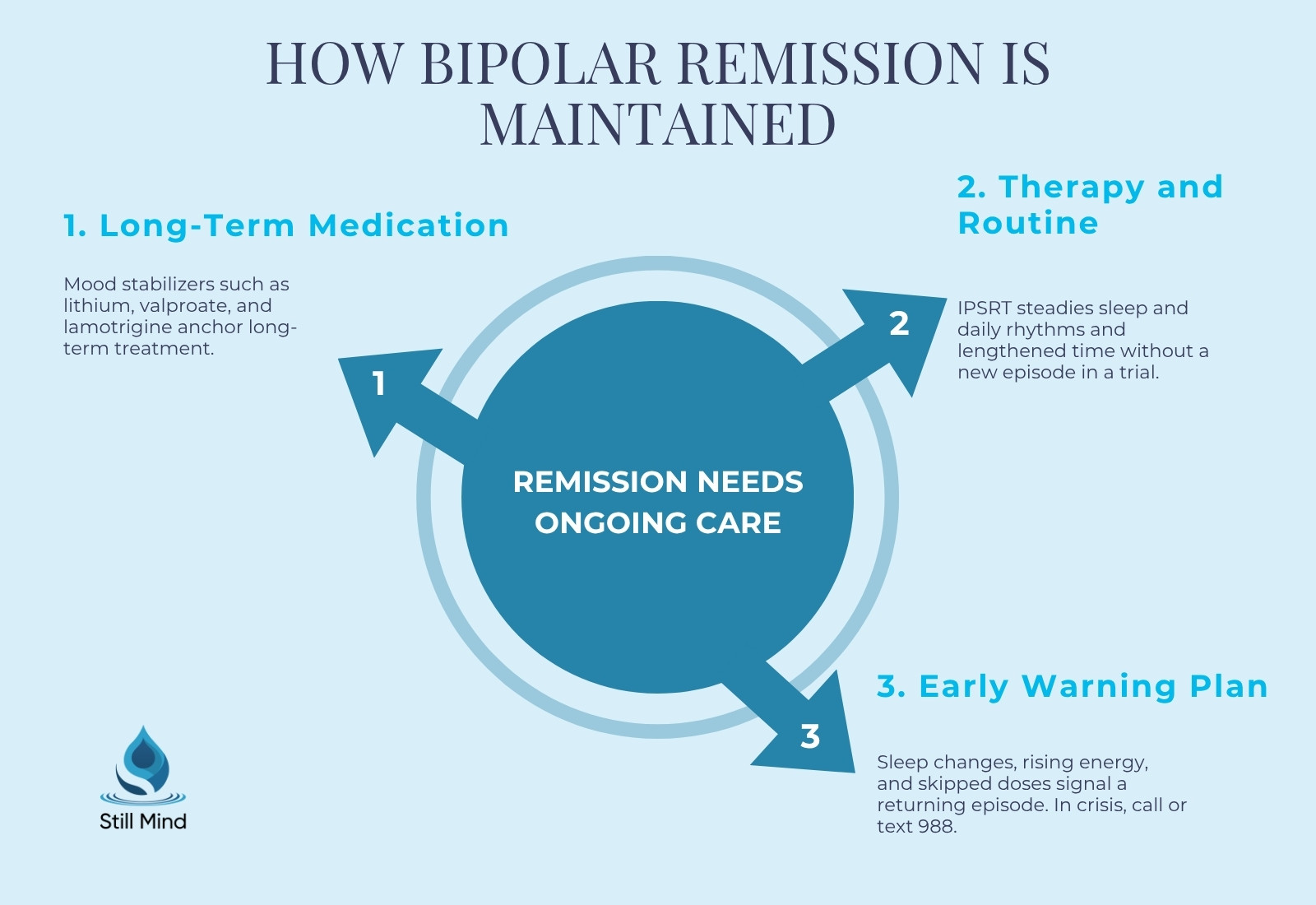
The signs that bipolar disorder is returning include sleep changes, rising energy or irritability, persistent low mood, increased alcohol or drug use, and skipped medication, and sleep disturbance adds to relapse risk, according to a 2008 review by Allison Harvey.
Early Warning Signs
There are 5 early warning signs of a returning bipolar episode:
- Sleep changes, such as needing far less sleep or sleeping far more than usual.
- Extra energy, racing plans, or irritability that lasts most of the day.
- Low mood or loss of interest that lasts most of the day for days at a time.
- More alcohol or drug use than usual.
- Missed medication doses or a plan to stop medication.
Extreme mood swings that last for days point toward a bipolar mood episode rather than a passing reaction to stress.
Severe Warning Signs
There are 4 severe warning signs that call for immediate help:
- Thoughts of suicide, talk of death, or saying life is not worth living.
- Hallucinations or delusions, which NIMH lists as signs of psychosis during severe manic or depressive episodes.
- Nights with almost no sleep while agitation keeps rising.
- Dangerous impulsive behavior, such as reckless driving or spending that puts safety or finances at risk.
Nierenberg and colleagues (2023) report an annual suicide rate of approximately 0.9% among people with bipolar disorder, compared with 0.014% in the general population, so every suicidal statement deserves an immediate response.
Call 911 when someone is in immediate danger. For suicidal thoughts or emotional crisis, call or text 988, or chat at 988lifeline.org, to reach the 988 Suicide and Crisis Lifeline. The 988 Lifeline offers support in Spanish and through ASL videophone for Deaf and hard-of-hearing callers.
Long-Term Effects of Repeated Episodes
Repeated bipolar episodes take a toll on work, relationships, and health over time. Judd and colleagues (2002) followed 146 patients with bipolar I disorder and found symptoms during 47.3% of weeks across a mean of 12.8 years of follow-up.
Could It Be Depression or BPD Instead of Bipolar Disorder?
Bipolar disorder differs from major depressive disorder because bipolar disorder includes manic or hypomanic episodes, and bipolar disorder differs from borderline personality disorder (BPD) because bipolar mood episodes last at least four days, while BPD mood shifts usually last a few hours.
| Feature | Bipolar I disorder | Bipolar II disorder | Major depressive disorder | BPD |
|---|---|---|---|---|
| Mania or hypomania | At least one manic episode | Hypomanic episodes, no full mania | None | None as a defining feature |
| Depressive episodes | Not required for diagnosis | Required, at least two weeks | Required, at least two weeks | Intense episodic low moods (dysphoria) |
| Length of mood shifts | At least one week for mania | At least four days for hypomania | At least two weeks for depression | A few hours, rarely more than a few days |
The durations come from the APA for mood episodes and from the DSM-5 affective instability criterion for BPD, as reproduced by Leichsenring and colleagues (2024).
Bipolar disorder that begins with depression looks like depression alone until a first manic or hypomanic episode appears, and the question of bipolar vs depression is a common reason for a second opinion.
Major depressive disorder shares the depressive episodes of bipolar disorder but never includes mania or hypomania, which is the feature a clinician checks for first.
A side-by-side look at borderline personality disorder vs. bipolar disorder covers triggers, mood timing, and treatment differences in more depth.
How Is Bipolar Disorder Treated to Stay in Remission?
Bipolar disorder is treated to stay in remission with long-term medication, such as the mood stabilizers lithium, valproate, and lamotrigine, plus psychotherapy that helps people understand the illness and keep taking medication, according to the APA and a 2023 JAMA review.
The APA calls medication the cornerstone of bipolar disorder treatment, supported by long-term psychotherapy.
Which Medications Keep Bipolar Disorder in Remission?
Nierenberg and colleagues (2023) name 2 groups of medications for long-term bipolar treatment, with these examples:
- Mood stabilizers: lithium, valproate, and lamotrigine.
- Antipsychotics: quetiapine, aripiprazole, asenapine, lurasidone, and cariprazine, some of which cause weight gain.
The FDA approved lurasidone (Latuda) for bipolar I depression in 2013, cariprazine (Vraylar) for bipolar I depression in 2019, and lumateperone (Caplyta) for bipolar I or II depression in adults in December 2021.
Lithium reduces the risk of suicide in people with mood disorders, according to Cipriani and colleagues (2013). The World Health Organization advises considering maintenance medication for at least six months in adults whose bipolar disorder is in remission.
Common Misconception: Feeling Stable Means Medication Is No Longer Needed
What the evidence shows: Stability during treatment reflects the treatment working, not the illness ending. Nierenberg and colleagues (2023) report that more than 50% of people with bipolar disorder do not stay adherent to treatment, and residual symptoms predicted recurrence in STEP-BD. Any change to bipolar medication belongs in a planned conversation with the prescribing psychiatrist.
Which Therapies Help Prevent Bipolar Relapse?
Interpersonal and social rhythm therapy (IPSRT), developed by Ellen Frank, stabilizes daily routines and sleep. In a trial of 175 people with bipolar I disorder by Frank and colleagues (2005), people who received IPSRT during acute treatment went longer without a new mood episode.
The APA notes that talk therapy helps patients with bipolar disorder learn about the illness and stay on medication, which helps prevent future mood episodes.
What Emerging Treatments Are Being Studied?
There are 2 investigational approaches for bipolar depression, and neither has FDA approval for bipolar disorder:
- Psilocybin with psychotherapy: a 2024 open-label trial of 15 adults with treatment-resistant bipolar II depression by Aaronson and colleagues found early signs of benefit and called for further study.
- Ketamine and esketamine: a 2023 meta-analysis by Nunez and colleagues found a mood switch rate of 2.4% and called esketamine data for bipolar depression limited.
How Does Still Mind Help Adults Stabilize Bipolar Disorder?
Still Mind helps adults stabilize bipolar disorder through inpatient residential care built around sleep normalization, careful medication adjustment by an on-site psychiatrist, and mood logging, followed by a coordinated step-down to outpatient or other ongoing care.
Still Mind provides one level of care, residential mental health treatment, for adults 18 and older rated at LOCUS level 5, the highest level of voluntary psychiatric need. Bipolar I disorder is among the mood disorders the Fort Lauderdale team treats.
Psychiatric Care Seven Days a Week
A Still Mind psychiatrist is on-site on weekdays and on call on weekends, so bipolar medication changes happen under psychiatric oversight seven days a week. The team monitors side effects such as a fast heart rate and tremors, and the internal psychiatrist leads medication management during the stay.
Measurable Stabilization Goals
Each Still Mind treatment plan is built in the first week around measurable goals. A typical plan follows 5 steps in this order:
- Normalize sleep.
- Improve mood through careful medication adjustment.
- Track mood through logging and journaling.
- Hold structured therapy conversations.
- Work toward behavioral goals.
The Still Mind team reassesses each client with the Level of Care Utilization System (LOCUS) every two weeks.
“With bipolar disorder, sleep is the first thing we measure and the first thing we fix. Medication is adjusted in small steps while we watch closely for side effects like a racing heart or tremors, and every client logs their mood, so we treat the pattern and not just the worst moment.”
Dr. Gladys Martinez, Medical Director, Still Mind
Therapy, Family Work, and Co-Occurring Care
Each Still Mind client receives 6 hours of group therapy daily, including psychoeducation and CBT-based groups, plus a 60-minute individual session every week. Family therapy takes place weekly when family involvement is clinically appropriate, and co-occurring substance use is treated within the same program as bipolar care.
Step-Down After Stabilization
Discharge planning begins once the physician and clinical team confirm improved sleep, mood, and behavior. The average Still Mind stay is about 42 days. The Still Mind team arranges placement with a step-down program anywhere in the country and coordinates transportation to it.
Frequently Asked Questions
Can bipolar disorder be cured?
Bipolar disorder has no cure, but long-term remission is a realistic goal with treatment. NIMH states that treatment helps many people, even those with the most severe forms of bipolar disorder.
Can bipolar 2 go away?
Bipolar II disorder does not go away on its own, just like bipolar I. Bipolar II depression responds to treatment, and lumateperone (Caplyta) has FDA approval for bipolar II depression in adults.
Do I still have bipolar disorder after years without an episode?
A person who has gone years without an episode still has bipolar disorder in remission. The stable years show that treatment and routine are working, and the risk of a future episode remains, which is why regular psychiatric follow-up continues.
Can stress trigger a bipolar episode after years of remission?
Psychosocial stress precedes many bipolar episodes, especially the first one. Robert Post (1992) reviewed evidence that stress plays a greater role in the first episode than in later ones, and his kindling theory proposes that later episodes need a smaller trigger.
Is bipolar disorder more common in men or women?
Bipolar disorder occurs at similar rates in men and women. NIMH reports past-year prevalence of 2.9% in males and 2.8% in females among U.S. adults.
What does bipolar 2 feel like?
Bipolar II disorder feels like long stretches of low mood broken by hypomanic periods that feel good and productive rather than alarming. NIMH notes that many people with bipolar II disorder spend extended periods in a persistent, low-grade depressive state, and that family and friends notice hypomanic changes the person does not.
Can you live a normal life with bipolar disorder?
People with bipolar disorder build full, stable lives with consistent treatment. NIMH states that an effective treatment plan helps people manage bipolar symptoms and improve quality of life.
References
- 988 Suicide and Crisis Lifeline. (n.d.). 988 Suicide and Crisis Lifeline. https://988lifeline.org/
- Aaronson, S. T., van der Vaart, A., Miller, T., LaPratt, J., Swartz, K., Shoultz, A., Lauterbach, M., Sackeim, H. A., & Suppes, T. (2024). Single-dose synthetic psilocybin with psychotherapy for treatment-resistant bipolar type II major depressive episodes: A nonrandomized open-label trial. JAMA Psychiatry, 81(6), 555-562. https://pubmed.ncbi.nlm.nih.gov/38055270/
- American Psychiatric Association. (2024). What are bipolar disorders? https://www.psychiatry.org/patients-families/bipolar-disorders/what-are-bipolar-disorders
- Cicero, D. C., Epler, A. J., & Sher, K. J. (2009). Are there developmentally limited forms of bipolar disorder? Journal of Abnormal Psychology, 118(3), 431-447. https://pmc.ncbi.nlm.nih.gov/articles/PMC2799927/
- Cipriani, A., Hawton, K., Stockton, S., & Geddes, J. R. (2013). Lithium in the prevention of suicide in mood disorders: Updated systematic review and meta-analysis. BMJ, 346, f3646. https://pubmed.ncbi.nlm.nih.gov/23814104/
- Frank, E., Kupfer, D. J., Thase, M. E., Mallinger, A. G., Swartz, H. A., Fagiolini, A. M., Grochocinski, V., Houck, P., Scott, J., Thompson, W., & Monk, T. (2005). Two-year outcomes for interpersonal and social rhythm therapy in individuals with bipolar I disorder. Archives of General Psychiatry, 62(9), 996-1004. https://pubmed.ncbi.nlm.nih.gov/16143731/
- Harvey, A. G. (2008). Sleep and circadian rhythms in bipolar disorder: Seeking synchrony, harmony, and regulation. American Journal of Psychiatry, 165(7), 820-829. https://pubmed.ncbi.nlm.nih.gov/18519522/
- Hirschfeld, R. M., Williams, J. B., Spitzer, R. L., Calabrese, J. R., Flynn, L., Keck, P. E., Jr., Lewis, L., McElroy, S. L., Post, R. M., Rapport, D. J., Russell, J. M., Sachs, G. S., & Zajecka, J. (2000). Development and validation of a screening instrument for bipolar spectrum disorder: The Mood Disorder Questionnaire. American Journal of Psychiatry, 157(11), 1873-1875. https://pubmed.ncbi.nlm.nih.gov/11058490/
- Iyer, V., Jain, A., & Mitra, P. (2026). Bipolar disorder. In StatPearls. StatPearls Publishing. https://www.ncbi.nlm.nih.gov/books/NBK558998/
- Judd, L. L., Akiskal, H. S., Schettler, P. J., Endicott, J., Maser, J., Solomon, D. A., Leon, A. C., Rice, J. A., & Keller, M. B. (2002). The long-term natural history of the weekly symptomatic status of bipolar I disorder. Archives of General Psychiatry, 59(6), 530-537. https://pubmed.ncbi.nlm.nih.gov/12044195/
- Kessing, L. V., Andersen, P. K., & Vinberg, M. (2018). Risk of recurrence after a single manic or mixed episode: A systematic review and meta-analysis. Bipolar Disorders, 20(1), 9-17. https://pubmed.ncbi.nlm.nih.gov/29239075/
- Leichsenring, F., Fonagy, P., Heim, N., Kernberg, O. F., Leweke, F., Luyten, P., Salzer, S., Spitzer, C., & Steinert, C. (2024). Borderline personality disorder: A comprehensive review of diagnosis and clinical presentation, etiology, treatment, and current controversies. World Psychiatry, 23(1), 4-25. https://pmc.ncbi.nlm.nih.gov/articles/PMC10786009/
- McGuffin, P., Rijsdijk, F., Andrew, M., Sham, P., Katz, R., & Cardno, A. (2003). The heritability of bipolar affective disorder and the genetic relationship to unipolar depression. Archives of General Psychiatry, 60(5), 497-502. https://pubmed.ncbi.nlm.nih.gov/12742871/
- National Institute of Mental Health. (2024). Bipolar disorder. https://www.nimh.nih.gov/health/topics/bipolar-disorder
- National Institute of Mental Health. (2025). Bipolar disorder (NIH Publication No. 25-MH-8088). https://www.nimh.nih.gov/health/publications/bipolar-disorder
- National Institute of Mental Health. (n.d.). Bipolar disorder [Statistics]. Retrieved September 24, 2026, from https://www.nimh.nih.gov/health/statistics/bipolar-disorder
- Nierenberg, A. A., Agustini, B., Köhler-Forsberg, O., Cusin, C., Katz, D., Sylvia, L. G., Peters, A., & Berk, M. (2023). Diagnosis and treatment of bipolar disorder: A review. JAMA, 330(14), 1370-1380. https://pubmed.ncbi.nlm.nih.gov/37815563/
- Nunez, N. A., Joseph, B., Kumar, R., Douka, I., Miola, A., Prokop, L. J., Mickey, B. J., & Singh, B. (2023). An update on the efficacy of single and serial intravenous ketamine infusions and esketamine for bipolar depression: A systematic review and meta-analysis. Brain Sciences, 13(12), 1672. https://pubmed.ncbi.nlm.nih.gov/38137120/
- Perlis, R. H., Ostacher, M. J., Patel, J. K., Marangell, L. B., Zhang, H., Wisniewski, S. R., Ketter, T. A., Miklowitz, D. J., Otto, M. W., Gyulai, L., Reilly-Harrington, N. A., Nierenberg, A. A., Sachs, G. S., & Thase, M. E. (2006). Predictors of recurrence in bipolar disorder: Primary outcomes from the Systematic Treatment Enhancement Program for Bipolar Disorder (STEP-BD). American Journal of Psychiatry, 163(2), 217-224. https://pubmed.ncbi.nlm.nih.gov/16449474/
- Post, R. M. (1992). Transduction of psychosocial stress into the neurobiology of recurrent affective disorder. American Journal of Psychiatry, 149(8), 999-1010. https://pubmed.ncbi.nlm.nih.gov/1353322/
- Post, R. M. (2020). How to prevent the malignant progression of bipolar disorder. Brazilian Journal of Psychiatry, 42(5), 552-557. https://pmc.ncbi.nlm.nih.gov/articles/PMC7524411/
- Song, J., Bergen, S. E., Kuja-Halkola, R., Larsson, H., Landén, M., & Lichtenstein, P. (2015). Bipolar disorder and its relation to major psychiatric disorders: A family-based study in the Swedish population. Bipolar Disorders, 17(2), 184-193. https://pubmed.ncbi.nlm.nih.gov/25118125/
- Sonne, S. C., & Brady, K. T. (2002). Bipolar disorder and alcoholism. Alcohol Research & Health, 26(2), 103-108. https://pmc.ncbi.nlm.nih.gov/articles/PMC6683827/
- Tohen, M., Zarate, C. A., Jr., Hennen, J., Khalsa, H. M., Strakowski, S. M., Gebre-Medhin, P., Salvatore, P., & Baldessarini, R. J. (2003). The McLean-Harvard First-Episode Mania Study: Prediction of recovery and first recurrence. American Journal of Psychiatry, 160(12), 2099-2107. https://pubmed.ncbi.nlm.nih.gov/14638578/
- U.S. Food and Drug Administration. (2013, June 28). Supplement approval letter: Latuda (lurasidone), NDA 200603/S-010, S-011. https://www.accessdata.fda.gov/drugsatfda_docs/appletter/2013/200603Orig1s010s011ltr.pdf
- U.S. Food and Drug Administration. (2019, May 24). Supplement approval letter: Vraylar (cariprazine), NDA 204370/S-006. https://www.accessdata.fda.gov/drugsatfda_docs/appletter/2019/204370Orig1s006ltr.pdf
- U.S. Food and Drug Administration. (2021, December 17). Supplement approval letter: Caplyta (lumateperone), NDA 209500/S-005, S-006. https://www.accessdata.fda.gov/drugsatfda_docs/appletter/2021/209500Orig1s005,s006ltr.pdf
- World Health Organization. (2023). Duration of maintenance treatment with antipsychotics or mood stabilizers in individuals with bipolar disorder. WHO mhGAP evidence centre: maintenance treatment in bipolar disorder
- Xu, J.-J., Zhu, X.-Q., Liu, S., Ding, L.-Y., Fu, B.-B., Sun, C.-C., Pan, Y.-L., Wang, W., & Zhang, L. (2024). Sociodemographic, clinical and treatment characteristics of current rapid-cycling bipolar disorder: A multicenter Chinese study. International Journal of Bipolar Disorders, 12(1), 11. https://pmc.ncbi.nlm.nih.gov/articles/PMC11004094/
- Young, R. C., Biggs, J. T., Ziegler, V. E., & Meyer, D. A. (1978). A rating scale for mania: Reliability, validity and sensitivity. British Journal of Psychiatry, 133, 429-435. https://pubmed.ncbi.nlm.nih.gov/728692/