



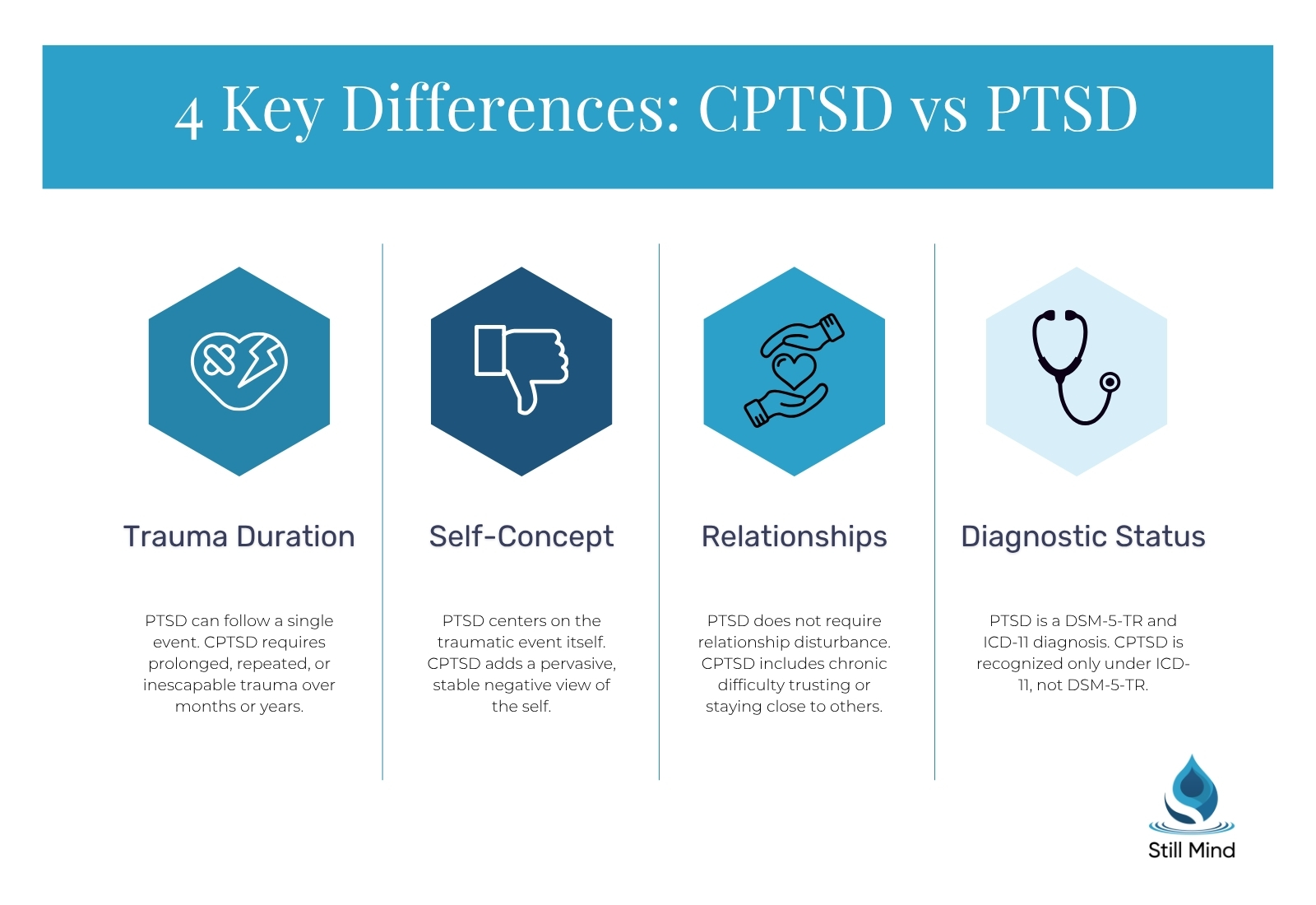
Complex PTSD (CPTSD) differs from PTSD because CPTSD adds three additional symptom clusters, called disturbances in self-organization, on top of the core PTSD symptoms. PTSD develops after a single or short-term traumatic event, while CPTSD stems from prolonged, repeated, or inescapable trauma.
Both conditions share intrusive memories, avoidance, and hypervigilance. CPTSD layers on affect dysregulation, a persistently negative self-concept, and lasting difficulty in relationships.
The distinction matters because it changes what treatment looks like. A person carrying childhood trauma often needs a different starting point than someone recovering from a single accident.
Key Takeaways
- ICD-11 classifies Complex PTSD as a distinct condition, while DSM-5-TR captures overlapping features through the dissociative subtype of PTSD.
- PTSD affects roughly 6.8% of U.S. adults over their lifetime, according to the National Comorbidity Survey Replication. Complex PTSD reaches a pooled global prevalence near 6.2%, but climbs to 40 to 50% among people already in mental health treatment settings.
- Adverse childhood experiences drive a large share of CPTSD cases. CDC surveillance data published in 2023 found 63.9% of U.S. adults report at least one adverse childhood experience, with 17.3% reporting four or more.
- The International Trauma Questionnaire is the only scale built specifically to separate PTSD from CPTSD. It measures both the three PTSD symptom clusters and the three disturbances in self-organization clusters.
- CPTSD recovery generally follows a phase-based model that stabilizes emotion regulation before trauma memories are processed directly.
What Is PTSD and What Is CPTSD?
PTSD and CPTSD are both trauma-related conditions, but they sit at different points on the same clinical spectrum.
PTSD: A Single-Event Trauma Response
Posttraumatic stress disorder (PTSD) is a DSM-5-TR trauma- and stressor-related disorder that emerges after a person experiences actual or threatened death, serious injury, or sexual violence, and its symptoms fall into four distinct clusters.
Core PTSD symptom clusters include:
- Intrusion symptoms trigger involuntary memories, nightmares, and flashbacks tied directly to the traumatic event.
- Avoidance behaviors drive a person away from reminders of the trauma, including specific people, places, or conversations.
- Negative alterations in cognition and mood produce persistent self-blame, detachment, and loss of interest in daily activities.
- Alterations in arousal and reactivity generate hypervigilance, an exaggerated startle response, and irritability.
Complex PTSD: A Response to Prolonged, Repeated Trauma
Complex PTSD (CPTSD) is an ICD-11 diagnosis that develops after prolonged, repeated, or inescapable trauma, typically trauma with an interpersonal origin such as childhood abuse or domestic violence; CPTSD is not a formal DSM-5-TR diagnosis in the United States, and DSM-5-TR instead addresses much of this presentation through the dissociative subtype of PTSD.
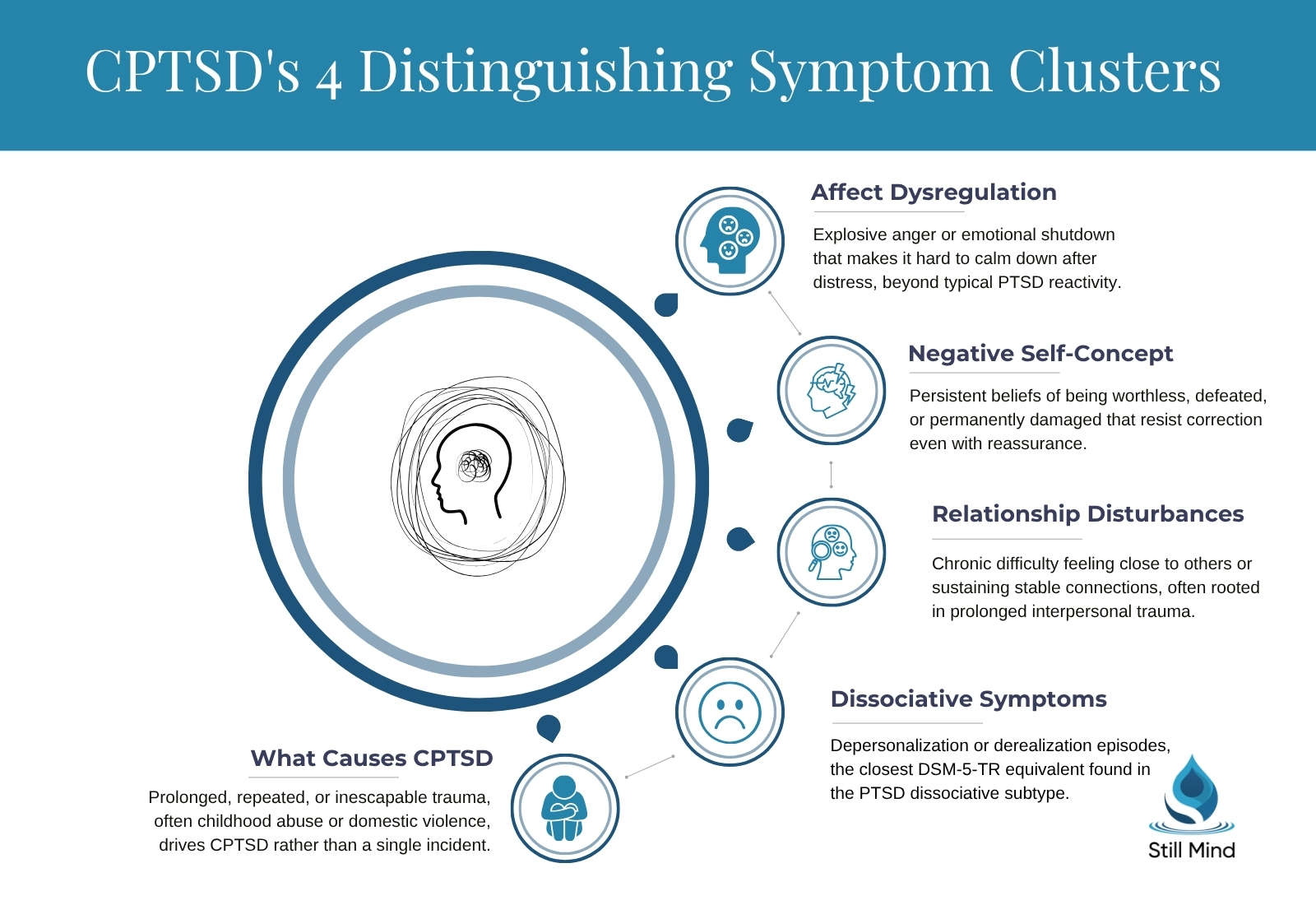
CPTSD builds on posttraumatic stress disorder by adding disturbances in self-organization, which include:
- Affect dysregulation produces explosive anger, emotional shutdown, or persistent difficulty calming down after distress.
- Negative self-concept generates lasting beliefs of being worthless, defeated, or permanently damaged.
- Disturbances in relationships create chronic difficulty feeling close to others or sustaining stable connections over time.
What Causes CPTSD and PTSD in the Brain and Body
PTSD and CPTSD both originate in disrupted fear processing, but CPTSD adds developmental and interpersonal trauma pathways that reshape identity and relationships.
Neurobiological Causes
Trauma changes brain structure and function in measurable ways:
- The amygdala shows heightened reactivity, producing an exaggerated fear response to both trauma reminders and neutral cues.
- The hippocampus often shows reduced volume, impairing the brain’s ability to place traumatic memories into proper time and context.
- The medial prefrontal cortex becomes underactive, weakening its normal role of suppressing amygdala-driven fear signals.
- The HPA axis, the body’s central stress-response system, produces dysregulated cortisol output that sustains a state of chronic alarm.
Genetic and Hereditary Factors
Family history and heritability shape trauma vulnerability:
- Twin studies attribute a meaningful share of PTSD risk to genetic factors, alongside the degree of environmental trauma exposure.
- A family history of anxiety disorders or mood disorders increases susceptibility to both PTSD and CPTSD following trauma exposure.
Developmental and Environmental Causes
Childhood and relational trauma directly precipitate CPTSD:
- Adverse childhood experiences (ACEs), including abuse, neglect, and household dysfunction, drive a large share of complex trauma presentations.
- Attachment disruption during childhood undermines a child’s later ability to regulate emotion and trust others in adulthood.
- Childhood emotional neglect and an invalidating environment, one that consistently dismisses a child’s emotional experience, produce the negative self-concept central to CPTSD.
- Psychiatrist Judith Herman’s 1992 framework in Trauma and Recovery first distinguished complex trauma from single-incident PTSD, establishing prolonged and inescapable trauma as its defining feature.
Comorbid and Secondary Causes
Co-occurring conditions frequently accompany CPTSD and PTSD:
- Major depressive disorder commonly co-occurs with CPTSD because chronic trauma exposure depletes the same neurochemical systems that regulate mood.
- Substance use disorder frequently develops alongside CPTSD through the self-medication hypothesis, where a person uses substances to numb hyperarousal and intrusive memories.
- Borderline personality disorder shares affect dysregulation with CPTSD, though the two conditions differ in etiology and self-concept stability, covered in detail below.
Substance-Related Pathways
Substance use disorders connect to trauma through specific mechanisms:
- The self-medication hypothesis explains why alcohol use disorder and CPTSD frequently coexist, since alcohol temporarily suppresses hyperarousal symptoms.
- Shared neurobiological vulnerability, including HPA axis dysregulation, raises risk for both substance use disorder and CPTSD after trauma exposure.
How Trauma Timing and Duration Shape PTSD vs CPTSD
PTSD and CPTSD diverge primarily along the timeline and duration of the trauma that causes them, not simply the intensity of a single event.
Diagnostic Timing Criteria
DSM-5-TR and ICD-11 set specific timing requirements:
- PTSD symptoms must persist for more than one month following trauma exposure to meet the DSM-5-TR threshold.
- A delayed-expression specifier applies when full PTSD criteria are not met until six months or more after the traumatic event.
- CPTSD under ICD-11 requires trauma that is prolonged, repeated, or inescapable, typically unfolding over months or years rather than a single incident.
Prevalence Across the Population
Current data show meaningful differences in how common each condition is:
- PTSD affects an estimated 6.8% of U.S. adults over their lifetime, a figure the National Institute of Mental Health continues to cite from the National Comorbidity Survey Replication.
- CPTSD reaches a pooled global prevalence near 6.2%, but climbs to 40 to 50% among people already receiving mental health treatment, according to a 2022 review in The Lancet.
- Adverse childhood experiences appear in 63.9% of U.S. adults, with 17.3% reporting four or more, according to 2023 CDC surveillance data.
Symptom Severity, Assessment, and Diagnosis
PTSD and CPTSD share a core set of symptoms, but severity and functional impact typically run deeper in CPTSD due to the added self-organization disturbances.
Common Symptoms Shared by Both Conditions
Both conditions produce this shared symptom foundation:
- Intrusive memories and flashbacks recreate the traumatic experience without warning, often triggered by sensory reminders.
- Hypervigilance keeps the nervous system in a constant state of threat detection, disrupting sleep and concentration.
- Avoidance of trauma reminders narrows daily functioning, limiting relationships, work performance, and routine activities.
Symptoms More Severe or Unique to CPTSD
CPTSD adds symptoms that extend beyond the standard PTSD presentation:
- Persistent shame and self-blame create a stable, deeply negative self-concept that resists correction even with reassurance.
- Emotional numbing alternates with explosive anger, reflecting the affect dysregulation cluster unique to CPTSD.
- Emotional dysregulation combined with chronic relationship instability distinguishes CPTSD from single-incident PTSD.
- Depersonalization or derealization episodes appear in the dissociative subtype of PTSD, the closest DSM-5-TR equivalent to CPTSD’s dissociative features.
Long-Term Effects if Left Untreated
Untreated trauma compounds over time:
- Chronic HPA axis dysregulation raises long-term risk for cardiovascular disease and metabolic dysfunction.
- Persistent negative self-concept in CPTSD often deepens into co-occurring major depressive disorder without intervention.
- Sustained relationship avoidance can produce long-term social isolation and reduced quality of life.
How Clinicians Diagnose PTSD and CPTSD
Clinicians rely on validated tools to distinguish the two conditions:
- The International Trauma Questionnaire (ITQ) is the primary scale built to ICD-11 criteria, measuring both PTSD symptoms and the three disturbances in self-organization clusters to separate CPTSD from PTSD.
- The PTSD Checklist for DSM-5 (PCL-5) is a 20-item self-report tool measuring DSM-5-TR PTSD symptom severity, though it does not directly capture the disturbances in self-organization clusters.
- The Clinician-Administered PTSD Scale (CAPS-5), described by the VA National Center for PTSD, provides a structured diagnostic interview considered the gold standard for confirming a PTSD diagnosis.
CPTSD vs Borderline Personality Disorder: How to Tell the Difference
CPTSD and borderline personality disorder share affect dysregulation and relationship difficulty, but they differ in underlying cause and self-concept stability.
| Feature | CPTSD | Borderline Personality Disorder |
|---|---|---|
| Underlying cause | Prolonged, repeated, or inescapable trauma | Genetic vulnerability combined with an invalidating environment |
| Self-concept | Stable, uniformly negative self-view | Unstable, shifting sense of identity |
| Relationship pattern | Avoidance of closeness and difficulty trusting others | Fear of abandonment paired with intense, unstable relationships |
| Diagnostic status | Formal ICD-11 diagnosis | Formal DSM-5-TR personality disorder |
Where the Two Conditions Overlap and Diverge
Three distinctions help separate CPTSD from borderline personality disorder:
- CPTSD traces directly to prolonged trauma exposure, while BPD’s cause involves genetic vulnerability combined with an invalidating environment, per psychologist Marsha Linehan’s biosocial model.
- CPTSD produces a stable, uniformly negative self-concept, whereas BPD produces an unstable, shifting sense of identity.
- CPTSD centers on relationship avoidance, while BPD often centers on fear of abandonment paired with unstable, high-intensity relationships.
Treatment for PTSD vs Complex PTSD
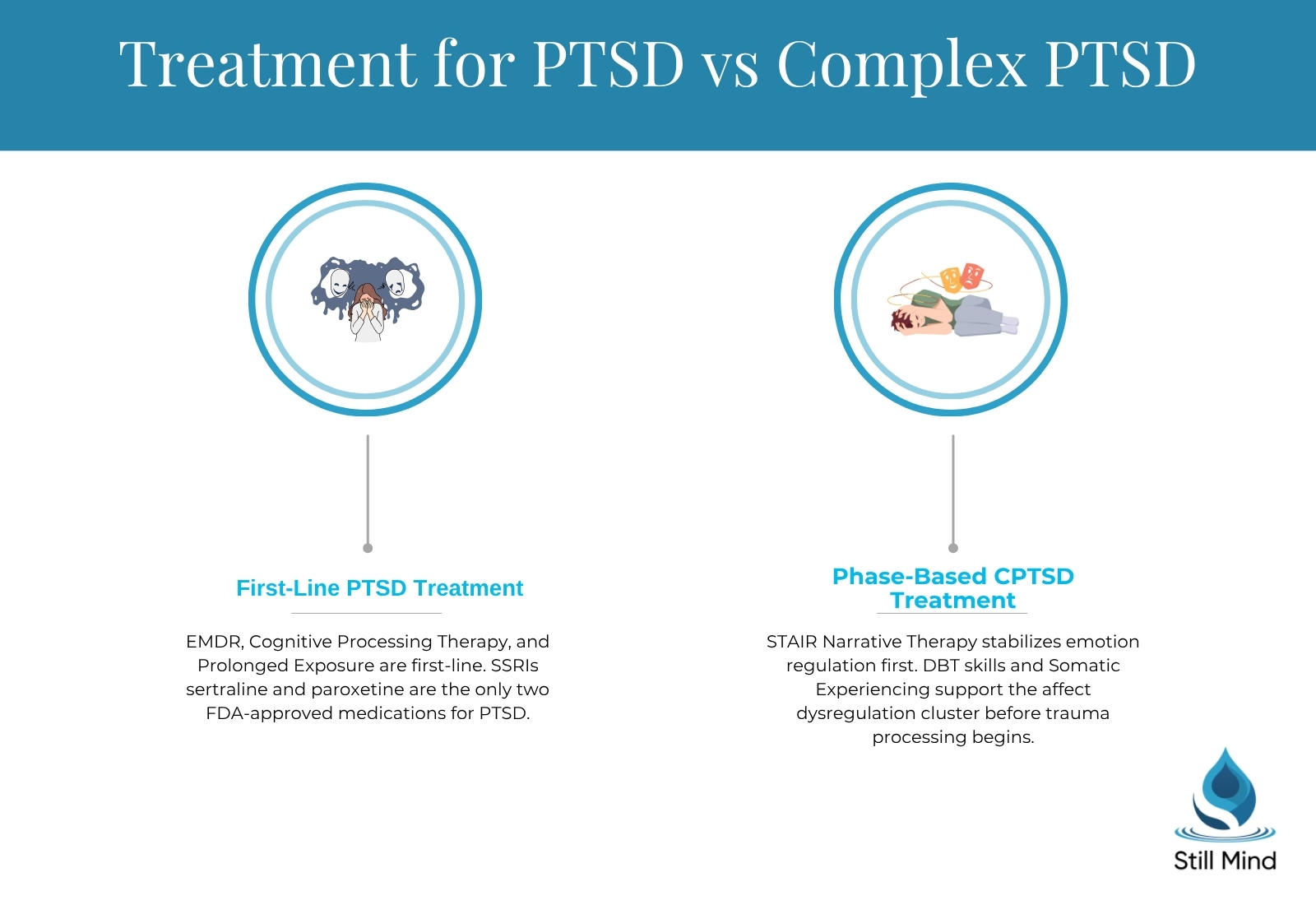
Treatment for PTSD and CPTSD both start with trauma-focused therapy, but CPTSD generally requires a longer, phase-based approach before trauma memories are processed directly.
First-Line Trauma-Focused Therapies
These therapies are considered first-line for trauma treatment:
- Cognitive Processing Therapy (CPT), developed by psychologist Patricia Resick, helps reframe distorted trauma-related beliefs about safety, trust, and self-worth.
- Eye Movement Desensitization and Reprocessing (EMDR) uses bilateral stimulation to help the brain reprocess traumatic memories without full verbal recounting.
- Prolonged Exposure (PE) therapy gradually reduces avoidance through structured, repeated engagement with trauma memories and reminders.
- Skills Training in Affective and Interpersonal Regulation (STAIR) Narrative Therapy, developed by psychologist Marylène Cloitre, targets the affect regulation and relationship skills CPTSD disrupts before trauma narrative work begins.
First-Line Pharmacological Treatments
Medication targets the neurochemical disruption trauma produces:
- SSRIs such as sertraline and paroxetine are the only two medications carrying FDA approval specifically for PTSD.
- SNRIs such as venlafaxine are used off-label and appear in VA and Department of Defense treatment guidelines.
- The alpha-1 antagonist prazosin is prescribed off-label to reduce trauma-related nightmares and improve sleep quality.
Second-Line and Adjunct Treatments
When first-line options fall short, clinicians add:
- Somatic Experiencing, developed by Peter Levine, addresses trauma stored in the body’s nervous system through physical awareness techniques.
- Dialectical behavior therapy skills groups support the emotion regulation difficulties central to CPTSD’s affect dysregulation cluster.
- Group therapy provides structured interpersonal practice, directly countering CPTSD’s relationship avoidance pattern.
Emerging and Investigational Treatments
Newer approaches are gaining clinical attention:
- MDMA-assisted therapy has moved through Phase 3 clinical trials for PTSD, though it remains investigational and is not yet FDA-approved for routine use.
- Ketamine and esketamine, FDA-approved for treatment-resistant depression, are under investigation for rapid reduction of trauma-related symptoms.
- Virtual reality exposure therapy is in active clinical use at some centers as an adjunct to traditional prolonged exposure protocols.
Treatment for Trauma at Still Mind Florida
Still Mind Florida treats PTSD and CPTSD through a combination of evidence-based therapy and structured emotional-regulation programming.
Dialectical Behavior Therapy for Emotional Regulation
Still Mind Florida’s DBT program addresses CPTSD’s affect dysregulation cluster directly:
- Specific DBT skills-group structure, session frequency, and facilitator credentials at Still Mind Florida require verification before publishing.
- DBT skills training targets distress tolerance and emotion regulation, both central to stabilizing CPTSD before deeper trauma work begins.
Dual Diagnosis Care for Co-Occurring Conditions
Dual diagnosis programming addresses trauma alongside substance use or mood disorders:
- [CLIENT INPUT NEEDED] Specific dual-diagnosis protocol details and level-of-care criteria at Still Mind Florida require verification before publishing.
- Integrated treatment addresses the self-medication pathway that often connects CPTSD to co-occurring substance use disorder.
Holistic Therapy to Support Nervous System Regulation
Holistic and skills-based therapy complements trauma-focused treatment:
- Specific holistic modalities offered, such as somatic work, mindfulness, or body-based practices, at Still Mind Florida require verification before publishing.
- Holistic approaches support the nervous system regulation that trauma-focused talk therapy alone does not always fully address.
“Trauma from a single event and trauma built up over years of chronic harm can look similar on the surface, but they call for different treatment sequencing. With clients carrying complex trauma.”
– Dr. Gladys Martinez, Clinical Director at Still Mind Florida
Frequently Asked Questions
What does complex PTSD feel like compared to PTSD?
Complex PTSD feels like PTSD’s flashbacks and hypervigilance plus a persistent sense of being fundamentally flawed. People with CPTSD often describe chronic shame, emotional numbness alternating with anger, and difficulty trusting anyone, even in safe relationships.
Does CPTSD ever go away?
CPTSD does not resolve on its own without treatment, but symptoms can improve substantially with phase-based trauma therapy. Recovery timelines vary, though many people see meaningful stabilization within several months of consistent treatment.
How is CPTSD treated differently from PTSD?
CPTSD treatment typically starts with emotion-regulation skills training, such as STAIR or DBT, before moving into trauma-processing therapies like EMDR or CPT. PTSD treatment often moves directly into trauma processing since self-organization symptoms are not the primary concern.
Is CPTSD the same as borderline personality disorder?
No. CPTSD and BPD share affect dysregulation and relationship difficulty, but CPTSD traces to prolonged trauma with a stable negative self-concept, while BPD involves a genetically influenced, shifting sense of identity.
Can children develop CPTSD?
Yes. Children exposed to prolonged abuse, neglect, or household dysfunction can develop CPTSD, often alongside attachment disruption. Adverse childhood experiences are a primary pathway, and most U.S. adults report experiencing at least one.
What causes CPTSD versus PTSD?
PTSD typically follows a single or short-term traumatic event, while CPTSD follows prolonged, repeated, or inescapable trauma, often interpersonal in nature. Both involve amygdala hyperactivity and HPA axis dysregulation, but CPTSD adds developmental attachment disruption.
Can you have both PTSD and CPTSD?
A person receives one diagnosis or the other under ICD-11, since CPTSD criteria include all PTSD symptoms plus disturbances in self-organization. Clinically, CPTSD is best understood as PTSD with additional, more pervasive symptom clusters layered on top.
What are emotional flashbacks?
Emotional flashbacks are sudden waves of intense feeling, such as shame, fear, or grief, tied to past trauma without a clear visual memory attached. They are common in CPTSD and can feel confusing since there is no obvious trigger.
References
- Herman, J. L. (1992). Trauma and Recovery. Basic Books.
- Cloitre, M., Shevlin, M., Brewin, C. R., Bisson, J. I., Roberts, N. P., Maercker, A., Karatzias, T., & Hyland, P. (2018). The International Trauma Questionnaire: development of a self-report measure of ICD-11 PTSD and complex PTSD. Acta Psychiatrica Scandinavica, 138(6), 536-546.
- Maercker, A., Cloitre, M., Bachem, R., et al. (2022). Complex post-traumatic stress disorder. The Lancet, 400(10345), 60-72.
- Kessler, R. C., Berglund, P., Demler, O., Jin, R., Merikangas, K. R., & Walters, E. E. (2005). Lifetime prevalence and age-of-onset distributions of DSM-IV disorders in the National Comorbidity Survey Replication. Archives of General Psychiatry, 62(6), 593-602.
- Swedo, E. A., et al. (2023). Prevalence of adverse childhood experiences among U.S. adults, Behavioral Risk Factor Surveillance System, 2011-2020. MMWR Morbidity and Mortality Weekly Report, 72(26), 707-715.
- National Institute of Mental Health. (2024). Post-Traumatic Stress Disorder.
- U.S. Department of Veterans Affairs, National Center for PTSD. (2024). PTSD and DSM-5.
- American Psychiatric Association. (2022). Diagnostic and Statistical Manual of Mental Disorders (5th ed., text rev.).
- World Health Organization. (2022). International Classification of Diseases (11th rev.).