


Antisocial personality disorder (ASPD) is a Cluster B personality disorder defined by a persistent pattern of disregarding and violating the rights of others, lack of remorse, and manipulative or deceitful behavior. It is formally diagnosed using the criteria in the DSM-5-TR and cannot be diagnosed in individuals under 18 years of age.
ASPD is often misunderstood as simply preferring solitude. It is, in fact, a serious mental health condition with real consequences for the individual and the people around them. Treatment is available, though it requires specialist care and, ideally, genuine motivation to change.
Highlights
- ASPD affects an estimated 0.2 to 3.3 percent of the general population and is approximately three times more common in men than in women (American Psychiatric Association, 2013).
- About 40 percent of children diagnosed with conduct disorder will go on to meet the criteria for ASPD as adults, making early identification of conduct disorder clinically important (Widiger & Gore, 2016).
- ASPD is one of the most difficult personality disorders to treat. Most individuals do not seek help voluntarily and are often referred by the court system rather than coming forward on their own.
- Symptoms of ASPD can begin to lessen after age 40, particularly the most overtly aggressive and impulsive behaviors, though the core personality pattern typically remains.
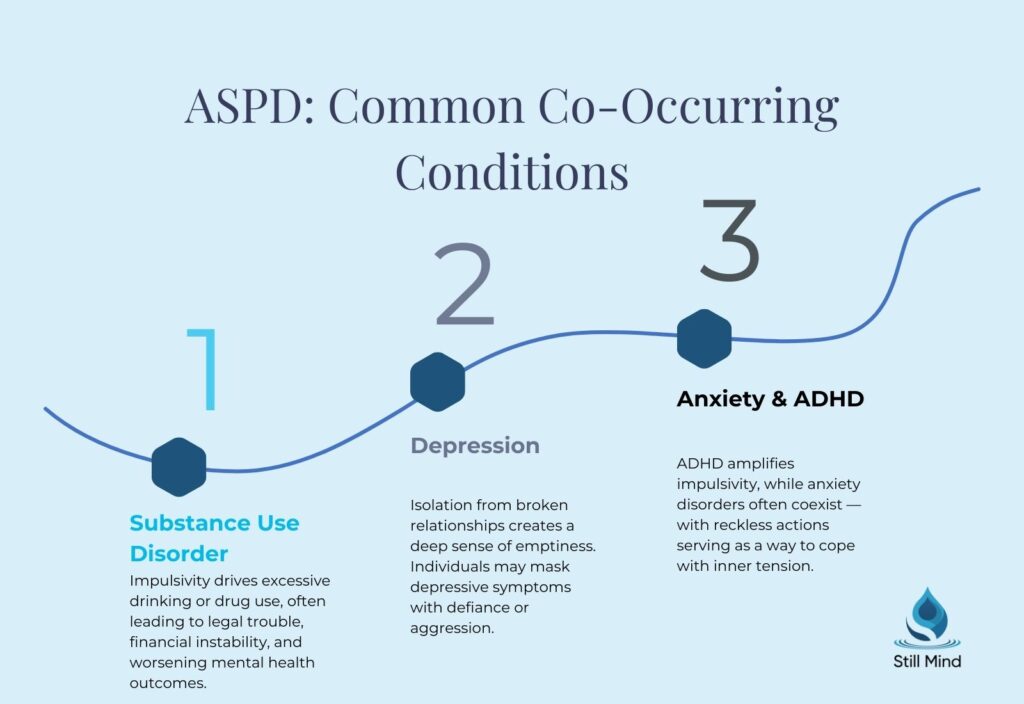
- High rates of co-occurring substance use disorder are found in people with ASPD, which complicates both diagnosis and treatment planning.
What Is Antisocial Personality Disorder?
Antisocial personality disorder is classified as a Cluster B personality disorder in the DSM-5-TR alongside borderline personality disorder, narcissistic personality disorder, and histrionic personality disorder. Cluster B disorders share a pattern of dramatic, impulsive, and emotionally dysregulated behavior, though each presents differently.
Despite what the name might suggest, ASPD is not about being introverted or preferring to be alone. It describes an enduring pattern of exploiting, deceiving, and harming others, combined with an absence of guilt or remorse about doing so. The disorder reflects a fundamental deficit in empathy and social conscience, not simply shyness or social discomfort.
ASPD is sometimes used interchangeably with the terms “sociopath” and “psychopath” in casual conversation. Clinically, neither sociopathy nor psychopathy is a formal DSM diagnosis. Psychopathy is now considered a specifier or variant of ASPD, associated with more calculated, predatory behavior and stronger genetic roots, while the broader ASPD diagnosis covers a wider range of presentations.
DSM-5 Diagnostic Criteria for ASPD
To receive a diagnosis of antisocial personality disorder, an individual must be at least 18 years old and show evidence of conduct disorder before age 15. They must also meet at least three of the following seven behavioral criteria, occurring persistently and not explained by another mental disorder:
- Repeated law-breaking: Consistently performing acts that are grounds for arrest, whether or not they actually result in legal consequences.
- Deceitfulness: Repeated lying, using false identities or aliases, or manipulating others for personal gain or entertainment.
- Impulsivity: Failure to plan ahead, making decisions without regard for consequences to self or others.
- Irritability and aggression: Repeated physical fights or assaults, often provoked by minor frustrations.
- Reckless disregard for safety: Consistently putting oneself or others at risk without apparent concern for the outcome.
- Consistent irresponsibility: Repeatedly failing to hold down employment, meet financial obligations, or honor other personal responsibilities.
- Lack of remorse: Indifference to the harm caused to others, or rationalizing that behavior with explanations that minimize or shift blame.
The diagnosis requires that these patterns are pervasive across multiple contexts, not limited to one relationship or setting, and that they represent a significant deviation from cultural norms.
Signs and Symptoms of ASPD
Beyond the formal diagnostic criteria, ASPD manifests in identifiable behavioral and interpersonal patterns that become apparent over time. These signs are often more visible to others than to the individual with the disorder, who may see their behavior as justified or simply pragmatic.
- Superficial charm: An initial presentation that can seem confident, engaging, or charismatic. This often fades once the individual’s goals are met or the relationship no longer serves them.
- Exploitation of others: Viewing relationships primarily as tools for personal gain, whether financial, social, or physical, without genuine regard for the other person’s wellbeing.
- Persistent dishonesty: Habitual lying not just for practical advantage but sometimes simply as a default mode of interaction. This includes pathological lying patterns that persist across relationships and settings.
- Blaming others: Consistent failure to accept personal responsibility, combined with rationalizations that reframe harmful behavior as the fault of others.
- Inability to sustain relationships: Difficulty maintaining genuine, mutual relationships due to an inability to prioritize another person’s feelings or needs over their own.
- Substance misuse: High rates of alcohol and drug use disorders co-occur with ASPD, often amplifying impulsive and aggressive behavior.
- Legal problems: Repeated encounters with law enforcement or the legal system as a consequence of rule-breaking behavior.
ASPD vs. Sociopath vs. Psychopath: What Is the Difference?
These three terms are frequently used interchangeably, but they have distinct meanings in clinical and research contexts.
| Term | Clinical Status | Key Characteristics |
|---|---|---|
| ASPD | Formal DSM-5 diagnosis | Broad behavioral pattern: disregard for others, deceit, impulsivity, lack of remorse. Diagnosed at 18+. |
| Sociopathy | Not a clinical diagnosis | Informal term often used to describe ASPD presentations that are more environmentally driven, impulsive, and emotionally reactive. |
| Psychopathy | Not a standalone diagnosis; specifier within ASPD | More calculated, predatory, emotionally detached. Stronger genetic component. Associated with higher risk of planned violence. |
Robert Hare, developer of the Psychopathy Checklist (PCL-R), has noted that while most psychopaths meet the criteria for ASPD, most people diagnosed with ASPD are not psychopaths. The distinction matters clinically because risk profiles, treatment responses, and prognoses differ significantly between the broader ASPD population and those with psychopathic features.
What Causes Antisocial Personality Disorder?
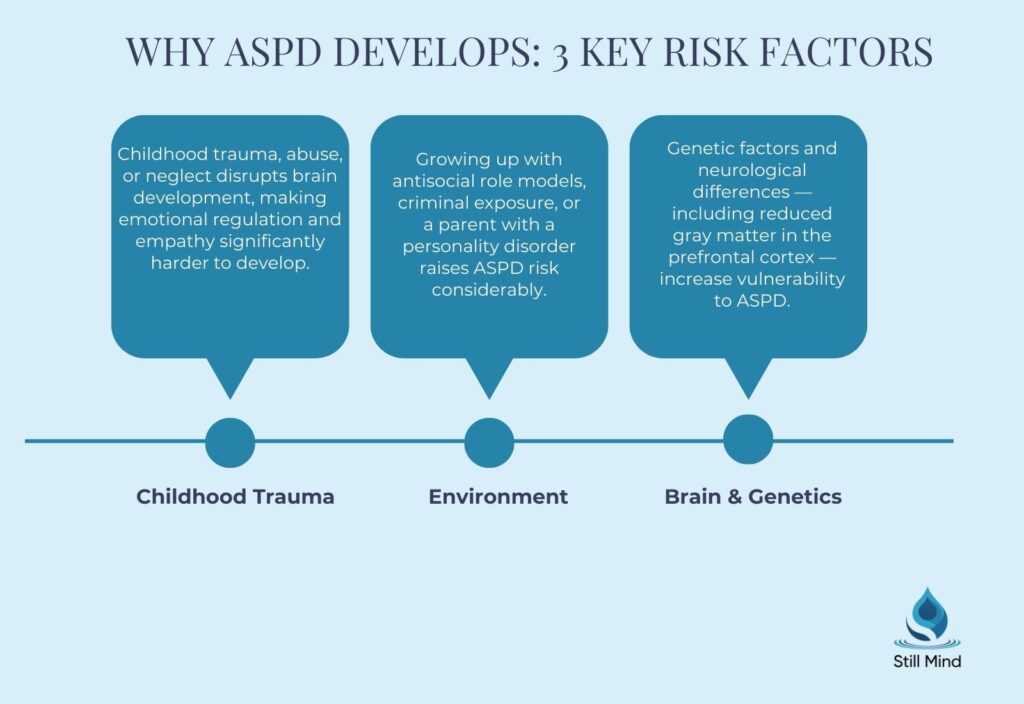
ASPD does not have a single identifiable cause. Current research points to a combination of genetic vulnerability and adverse environmental experiences, particularly in early childhood.
Genetic factors
ASPD has a meaningful hereditary component. Having a biological parent or close family member with ASPD or related conditions significantly increases the likelihood of developing it. Twin studies suggest genetic factors account for roughly 40 to 70 percent of the variance in antisocial behavior.
Childhood conduct disorder
ASPD in adults is almost always preceded by conduct disorder in childhood or adolescence. Conduct disorder involves a persistent pattern of aggression, rule violation, destruction of property, and serious violations of social norms. Approximately 40 percent of children with conduct disorder will develop ASPD as adults. Two behaviors in childhood considered particularly strong warning signs are setting fires and cruelty to animals.
Environmental and trauma factors
Childhood abuse, neglect, and exposure to violence are strongly associated with ASPD. Childhood emotional neglect in particular can disrupt the development of empathy and emotional regulation, laying the groundwork for antisocial patterns. Growing up in a household where a parent modeled antisocial behavior compounds both genetic and environmental risk.
Neurological differences
Neuroimaging studies have found structural and functional differences in the brains of individuals with ASPD, particularly in areas governing emotional processing, impulse control, and decision-making such as the prefrontal cortex and amygdala. These differences are associated with reduced fear responses and diminished capacity for empathic processing.
How ASPD Affects Daily Life and Relationships
ASPD has wide-ranging consequences for virtually every domain of functioning. Most of these consequences are most visible to the people around the individual rather than to the individual themselves, who typically does not experience significant distress over their own behavior.
- Relationships: Intimate relationships are frequently unstable, exploitative, or short-lived. Partners may experience the individual as controlling, dishonest, or indifferent to their needs. The individual may form apparent attachments but these tend to be driven by personal utility rather than genuine connection.
- Employment: Difficulty following rules, respecting authority, and maintaining consistent effort leads to chronic job instability. Frequent firings, walkouts, and gaps in employment are common.
- Legal consequences: Criminal behavior, from fraud and theft to assault, is disproportionately represented in the ASPD population. ASPD is notably prevalent in prison populations.
- Financial instability: Impulsivity, irresponsibility, and disregard for consequences contribute to chronic financial problems, debt, and exploitation of others for resources.
- Parenting: Parents with ASPD have higher rates of neglectful or abusive parenting, which perpetuates the cycle of risk for the next generation.
Diagnosis: How Is ASPD Identified?
ASPD is diagnosed through a comprehensive psychological evaluation conducted by a qualified mental health professional, typically a psychiatrist or licensed psychologist. There is no blood test, brain scan, or self-report questionnaire that can diagnose ASPD on its own.
The evaluator will review the individual’s history of behavior across multiple settings and time periods, assess for the presence of conduct disorder prior to age 15, and rule out other conditions that might better explain the presentation. These include narcissistic personality disorder, bipolar disorder, substance-induced behavior changes, and Cluster A personality disorders.
In practice, most individuals with ASPD do not seek evaluation voluntarily. The assessment is frequently initiated by a court order, a concerned family member, or as part of a broader mental health evaluation during incarceration or legal proceedings.
ASPD Treatment Options
Antisocial personality disorder is widely regarded as one of the most challenging personality disorders to treat. The core obstacles are that individuals rarely see their behavior as a problem, have low motivation to change, and are often only in treatment because they are required to be. That said, treatment can reduce the most harmful behaviors, particularly when it targets co-occurring conditions like substance use and depression.
- Cognitive Behavioral Therapy (CBT): CBT focuses on identifying and changing distorted thinking patterns that drive antisocial behavior. It helps individuals recognize the consequences of their actions, develop problem-solving skills, and manage impulsivity. It is the most commonly used evidence-based approach for ASPD.
- Mentalization-Based Therapy (MBT): MBT focuses on building the capacity to understand one’s own mental states and those of others, an area of marked deficit in ASPD. Early research shows promise, particularly for those with mixed ASPD and borderline features.
- Schema Therapy: This approach addresses deeply ingrained maladaptive patterns formed in early childhood. It can be effective for individuals willing to engage in longer-term exploratory work.
- Medication: No medication is FDA-approved specifically for ASPD. However, medications may be used to manage specific symptoms such as impulsivity, aggression, depression, or co-occurring anxiety. Mood stabilizers and antidepressants are sometimes used in this context.
- Treatment for co-occurring conditions: Addressing substance use disorder alongside ASPD is essential. Untreated addiction substantially worsens antisocial behavior and reduces engagement with any other form of treatment.
- Group therapy and therapeutic communities: For some individuals, peer-based treatment environments have shown promise by creating structured social accountability and modeling prosocial behavior.
Outcomes are more favorable when there is genuine, internally motivated engagement with treatment, when co-occurring substance use is addressed simultaneously, and when the individual has stronger social support. Younger individuals and those with less severe presentations tend to show better treatment response.
Living With Someone Who Has ASPD
If a family member, partner, or colleague has ASPD, the impact on those close to them can be significant. Manipulation, dishonesty, and emotional unavailability are common experiences for people in relationships with someone with ASPD.
Protecting your own mental health is the primary concern. This means setting and maintaining firm boundaries, not accepting blame for the other person’s behavior, and seeking your own therapeutic support. Trauma bonding can develop in close relationships with individuals with ASPD, making it difficult to leave or disengage even when the relationship is harmful.
You cannot force someone with ASPD to change. Treatment requires the individual’s own participation. What you can control is your response to their behavior and whether you continue to allow it to affect you.
Frequently Asked Questions About ASPD
What is having antisocial personality disorder like?
Most individuals with ASPD do not experience their own behavior as distressing. They may feel boredom, frustration, or irritability when their goals are blocked, but they typically do not feel guilt or empathy in the way most people do. From the inside, the disorder is often experienced as simply operating with different values, not as a mental illness. Distress, when present, tends to come from external consequences like legal problems or relationship losses rather than internal suffering.
What are the traits of antisocial personality disorder?
The core traits of ASPD include persistent disregard for the rights of others, deceitfulness, impulsivity, irritability and aggression, reckless disregard for safety, irresponsibility across work and financial obligations, and lack of remorse. These traits must be present since at least adolescence, occur across multiple settings, and cause significant harm to others or social functioning to meet the diagnostic threshold.
Can people with ASPD love?
People with ASPD can form attachments and may express what functions as love, but it tends to operate differently than in neurotypical relationships. Emotional depth and reciprocity are often limited. Relationships are frequently valued instrumentally, for what they provide, rather than for genuine mutual connection. Some individuals with ASPD do maintain long-term relationships, though partners often report the relationship is one-sided or emotionally unfulfilling.
Can people with ASPD live normally?
Many individuals with ASPD hold jobs, maintain households, and sustain relationships, particularly when antisocial traits are in the mild to moderate range or when they have found environments where their traits are less disruptive. However, chronic legal problems, financial instability, and relationship failures are common. Outcomes generally improve with age, as the most impulsive and aggressive features of ASPD tend to decrease after age 40 in many individuals.
Is ASPD treatable?
ASPD is difficult but not impossible to treat. CBT, mentalization-based therapy, and schema therapy can produce meaningful reductions in harmful behavior, particularly impulsivity and aggression. Treatment for co-occurring substance use is especially important. The main barrier is motivation: most individuals with ASPD do not seek treatment voluntarily and may disengage quickly when external pressure is removed. Long-term outcomes are better when treatment is sustained and internally motivated.
Can someone with ASPD feel guilt?
The absence of remorse is a defining feature of ASPD, but it exists on a spectrum. Some individuals with milder presentations can experience functional versions of guilt, particularly in relation to people they are attached to. Those with psychopathic features within ASPD have a more profound and stable deficit in guilt and empathy. The capacity for remorse is one of the key differentiators between ASPD subtypes and is relevant to treatment prognosis.
Bottom Line
Antisocial personality disorder is a serious, chronic condition that causes real harm to individuals and the people around them. It is not a lifestyle choice, a sign of strength, or an untreatable diagnosis. With the right intervention and genuine engagement, behavioral improvements are possible.
If you or someone in your life is struggling with ASPD or its effects, Still Mind Florida provides specialized mental health treatment tailored to complex personality presentations. Our clinical team has experience working with co-occurring conditions and can build a personalized treatment plan. Reach out through our admissions page to learn more about your options.
References
- American Psychiatric Association. (2013). Diagnostic and statistical manual of mental disorders (5th ed.). American Psychiatric Publishing.
- Widiger, T. A., & Gore, W. L. (2016). Personality disorders. In Encyclopedia of mental health (2nd ed.). Academic Press.
- Hare, R. D. (2003). Manual for the revised psychopathy checklist (2nd ed.). Multi-Health Systems.
- Glenn, A. L., & Raine, A. (2014). Psychopathy: An introduction to biological findings and their implications. New York University Press.
- Farrington, D. P. (2005). The importance of child and adolescent psychopathy. Journal of Abnormal Child Psychology, 33(4), 489-497.
- National Institute of Mental Health. (2023). Personality disorders. U.S. Department of Health and Human Services. https://www.nimh.nih.gov/health/topics/personality-disorders
- Salekin, R. T. (2002). Psychopathy and therapeutic pessimism: Clinical lore or clinical reality? Clinical Psychology Review, 22(1), 79-112.
- Bateman, A., & Fonagy, P. (2016). Mentalization-based treatment for personality disorders. Oxford University Press.
- Ogloff, J. R. P. (2006). Psychopathy/antisocial personality disorder conundrum. Australian and New Zealand Journal of Psychiatry, 40(6-7), 519-528.
- Raine, A. (2002). Annotation: The role of prefrontal deficits, low autonomic arousal, and early health factors in the development of antisocial and aggressive behavior in children. Journal of Child Psychology and Psychiatry, 43(4), 417-434.