



Smiling depression describes the experience of living with clinical depression while appearing perfectly fine to the outside world. The person shows up to work, maintains relationships, and even laughs at dinner while carrying persistent sadness, emptiness, and exhaustion that nobody around them can see.
It is not a formal diagnosis, but the suffering is entirely real. This article explains what smiling depression is, how it differs from typical depression, the warning signs to recognize, and why it carries a higher risk than many people realize.
Key Highlights
- Smiling depression is not an official DSM-5 diagnosis, but clinically aligns most closely with Major Depressive Disorder, carrying an “atypical features” specifier.
- Between 15% and 40% of people with depression meet criteria for atypical depression, the closest clinical equivalent to smiling depression, according to research published in PMC.
- People with atypical depression attempt suicide at a rate of 34.6% compared to 20.3% in non-atypical depression, highlighting the specific danger of hidden presentations.
- Approximately 31% of U.S. adults with moderate-to-severe depression symptoms carry no formal diagnosis, meaning millions are suffering without clinical support.
- Cognitive behavioral therapy (CBT), interpersonal therapy (IPT), and in some cases monoamine oxidase inhibitors (MAOIs) show the strongest evidence for treating smiling and atypical depression.
What Is Smiling Depression?
Smiling depression is a colloquial term for a form of depression where the outward presentation actively contradicts the internal emotional reality. The person looks fine. They may be social, motivated at work, physically active, and emotionally available to others. Behind that exterior, they are experiencing the core symptoms of clinical depression: persistent low mood, emptiness, loss of joy, fatigue, and hopelessness.
The gap between how a person looks and how they feel is what defines smiling depression. It is not about faking happiness. Many people with this presentation have genuinely internalized a belief that they must appear well, and have suppressed their distress so thoroughly that even they may struggle to recognize how unwell they actually are.
The closest formal clinical diagnosis is Major Depressive Disorder (MDD) with the “atypical features” specifier. The defining criterion for this specifier is mood reactivity, the ability for mood to genuinely lift in response to positive events. This is part of what makes the presentation misleading. Unlike melancholic depression where mood is fixed and unresponsive, people with atypical features can have real moments of genuine pleasure, which makes their depression invisible to others and sometimes to themselves.
Is Smiling Depression Real?
Yes. While “smiling depression” does not appear in the DSM-5 as a distinct diagnosis, the experience it describes is clinically real, well-documented, and associated with serious outcomes.
Research on masked depression and atypical depression has been published since the 1970s. A landmark review published in PMC confirmed that atypical depression represents 15% to 40% of all depressive presentations. Decades of clinical literature document patients who maintain functional exteriors while experiencing significant internal suffering. The phenomenon is real. The only question is terminology, and “smiling depression” has become the most accessible way the public recognizes and searches for it.
Smiling Depression vs. Regular Depression: Key Differences
The most important clinical distinction is that smiling depression involves maintained functioning and a hidden presentation, while typical depression tends to be more visibly apparent.
| Feature | Smiling / Atypical Depression | Typical (Melancholic) Depression |
|---|---|---|
| Outward appearance | Functional, often cheerful or “fine” | Visibly withdrawn, sad, or impaired |
| Mood responsiveness | Mood can lift with positive events (mood reactivity) | Mood fixed regardless of circumstances |
| Sleep patterns | Often hypersomnia (sleeping too much) | Often insomnia, early morning waking |
| Appetite changes | Often increased appetite or weight gain | Often decreased appetite or weight loss |
| Energy | Leaden heaviness in limbs; still appears active | Visible psychomotor retardation or agitation |
| Social behavior | Maintains relationships, highly sensitive to rejection | Often withdraws socially |
| Detection difficulty | Very difficult to identify; often missed by clinicians and loved ones | More visible and more likely to be identified |
| Suicide risk | Higher due to maintained energy and lack of detection | High, but more likely to have clinical support in place |
Smiling Depression vs. High-Functioning Depression
These two terms are often used interchangeably, but there is a meaningful distinction. High-functioning depression typically refers to Persistent Depressive Disorder (PDD, formerly dysthymia), a lower-intensity but chronic form of depression that can persist for years. People with high-functioning depression maintain their daily obligations despite ongoing low-level depressive symptoms.
Smiling depression, by contrast, more often describes a presentation of Major Depressive Disorder that is actively concealed. The severity may be episodic and intense rather than chronic and low-grade. The key distinction is the active masking component: in smiling depression, the person is presenting a version of themselves to the world that does not match their internal reality. In high-functioning depression, the person may be more open about struggling, but they are simply managing to keep going despite it.
Signs and Symptoms of Smiling Depression
Because the outward presentation is concealing the internal experience, smiling depression requires looking for two distinct sets of signs: the internal symptoms the person experiences privately, and the external patterns others may observe over time.
Internal Symptoms the Person Experiences
- Persistent inner emptiness or sadness: A background emotional flatness or heaviness that coexists with functional external behavior
- Loss of genuine pleasure: Activities and relationships produce less enjoyment than they once did, even when the person continues to participate in them
- Chronic exhaustion: A bone-deep fatigue that is not explained by activity levels and does not resolve with rest; sometimes described as physical heaviness in the limbs
- Intense rejection sensitivity: Extreme emotional reactions to perceived criticism or social rejection that seem disproportionate to the situation
- Persistent hopelessness about the future: A private sense that things will not improve, even when circumstances appear stable or positive
- Escapist thinking: Fantasies about disappearing, sleeping indefinitely, or being elsewhere that feel like relief rather than desire
- Difficulty with genuine intimacy: Maintaining closeness while concealing true emotional states creates an ongoing sense of disconnection and loneliness even in social settings
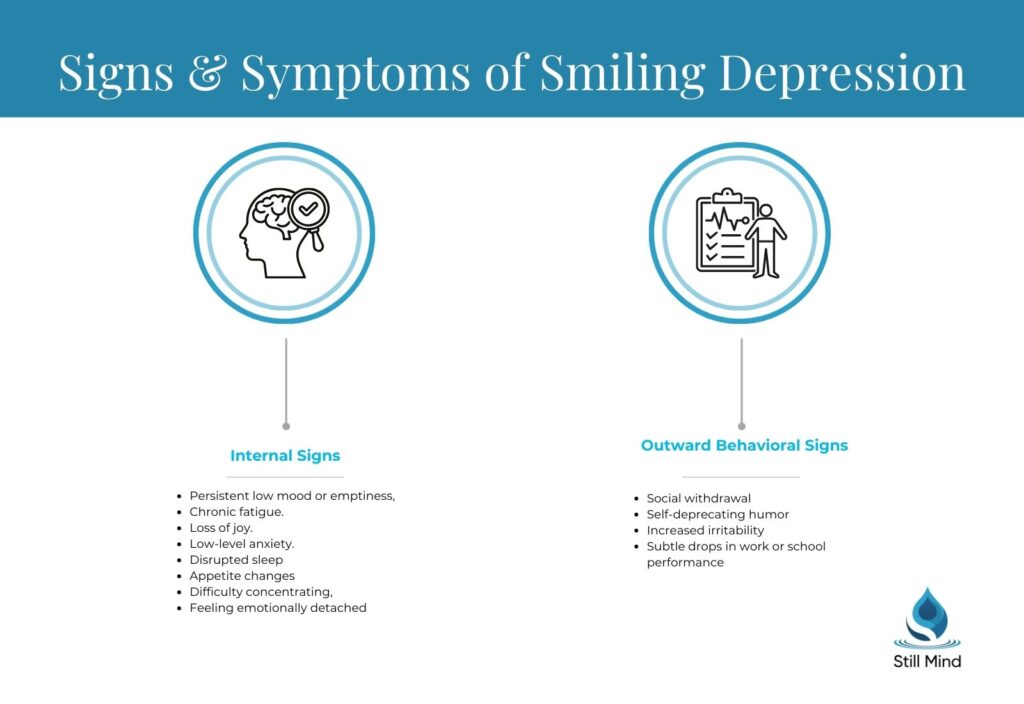
External Signs Others May Notice
- Humor used as deflection: Consistently steering conversations away from genuine emotional content with jokes or lightness
- Over-commitment to helping others: Focusing intensely on other people’s needs as a way of avoiding their own
- Subtle withdrawal from meaningful conversations: Present physically but less available for anything real or vulnerable
- Increased alcohol use or other numbing behaviors: Regular drinking, overworking, or excessive screen time as a way of managing internal pain
- Unexplained changes in sleep or eating: Sleeping significantly more than usual, or subtle shifts in appetite that are brushed off as stress
- Loss of enthusiasm for things they previously loved: Stopping hobbies, skipping events they once looked forward to, or participating with an obvious lack of engagement
Recognizing these signs requires sustained attention over time. A single occasion of any of these behaviors is not diagnostic. A pattern of increasing emotional unavailability, diminished genuine pleasure, and private exhaustion in someone who appears otherwise fine is the signal worth taking seriously.
What Causes Smiling Depression?
Smiling depression develops from the same biological and psychological roots as any form of depression, with an additional layer of social and personality factors that drive the concealment. Understanding both dimensions is essential for effective treatment.
Biological Factors
Depression involves disrupted neurotransmitter functioning across serotonin, norepinephrine, and dopamine systems, as well as dysregulation of the hypothalamic-pituitary-adrenal (HPA) axis that governs the stress response. Genetic vulnerability plays a meaningful role — family history of depression significantly raises risk. None of these biological processes is visible from the outside, which means a person can be experiencing significant neurobiological dysregulation while appearing entirely well.
Psychological Factors
Perfectionism is one of the most consistent personality factors associated with smiling depression. People who hold rigid standards for how they should present themselves, competent, positive, and unburdened, are far more likely to suppress depressive symptoms than to seek help. The inner narrative is often “I have no right to feel this way” or “others have it worse,” which simultaneously validates the depression and prevents them from addressing it.
Childhood experiences involving emotional invalidation, high achievement expectations, or inconsistent caregiving can establish these patterns early. Learning that emotional needs are burdensome and that being “fine” is safer than being honest sets a template that persists into adult life.
Social and Cultural Factors
Depression stigma remains a powerful driver of concealment. People in high-visibility roles, such as executives, caregivers, healthcare workers, and parents, face particular pressure to appear stable and competent. Admitting to depression in these contexts can feel like a professional or personal risk.
Cultural backgrounds that emphasize emotional restraint, collective responsibility over individual need, or the primacy of outward composure further reinforce the tendency to mask. Gender norms play a role as well: research consistently shows that atypical depression is approximately four times more common in women, while men are more likely to express depression through anger, risk-taking, and substance use rather than visible sadness, both patterns that reduce the likelihood of accurate identification and treatment.
Social media adds an additional dimension. The curated presentation of life online reinforces the idea that visible happiness is the acceptable norm, making it harder for people to acknowledge internal suffering when their own feed tells a different story. Concealing depression increasingly extends from physical social settings into digital ones.
Who Is Most at Risk?
While smiling depression can affect anyone, certain profiles carry an elevated risk. People who are high-achieving, socially active, or in caregiving roles are at disproportionate risk because the gap between their external roles and internal reality can be especially wide.
Risk factors include a personal or family history of depression or anxiety, a personality style characterized by perfectionism or strong people-pleasing tendencies, a cultural background that discourages emotional openness, previous trauma or adverse childhood experiences, and major life transitions such as job loss, relationship breakdown, or bereavement that trigger a depressive episode while external functioning is maintained out of necessity or habit.
Conditions that frequently co-occur with smiling depression include anxiety disorders and burnout, both of which can mask depressive symptoms beneath a veneer of productivity and drive.
Why Smiling Depression Is Particularly Dangerous
Smiling depression carries a specific clinical danger that often goes unrecognized: the person is suffering severely but is not receiving help because nobody, including sometimes the person themselves, recognizes that help is needed.
Research published in PMC on atypical depression found that 34.6% of patients with this presentation had attempted suicide, compared to 20.3% in nonatypical depression. The higher rate is not necessarily because the condition is more severe, but because the person is far less likely to have been identified, assessed, and supported before reaching a crisis point.
The treatment gap compounds this risk further. Approximately 31% of Americans with clinically significant depression carry no formal diagnosis, according to research published in PMC (2022). When depression is hidden and undiagnosed, it cannot be treated. When it cannot be treated, it escalates. People with smiling depression often continue to look fine right up to the moment of crisis, which is precisely what makes early identification and honest self-disclosure so important.
If you or someone you care about is experiencing thoughts of suicide, please contact the 988 Suicide and Crisis Lifeline by calling or texting 988. Support is available 24 hours a day.
How Smiling Depression Is Diagnosed
There is no specific test for smiling depression. Diagnosis requires a thorough clinical evaluation by a licensed mental health professional or physician. The challenge is that standard depression screening tools like the PHQ-9 rely on self-reporting, and people with smiling depression often minimize or underreport their symptoms either because they are not fully aware of their own severity or because they have become practiced at presenting as well.
An accurate evaluation includes a detailed clinical interview about the quality and duration of mood, energy, sleep, appetite, pleasure, and interpersonal functioning. A physical examination and basic laboratory work may be ordered to rule out medical causes of depressive symptoms such as thyroid dysfunction, vitamin D deficiency, or anemia. A full psychiatric and medication history helps identify patterns, and gathering collateral information from a trusted family member or partner can sometimes reveal discrepancies between internal experience and external presentation.
The most important clinical adaptation for identifying smiling depression is active, direct questioning about internal experience rather than surface functioning. Asking “Are you managing?” typically gets a “yes.” Asking “When is the last time you felt genuinely happy, not just fine?” often opens a very different conversation. Understanding the relationship between anhedonia, the loss of capacity for pleasure, and depression is a key part of assessing what is actually happening beneath the surface.
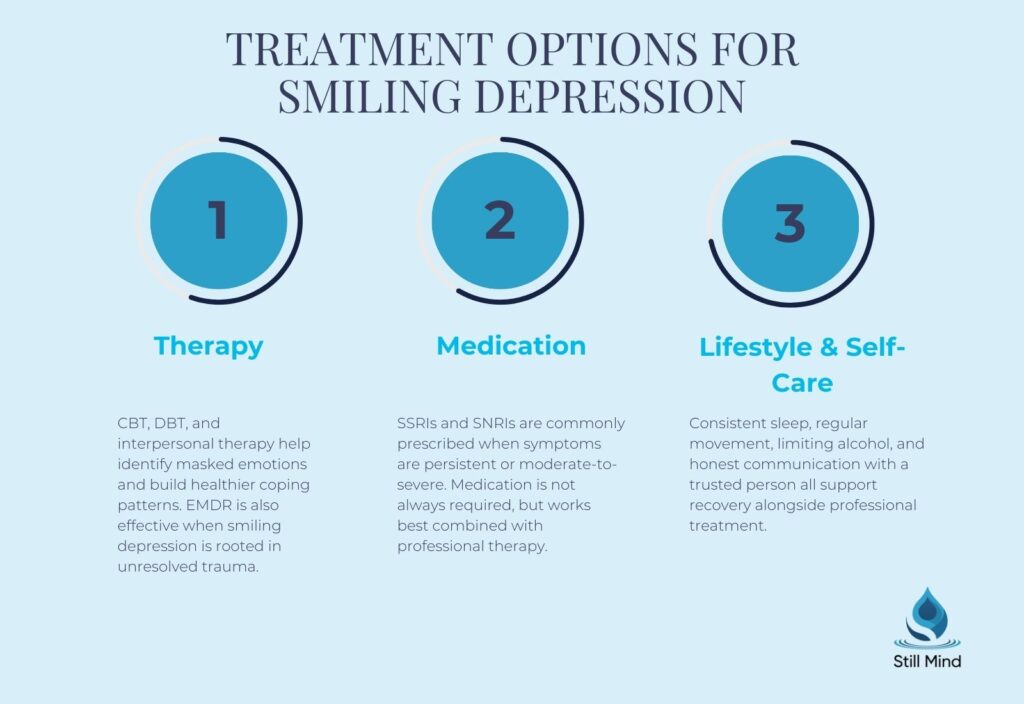
Treatment for Smiling Depression
Smiling depression responds well to treatment. The obstacle is not treatability. It is identification and willingness to seek help. Once a person engages in care, a combination of psychotherapy and, where needed, medication produces meaningful and lasting improvement.
Cognitive Behavioral Therapy (CBT)
CBT is the most extensively researched psychotherapy for depression and the first-line recommendation per APA clinical guidelines. For smiling depression specifically, CBT addresses the cognitive distortions that sustain the masking pattern, beliefs like “I must always appear strong,” “showing vulnerability is weakness,” or “my pain is not real enough to deserve help.” The work involves identifying these beliefs, testing them against evidence, and gradually building tolerance for authentic emotional expression.
Cognitive behavioral therapy at Still Mind Florida is delivered in a structured, evidence-based format by licensed clinicians who understand the specific clinical presentation of hidden depression.
Interpersonal Therapy (IPT)
IPT targets the relational context in which depression develops and is maintained. It is one of only two psychological treatments (alongside CBT) recommended as first-line in multiple international guidelines. A meta-analysis of 38 studies involving over 4,350 patients found IPT significantly superior to control conditions. For smiling depression, IPT directly addresses the interpersonal dynamics that reinforce concealment role conflicts, role transitions, unresolved grief, and the difficulty of authentic emotional disclosure in close relationships.
Dialectical Behavior Therapy (DBT)
When smiling depression co-occurs with emotional dysregulation, rejection sensitivity, or self-harm behaviors, dialectical behavior therapy provides practical distress tolerance and emotion regulation skills that directly address these patterns.
Medication
SSRIs are the standard first-line pharmacological treatment for depression and are appropriate for most presentations of smiling depression. However, when the presentation includes significant atypical features, the evidence base specifically supports monoamine oxidase inhibitors (MAOIs). Research consistently shows phenelzine (Nardil) and other MAOIs achieve response rates approaching two-thirds of patients in atypical depression trials, outperforming SSRIs in this specific clinical subgroup. MAOIs are reserved for cases that do not respond to first-line treatments due to dietary restrictions, but when standard options are insufficient, they should be seriously considered.
Combined treatment medication alongside psychotherapy consistently outperforms either approach alone for moderate to severe depression.
Lifestyle and Natural Approaches
A 2024 systematic review and network meta-analysis published in BMJ, examining 218 randomized controlled trials with over 14,000 participants, found that exercise produces antidepressant effects comparable to psychotherapy and medication. Walking, jogging, yoga, and strength training all produced clinically significant effects, with effect sizes ranging from 0.49 to 0.63. Exercise is one of the most accessible and evidence-supported natural interventions available for depression.
Mindfulness practice, improved sleep consistency, reduction in alcohol use, and deliberate social connection also contribute meaningfully to recovery. For smiling depression specifically, practicing vulnerability, small moments of honest emotional disclosure in safe relationships, is itself a form of treatment. The habit of concealment is reinforced by repetition; it is undone the same way.
How to Help Someone with Smiling Depression
Helping someone who appears fine but may be struggling internally requires a specific kind of attention and language. Generic check-ins (“You seem great!”) tend to reinforce the mask rather than create space for honesty.
More effective approaches include creating private, low-pressure moments for real conversation. Rather than asking “how are you?” in a group setting, finding one-on-one time and asking something more specific opens a different kind of conversation: “You’ve seemed different lately, not bad, just different. I just want to check in properly.” Name what you have observed over time rather than what you feel in the moment. Focus on behaviors and patterns, not diagnoses or assumptions.
If the person discloses they are struggling, resist the urge to problem-solve immediately. The most valuable thing in that moment is to listen, validate, and resist minimizing. “You seem too happy to be depressed” is one of the most isolating things a person with smiling depression can hear. If you are concerned about safety, ask directly: “Are you having any thoughts of hurting yourself?” Asking the question does not plant the idea. It often opens a conversation that could not have happened otherwise.
Supporting someone through depression also means helping them access professional support, researching options together, offering to make a call, or accompanying them to a first appointment if that is what removes the barrier.
When to Consider Residential Treatment
For smiling depression specifically, residential treatment offers something that outpatient care cannot: removal from the environment and social roles that sustain the masking behavior. When a person is seen weekly for 50 minutes, they have six days between sessions to maintain their “fine” exterior. In a residential setting, there is no audience to perform for. The 24-hour therapeutic environment supports authentic emotional expression in ways that are structurally impossible in outpatient care.
Residential treatment is appropriate when depression is severe, persistent, or treatment-resistant; when there is active suicidal ideation; when co-occurring conditions complicate outpatient care; or when the person has been managing alone for so long that they lack the structural support to recover without intensive intervention. The step-down pathway from residential to partial hospitalization to intensive outpatient provides a graduated return to daily life with new skills for emotional honesty and sustainable wellbeing.
Frequently Asked Questions
How do you help someone with smiling depression?
Create private, low-pressure opportunities for honest conversation using specific questions rather than generic check-ins. Focus on patterns you have observed over time, and listen without minimizing. If the person discloses depression, resist the urge to explain it away based on how they appear. Help them find and access professional support. If you are concerned about safety, ask directly about suicidal thoughts. Early, consistent engagement matters far more than any single conversation.
How do you lift yourself out of depression?
Depression is a medical condition, not a personal failing, and it typically requires professional support to treat effectively. Alongside clinical treatment, the strongest self-directed evidence supports regular exercise (which a 2024 BMJ meta-analysis found comparable to medication and therapy), maintaining a daily routine, reducing alcohol use, and staying socially connected. Small behavioral steps — not willpower — are what create momentum in depression recovery. Contact your primary care provider for a formal evaluation and referral.
How do I know if I’m depressed?
The DSM-5 requires five or more of the following symptoms for at least two weeks: persistent sadness or emptiness, loss of interest or pleasure, appetite or weight changes, sleep disruption, fatigue, difficulty concentrating, feelings of worthlessness, and thoughts of death. One must be depressed mood or loss of interest. For smiling depression, the question to ask yourself is not “do I look depressed?” but “when did I last feel genuinely, freely happy, not just fine?” If you cannot remember, that matters clinically.
How do you relieve depression naturally?
The most evidence-supported natural approaches are aerobic exercise (particularly walking, jogging, and yoga), mindfulness meditation, consistent sleep, reduction of alcohol and substance use, and deliberate maintenance of social connection. A 2024 systematic review across 218 trials confirmed that moderate-intensity exercise produces antidepressant effects comparable to pharmacotherapy. Natural approaches work best as adjuncts to professional treatment, not substitutes for it. A clinician can help integrate both approaches in a plan tailored to your situation.
Is smiling depression more dangerous than regular depression?
The specific danger of smiling depression is not that it is inherently more severe, but that it is far more likely to go undetected and untreated. Research shows that atypical depression, the closest clinical equivalent, is associated with higher rates of suicide attempts (34.6% vs. 20.3% in nonatypical depression). The combination of significant internal suffering, maintained external functioning, reduced likelihood of being identified, and delayed treatment creates a genuine clinical risk that deserves urgent attention.
Can smiling depression go away on its own?
Depressive episodes do sometimes resolve without treatment, but this is not a reliable or safe approach, particularly for smiling depression, where the concealment makes monitoring difficult and the absence of visible distress can create a false sense that things are improving when they are not. Without treatment, depression is more likely to recur, intensify, or evolve into a chronic pattern. Professional evaluation and targeted treatment significantly improve both the speed of recovery and the likelihood of staying well.
Bottom Line
Smiling depression is one of the most dangerous forms of depression precisely because it is the hardest to see. Looking fine is not the same as being fine. The persistent gap between how a person appears and how they actually feel is itself a sign that something is wrong and a signal that professional support is overdue.
If this article describes your experience or someone you love, Still Mind Florida offers residential mental health treatment for adults with depression and co-occurring conditions in a structured, compassionate environment. You do not have to keep performing well. Contact our admissions team to speak with someone today.
References
- American Psychiatric Association. (2022). Diagnostic and statistical manual of mental disorders (5th ed., text rev.). American Psychiatric Publishing.
- Singh, T., & Williams, K. (2006). Atypical depression. Psychiatry (Edgemont), 3(4), 33–39.
- Matza, L. S., Revicki, D. A., Davidson, J. R., & Stewart, J. W. (2003). Depression with atypical features in the National Comorbidity Survey. Archives of General Psychiatry, 60(8), 817–826.
- Posternak, M. A., & Zimmerman, M. (2002). Partial validation of the atypical features subtype of major depressive disorder. Archives of General Psychiatry, 59(1), 70–76.
- National Institute of Mental Health. (2023). Major depression statistics. Retrieved from https://www.nimh.nih.gov/health/statistics/major-depression
- Centers for Disease Control and Prevention. (2024). Depression prevalence in adolescents and adults. NCHS Data Brief No. 527. Retrieved from https://www.cdc.gov/nchs/products/databriefs/db527.htm
- Bonanno, G. A., et al. (2021). Prevalence of suicidality in major depressive disorder. PMC. Greenberg, P., et al. (2022). Prevalence and impact of diagnosed and undiagnosed depression in the United States. PMC.
- Noetel, M., et al. (2024). Effect of exercise for depression: Systematic review and network meta-analysis of randomised controlled trials. BMJ, 384.
- World Health Organization. (2025). Depressive disorder (depression).