


Borderline personality disorder BDP vs bipolar disorder both produce extreme mood instability, impulsive behavior, and significant relationship disruption, but they are distinct conditions with different neurobiological causes, different treatment approaches, and different durations and trigger of mood changes.
In BPD, mood shifts last minutes to hours and are almost always triggered by an interpersonal event. In bipolar disorder, mood episodes last days to weeks and often arise without a clear external trigger. Getting this distinction right determines whether a patient receives lithium or DBT: and that difference is clinically consequential.
Key Takeaways
- Studies estimate that 40% of individuals with BPD are initially misdiagnosed with bipolar disorder, typically because both conditions involve mood instability, impulsivity, and functional impairment: but the underlying mechanism, duration, and triggers differ fundamentally.
- The single most reliable clinical differentiator is mood change duration: BPD mood shifts last minutes to hours and are reactively triggered by interpersonal events; bipolar manic episodes require a minimum of 7 consecutive days (4 days for hypomania) by DSM-5-TR criteria.
- Negative symptoms unique to BPD: chronic identity disturbance, frantic efforts to avoid abandonment, and recurrent self-harm as a defining diagnostic criterion: do not occur in bipolar disorder between mood episodes.
- According to the National Institute of Mental Health, bipolar disorder affects approximately 2.8% of U.S. adults annually, while BPD affects approximately 1.4%: but their symptom overlap makes them among the most commonly confused diagnoses in outpatient psychiatry.
- First-line treatment differs fundamentally: BPD requires dialectical behavior therapy (DBT) as the primary evidence-based intervention; bipolar disorder requires mood stabilizers (lithium, lamotrigine, valproate) and atypical antipsychotics as foundation treatments, with psychotherapy as adjunct rather than primary.
What Are BPD and Bipolar Disorder?
Both conditions are defined in the DSM-5-TR, and both involve emotional extremes: but they are classified in entirely different diagnostic categories.
Borderline Personality Disorder: DSM-5-TR Definition
Borderline personality disorder (BPD) is classified under DSM-5-TR as a Cluster B personality disorder, defined by a pervasive pattern of instability in interpersonal relationships, self-image, and affect combined with marked impulsivity beginning by early adulthood and present across contexts.
The nine DSM-5-TR BPD diagnostic criteria (5 or more required for diagnosis):
- Criterion 1: Frantic efforts to avoid real or imagined abandonment.
- Criterion 2: A pattern of unstable and intense interpersonal relationships alternating between idealization and devaluation.
- Criterion 3: Identity disturbance: markedly and persistently unstable self-image or sense of self.
- Criterion 4: Impulsivity in at least two areas that are potentially self-damaging (spending, sex, substance use, reckless driving, binge eating).
- Criterion 5: Recurrent suicidal behavior, gestures, or threats, or self-mutilating behavior.
- Criterion 6: Affective instability due to a marked reactivity of mood: intense episodic dysphoria, irritability, or anxiety usually lasting a few hours and only rarely more than a few days.
- Criterion 7: Chronic feelings of emptiness.
- Criterion 8: Inappropriate, intense anger or difficulty controlling anger.
- Criterion 9: Transient, stress-related paranoid ideation or severe dissociative symptoms.
Bipolar Disorder: DSM-5-TR Definition
Bipolar disorder is classified under the DSM-5-TR bipolar and related disorders section and includes three primary diagnoses: Bipolar I disorder (defined by at least one manic episode, with or without depressive episodes), Bipolar II disorder (defined by at least one hypomanic episode and at least one major depressive episode, with no manic episodes), and Cyclothymic disorder (chronic hypomanic and depressive symptoms not meeting full episode criteria over at least two years).
DSM-5-TR manic episode criteria (Bipolar I):
- Duration: Minimum 7 consecutive days of elevated, expansive, or irritable mood plus increased goal-directed activity or energy, present most of the day, nearly every day: or any duration if hospitalization is required.
- At least 3 of 7 additional symptoms: Inflated self-esteem or grandiosity; decreased need for sleep (feels rested after 3 hours); more talkative than usual or pressured speech; racing thoughts or flight of ideas; distractibility; increased goal-directed activity or psychomotor agitation; excessive involvement in activities with high potential for painful consequences.
- Functional impairment: Sufficient to cause marked impairment in social or occupational functioning or to necessitate hospitalization.
Why BPD and Bipolar Are So Frequently Confused
The diagnostic confusion between BPD and bipolar disorder is one of the most consequential in psychiatry because the two conditions share surface features while requiring fundamentally different treatment approaches.
Shared features that create misdiagnosis:
- Emotional intensity: Both conditions involve mood states more intense than neurotypical experience, leading clinicians who observe mood extremes without detailed history-taking to default to the more commonly known bipolar diagnosis.
- Impulsivity: Impulsive spending, sexual behavior, and substance use appear in both conditions, though the mechanism and context differ: in BPD, impulsivity peaks during interpersonally triggered emotional dysregulation; in bipolar, it peaks during manic and hypomanic episodes that arise from internal neurobiological state shifts.
- Partial response to mood stabilizers: Lamotrigine and other mood stabilizers produce modest reductions in BPD emotional reactivity, which can create the impression that a bipolar diagnosis was correct when the partial response is actually targeting the affective instability component of BPD rather than true mood episodes.
What Causes BPD vs What Causes Bipolar
The etiologies of BPD and bipolar disorder diverge significantly: a distinction that helps explain why they respond to different treatments and why accurate diagnosis matters beyond just labeling.
Causes of BPD: Biosocial Model and Developmental Trauma
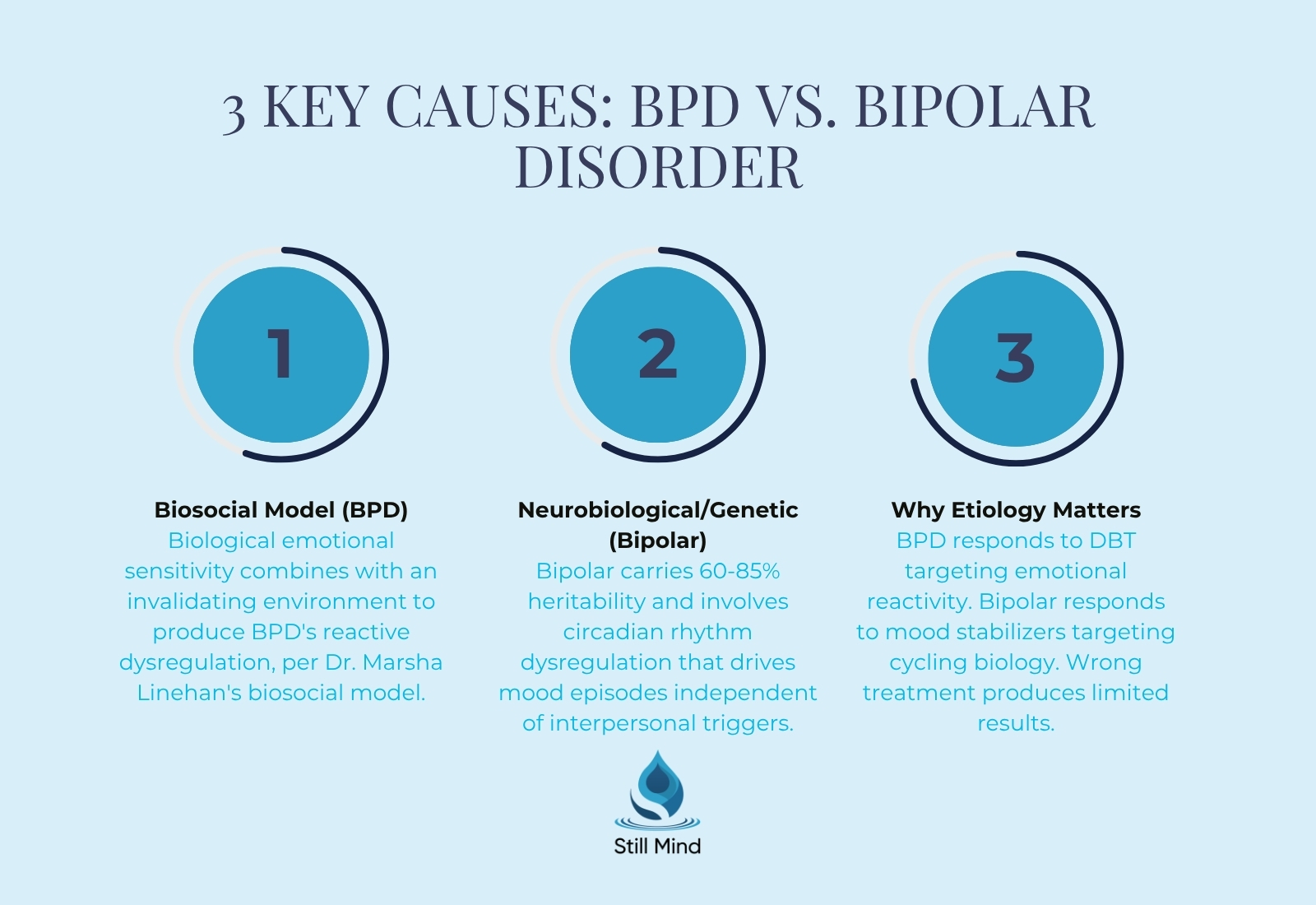
BPD is understood through Dr. Marsha Linehan’s biosocial model as the product of an innate biological emotional sensitivity transacting with a chronically invalidating developmental environment.
Primary etiological factors in BPD:
- Amygdala hyperreactivity: Neuroimaging studies demonstrate exaggerated amygdala responses to neutral and emotional social stimuli in BPD, combined with reduced prefrontal inhibitory control: a pattern that produces the intense, reactive emotional episodes that characterize the disorder.
- Childhood adversity and trauma: Adverse childhood experiences (ACEs) including emotional neglect, emotional abuse, sexual abuse, and witnessing domestic violence are documented risk factors; BPD has higher rates of childhood trauma exposure than any other DSM-5-TR personality disorder.
- Invalidating environment: Parenting environments that consistently dismissed, minimized, or punished emotional responses prevent the developing child from acquiring the internal emotion regulation capacities that BPD individuals characteristically lack as adults.
- Genetic heritability: Twin studies estimate BPD heritability at approximately 40-60%, suggesting a significant genetic contribution to the neurobiological sensitivity underlying the disorder, though no single gene has been identified.
Causes of Bipolar Disorder: Neurobiological and Genetic Factors
Bipolar disorder’s etiology is substantially more weighted toward neurobiological and genetic factors, with less consistent evidence for the developmental trauma pathways central to BPD.
Primary etiological factors in bipolar disorder:
- High heritability: Bipolar disorder heritability estimates range from 60-85% in twin studies: among the highest of any psychiatric condition: with first-degree relatives of bipolar patients carrying approximately a 10-fold increased risk compared to the general population.
- Neurobiological mechanisms: Bipolar disorder involves dysregulation of circadian rhythm systems, dopaminergic and noradrenergic pathways mediating reward and arousal, and HPA axis function governing stress response: a broader neurobiological profile than the amygdala-prefrontal circuit dysfunction central to BPD.
- Emil Kraepelin’s early framework: Emil Kraepelin, the German psychiatrist who classified “manic-depressive insanity” in 1899, established the foundational observation that bipolar disorder involves discrete episodes with full recovery periods between them: a longitudinal course that remains diagnostically central to bipolar and fundamentally different from BPD’s chronic baseline dysfunction.
- Circadian system disruption: Disruptions to sleep-wake cycles consistently precipitate manic and hypomanic episodes in bipolar disorder, linking the disorder’s episodic biology to chronobiological systems that operate independently of interpersonal triggers: a mechanism absent in BPD-driven extreme mood swings.
Why the Underlying Biology Matters for Treatment
The biological difference between amygdala-driven reactive emotional dysregulation in BPD and circadian-linked neurobiological state shifts in bipolar disorder explains why the treatments are different and why using the wrong treatment produces limited results: mood stabilizers target the ionic and synaptic mechanisms of mood episode cycling rather than the emotional sensitivity and interpersonal reactivity that drive BPD, while DBT targets the emotional regulation deficits of BPD rather than the manic circuit biology of bipolar disorder.
BPD vs Bipolar: Mood Changes Compared
Duration and trigger represent the two most operationally useful clinical features for separating BPD from bipolar disorder in real-world assessment.
Mood Instability in BPD: Minutes to Hours, Triggered by Relationships
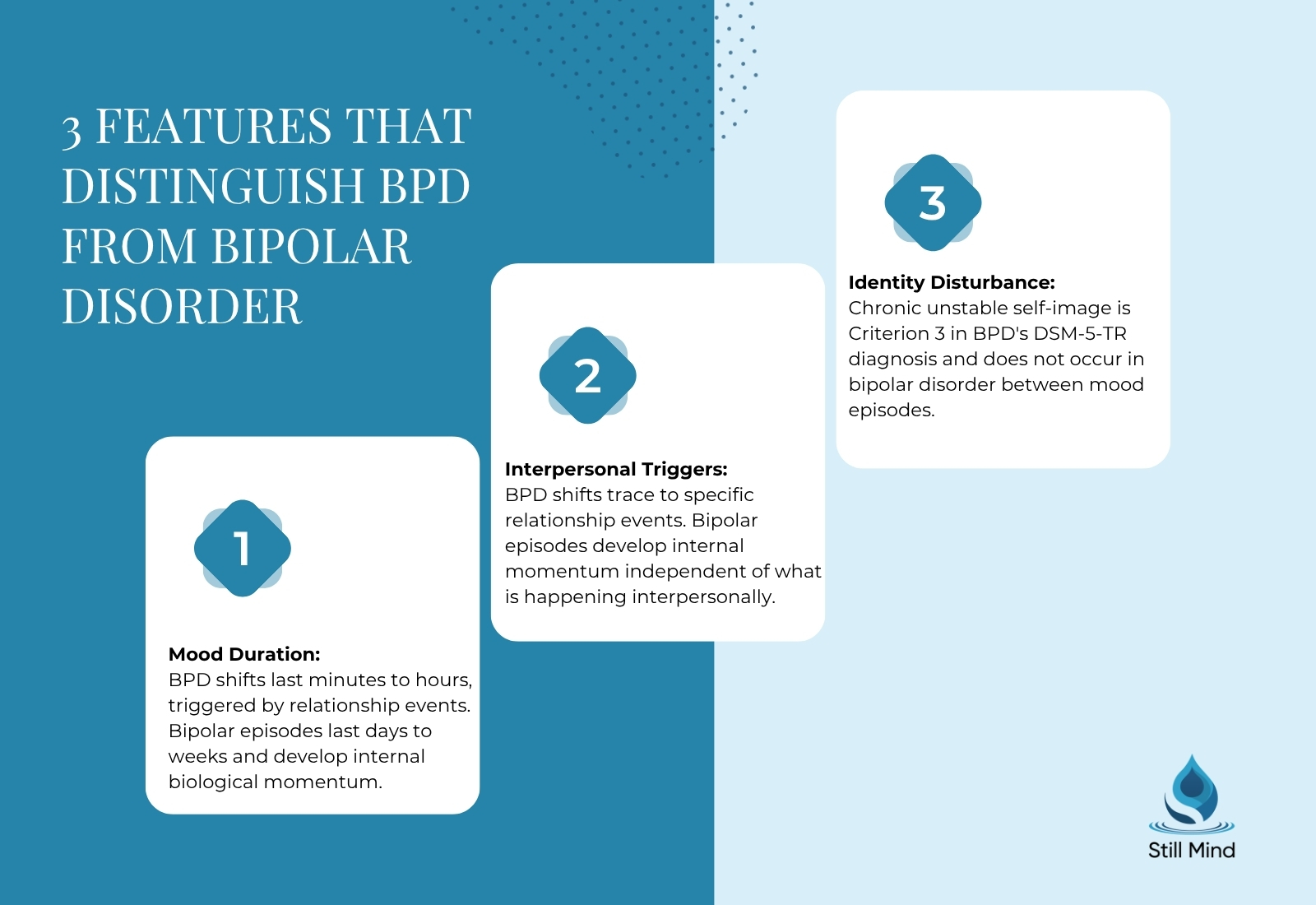
DSM-5-TR Criterion 6 for BPD explicitly states that the affective instability involves episodes “usually lasting a few hours and only rarely more than a few days”: directly incorporating duration as a defining feature of BPD’s mood pathology.
BPD mood change characteristics:
- Rapid onset: Mood shifts in BPD typically move from baseline to peak intensity within minutes, in response to an identifiable interpersonal trigger; the individual can often name the exact moment and event that initiated the shift.
- Reactive content: BPD mood states are almost always reactive to a specific relationship event: a perceived rejection, abandonment, criticism, or invalidation: giving them a qualitatively different character from the internally generated grandiosity or energy of mania.
- Rapid resolution with trigger removal: Unlike bipolar mood episodes that persist regardless of circumstances, BPD mood shifts often de-escalate quickly once the triggering interpersonal situation resolves or the individual physically separates from the triggering context.
Mood Episodes in Bipolar Disorder: Days to Weeks, Often Internally Driven
Bipolar mood episode characteristics:
- Duration requirements: DSM-5-TR requires a minimum of 7 consecutive days for a manic episode and 4 consecutive days for a hypomanic episode; major depressive episodes require 2 weeks; these duration thresholds do not apply to BPD mood shifts and represent the most reliable single point of clinical differentiation.
- Internal biological drive: While bipolar episodes can be precipitated by external stressors (particularly sleep disruption), they typically develop an internal momentum independent of external circumstances: a manic patient does not return to euthymia simply because the triggering situation resolves.
- Distinct manic symptom signature: True mania involves features absent from BPD: decreased need for sleep (feeling fully rested after 3 hours), grandiosity, pressured speech, racing thoughts, increased goal-directed activity, and hypersexuality that persist continuously for the episode duration and are not present between episodes. These features are not part of BPD’s clinical profile.
BPD vs Bipolar Disorder: Key Symptoms Compared
A comprehensive comparison across eight clinical dimensions clarifies the practical difference between these two frequently confused diagnoses.
| Clinical Feature | Borderline Personality Disorder (BPD) | Bipolar Disorder |
|---|---|---|
| Mood shift duration | Minutes to hours; rarely more than a few days (per DSM-5-TR) | Manic: minimum 7 days; depressive: minimum 2 weeks |
| Primary trigger | Interpersonal events: rejection, abandonment, conflict | Often internally driven; sleep disruption is a major precipitant |
| Identity stability | Chronically unstable self-image (Criterion 3); sense of self shifts with relationships | Stable identity between episodes; grandiosity occurs only during mania |
| Between-episode functioning | Chronic baseline emotional dysregulation and relational instability | Often full return to normal functioning between episodes |
| Self-harm and suicidality | Recurrent self-harm is a defining diagnostic criterion (Criterion 5) | Suicidal ideation can occur during depressive episodes; not a defining criterion |
| Fear of abandonment | Core diagnostic feature driving frantic behaviors (Criterion 1) | Not a diagnostic feature; relationship strain may accompany episodes |
| Grandiosity | Absent (or limited to brief reactive states) | Hallmark of manic/hypomanic episodes; inflated self-esteem or grandiosity |
| Sleep requirement | Normal sleep need maintained | Decreased need for sleep (feeling rested after 3 hours) is a manic criterion |
Features Unique to BPD Not Present in Bipolar
BPD-specific clinical features:
- Splitting: The cognitive defense of splitting: dividing people, experiences, and oneself into entirely good or entirely bad: is characteristic of BPD and produces the idealization-devaluation cycle that destabilizes relationships; it is not a feature of bipolar disorder.
- Chronic emptiness: The persistent sense of inner emptiness described in Criterion 7 of BPD represents a between-episode baseline state that is absent in bipolar disorder, where the euthymic state typically involves a felt sense of self continuity.
- Abandonment sensitivity: The frantic, sometimes extreme efforts to prevent real or imagined abandonment: including impulsive behaviors, self-harm threats, or complete relational reorganization: are distinctive to BPD and not characteristic of bipolar disorder even during acute episodes.
Features Unique to Bipolar Not Present in BPD
Bipolar-specific clinical features:
- Decreased sleep need: The manic symptom of feeling fully rested after 3-4 hours of sleep: not insomnia but a genuine reduction in sleep requirement without daytime fatigue: is pathognomonic of mania and does not occur in BPD emotional dysregulation.
- Pressured speech and racing thoughts: The formal thought disorder features of mania: rapid, pressured speech that is difficult to interrupt and subjective racing thoughts that the individual cannot slow down: are absent from BPD’s clinical profile regardless of emotional intensity.
- Grandiosity: Inflated self-esteem or grandiose beliefs (believing one has special powers, a unique mission, or abilities significantly exceeding one’s actual capacities) define manic episodes and do not occur in BPD, where self-image is chronically unstable rather than chronically inflated.
How BPD and Bipolar Are Diagnosed
Neither BPD nor bipolar disorder can be diagnosed by laboratory test or neuroimaging; both require structured clinical assessment using validated instruments and longitudinal history.
Diagnostic Tools for BPD
Assessment instruments:
- MSI-BPD: The McLean Screening Instrument for BPD: a 10-item self-report questionnaire where a score of 7 or higher indicates probable BPD and warrants full diagnostic evaluation; designed as a rapid clinical screening tool rather than a diagnostic instrument.
- ZAN-BPD: The Zanarini Rating Scale for Borderline Personality Disorder measures BPD symptom severity on a 0-36 scale across affective, cognitive, impulsive, and interpersonal domains, used for treatment monitoring rather than initial diagnosis.
- Structured Clinical Interview (SCID-II): The gold-standard diagnostic interview for all DSM-5-TR personality disorders; the SCID-II generates a systematic assessment of all 9 BPD criteria against explicit definitional thresholds that reduce the clinician variability affecting unstructured interviews. Additionally, visiting the BPD screening tool can provide an initial indication worth discussing with a clinician.
Diagnostic Tools for Bipolar Disorder
Assessment instruments:
- MDQ: The Mood Disorder Questionnaire: a 13-item self-report screening tool for bipolar disorder that asks about a lifetime history of hypomanic and manic symptoms; a positive screen requires 7 or more symptom items endorsed, plus co-occurrence during the same time period, plus moderate to severe functional impairment.
- YMRS: The Young Mania Rating Scale: an 11-item clinician-administered instrument measuring manic episode severity across elevated mood, increased motor activity, sexual interest, sleep, irritability, speech, language and thought disorder, thought content, disruptive or aggressive behavior, appearance, and insight.
- Longitudinal history: Because bipolar disorder requires documented mood episodes of specific duration, a careful longitudinal history: ideally including collateral information from family members: is indispensable for separating bipolar from BPD, particularly in patients who present during a depressive episode when both diagnoses can appear identical in cross-section.
Can You Have Both BPD and Bipolar Disorder?
Co-occurrence of BPD and bipolar disorder is clinically real, with prevalence estimates ranging from 10-20% of bipolar patients also meeting BPD criteria. When both diagnoses are present, treatment requires addressing both simultaneously: mood stabilizers for bipolar’s episodic biology and DBT for BPD’s emotional regulation deficits. Attempting to treat only one condition when both are present produces partial improvement at best. A dual diagnosis treatment approach that integrates both psychiatric and psychotherapeutic components produces better outcomes than sequential treatment.
Clinicians should also be aware that some patients with BPD and co-occurring major depressive disorder (MDD) may present identically to bipolar II disorder in cross-sectional assessment, with depressive episodes and emotional reactivity that superficially resembles hypomania; longitudinal assessment and careful duration tracking are essential for distinguishing these presentations.
Treatment for BPD vs Bipolar Disorder
Treatment diverges significantly between these two conditions: an accurate diagnosis is prerequisite to appropriate care.
First-Line Treatment for BPD
Evidence-based BPD treatment:
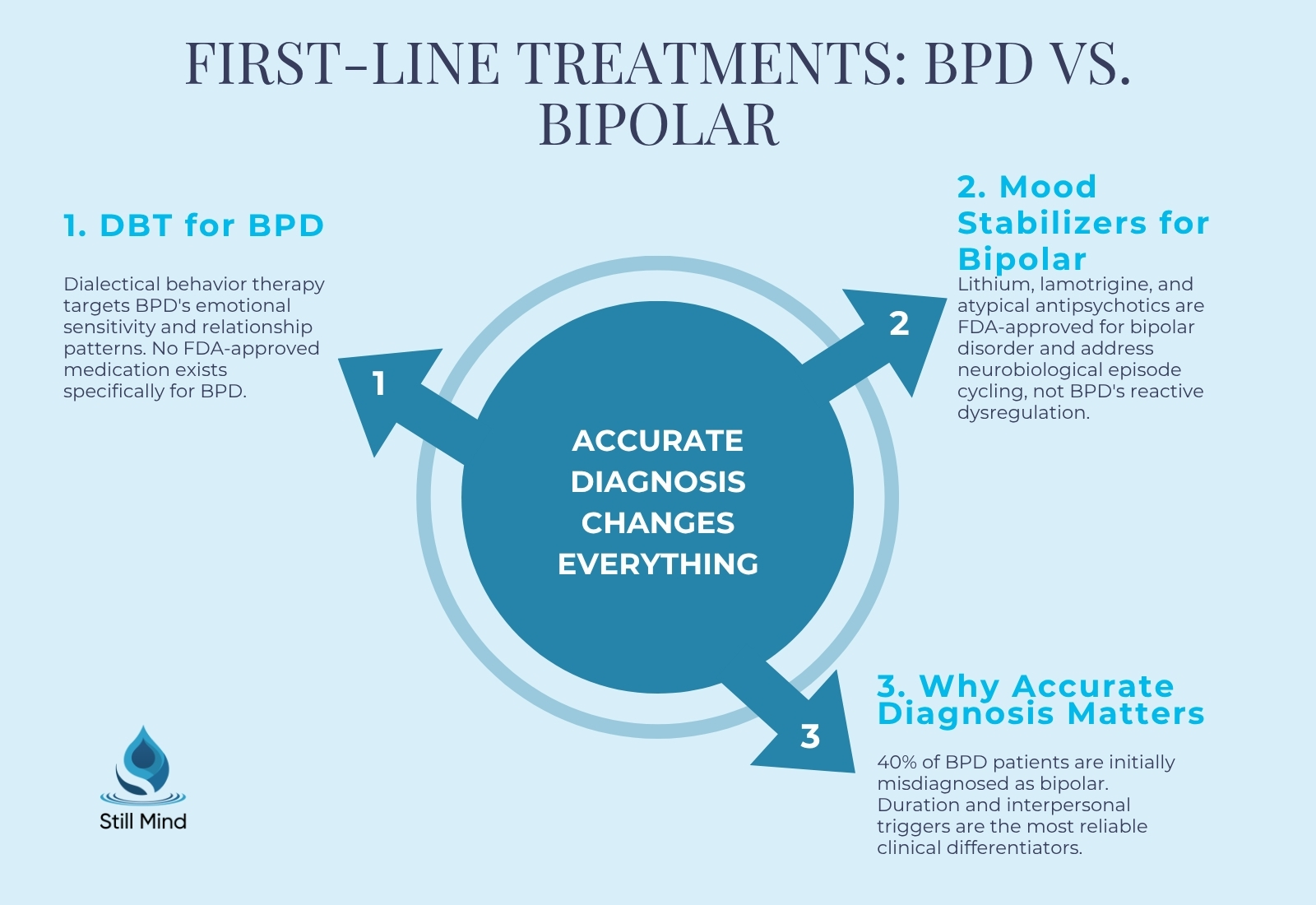
- Dialectical behavior therapy (DBT): DBT is the most evidence-supported treatment for BPD, with multiple randomized controlled trials demonstrating significant reductions in self-harm, suicidal behavior, and psychiatric hospitalizations compared to treatment as usual; DBT is the only treatment with an FDA Breakthrough Therapy Designation specifically for BPD.
- Mentalization-based therapy (MBT): MBT targets the mentalizing capacity that collapses during BPD episodes and demonstrates comparable efficacy to DBT in RCTs, with evidence for improved interpersonal functioning and reduction of self-harm over two-year follow-up periods.
- Medications in BPD: No medication is FDA-approved for BPD; medications address specific symptom domains (SSRIs for depressive symptoms, mood stabilizers for impulsivity and affective lability, low-dose atypical antipsychotics for cognitive-perceptual symptoms) as adjuncts to psychotherapy rather than as primary treatment.
First-Line Treatment for Bipolar Disorder
Evidence-based bipolar treatment:
- Mood stabilizers: Lithium carbonate remains the gold-standard mood stabilizer for bipolar I disorder, with demonstrated efficacy for both manic episodes and long-term relapse prevention; lamotrigine shows particular efficacy for bipolar depression prevention; valproate targets acute mania.
- Atypical antipsychotics: Quetiapine, olanzapine, aripiprazole, risperidone, and lurasidone hold FDA approvals for specific bipolar phases; quetiapine has the broadest indication profile, covering acute mania, bipolar depression, and maintenance treatment.
- Psychotherapy in bipolar: Cognitive behavioral therapy, interpersonal and social rhythm therapy (IPSRT: which specifically targets the circadian rhythm disruption underlying bipolar episodes), and psychoeducation programs produce significant reductions in bipolar relapse rates as adjuncts to pharmacotherapy; unlike in BPD, therapy functions as a supplement to medication rather than the primary treatment.
Why Getting the Right Diagnosis Matters
Misdiagnosing BPD as bipolar disorder produces three predictable clinical failures: antidepressants prescribed without mood stabilizers can destabilize BPD emotional dysregulation; mood stabilizer monotherapy without DBT leaves BPD’s interpersonal and identity pathology entirely unaddressed; and the patient may spend years in a diagnostic framework that does not explain their experience or guide them toward the treatments that actually work. Conversely, misdiagnosing bipolar disorder as BPD: and withholding mood stabilizers: leaves a patient cycling through preventable mood episodes that DBT alone cannot interrupt.
“The most important question I ask is: ‘When your mood shifts, does it happen because of something that happened between you and another person?’ In BPD, the answer is almost always yes: you can trace it to a specific moment in a relationship. In bipolar, the episode builds on its own timetable. That distinction alone changes everything about how we approach treatment.”
Treatment for BPD and Bipolar Disorder at Still Mind
Still Mind provides comprehensive assessment and treatment for both borderline personality disorder and bipolar disorder, with particular expertise in cases where diagnostic complexity, misdiagnosis history, or dual-diagnosis presentations require careful clinical differentiation before a treatment plan can be established.
Dialectical Behavior Therapy for BPD
DBT at Still Mind:
- BPD-specific intervention: DBT was developed specifically by Marsha Linehan to treat the emotional dysregulation, self-harm, and interpersonal instability that define BPD: making it the most appropriate psychotherapeutic option for patients whose instability stems from the reactive, interpersonally triggered mechanism of BPD rather than from bipolar’s internal mood episode biology.
- Skills training components: The four DBT skill modules: distress tolerance, emotion regulation, interpersonal effectiveness, and mindfulness: directly target the deficits documented in BPD neurobiological and developmental research, providing patients with evidence-based tools for managing the full clinical spectrum of BPD episodes. [CLIENT INPUT NEEDED: Confirm program structure: full DBT vs. DBT-informed: at Still Mind.]
Comprehensive Mood Disorder Treatment
Bipolar and mood disorder care:
- Psychiatric evaluation and medication management: Accurate diagnosis of bipolar disorder requires comprehensive psychiatric evaluation that distinguishes bipolar mood episodes from BPD emotional dysregulation; Still Mind’s psychiatric team conducts this assessment using validated instruments and longitudinal clinical history before initiating any pharmacological protocol.
- Psychoeducation: Understanding the biology of bipolar disorder: particularly the circadian rhythm mechanisms that precipitate episodes: is a core component of bipolar relapse prevention; Still Mind’s psychoeducation program provides this foundation for patients and their family members. [CLIENT INPUT NEEDED: Confirm what specific mood disorder psychoeducation components are available at Still Mind.]
Dual Diagnosis Care for Complex Presentations
Co-occurring conditions and complex cases:
- BPD plus bipolar: When both diagnoses are confirmed to co-occur, treatment requires an integrated approach combining mood stabilization pharmacotherapy with DBT: neither treatment alone adequately addresses both conditions.
- Trauma and personality: Many patients who present with BPD also carry PTSD and anxiety disorders alongside their anxious attachment patterns; comprehensive assessment at admission identifies the full diagnostic picture so treatment planning addresses all contributing conditions rather than only the presenting complaint.
- Admissions: Patients seeking diagnostic clarity or treatment for BPD, bipolar disorder, or suspected dual diagnosis can contact Still Mind’s admissions team for a confidential clinical assessment that determines the right level and type of care for their specific situation.
Frequently Asked Questions
Is BPD the same as bipolar disorder?
No. BPD and bipolar disorder are distinct diagnoses classified in different DSM-5-TR categories. BPD is a personality disorder defined by chronic emotional dysregulation, identity instability, and relationship instability. Bipolar disorder is a mood disorder defined by discrete episodes of mania, hypomania, or depression. They share mood instability as a feature but differ in duration, trigger, biological mechanism, and treatment response.
What is the key difference between BPD and bipolar?
Duration is the most reliable single differentiator. BPD mood shifts last minutes to hours and are almost always triggered by a specific interpersonal event. Bipolar mood episodes last days to weeks (7 consecutive days minimum for mania by DSM-5-TR) and often arise without an identifiable external trigger. Identity disturbance, splitting, and recurrent self-harm are additional features specific to BPD that are absent from bipolar disorder between mood episodes.
Can you have both BPD and bipolar disorder?
Yes. Co-occurrence estimates range from 10-20% of bipolar patients also meeting BPD criteria. When both diagnoses are present, treatment must address both: mood stabilizers for bipolar’s episodic biology and DBT for BPD’s emotional dysregulation. Neither treatment alone produces adequate outcomes in dual-diagnosis cases. Thorough diagnostic evaluation is essential before initiating treatment to ensure both conditions are identified and targeted.
How do doctors diagnose BPD vs bipolar?
Clinicians use validated instruments: the MSI-BPD or SCID-II for BPD, and the MDQ or YMRS for bipolar: alongside careful longitudinal history. The most diagnostically critical question involves mood change duration and interpersonal triggers. Family history is also informative: bipolar disorder carries substantially higher genetic heritability and a higher first-degree family risk than BPD. Longitudinal observation over multiple assessments is often more diagnostic than any single cross-sectional evaluation.
Why is BPD misdiagnosed as bipolar?
BPD is frequently misdiagnosed as bipolar because both involve emotional intensity, impulsivity, and relationship disruption; bipolar is more widely known and less stigmatized than BPD; and BPD’s rapid mood shifts can superficially resemble rapid cycling bipolar disorder. Studies document a 40% initial misdiagnosis rate for BPD. The misdiagnosis persists when clinicians assess mood intensity without assessing episode duration or interpersonal triggers, the two features that most reliably separate the conditions.
Is BPD worse than bipolar disorder?
Neither condition is categorically worse; both cause significant suffering and functional impairment. BPD is associated with higher rates of self-harm and a chronic daily impairment that bipolar patients often do not experience between episodes. Bipolar I carries risks of severe manic episodes requiring hospitalization and may have higher rates of completed suicide in some studies. The impact depends heavily on diagnosis accuracy, treatment access, comorbidities, and social support: factors that matter more for prognosis than the diagnostic label itself.
What medications work for BPD vs bipolar?
For bipolar disorder: FDA-approved mood stabilizers (lithium, lamotrigine, valproate) and atypical antipsychotics (quetiapine, aripiprazole, olanzapine) are first-line pharmacological treatments with established evidence for episode prevention and treatment. For BPD: no medication is FDA-approved specifically for BPD; medications address symptom domains as adjuncts to DBT, with SSRIs for comorbid depression, mood stabilizers for impulsivity, and low-dose antipsychotics for cognitive-perceptual symptoms and dissociation.
Can BPD mood shifts look like rapid cycling bipolar?
Yes, and this is the most common source of misdiagnosis. BPD’s within-day mood variability: with multiple emotional shifts across a single day in response to interpersonal events: superficially resembles rapid cycling bipolar disorder. The distinction lies in duration (BPD shifts last minutes to hours; even rapid cycling bipolar episodes last days) and trigger (BPD shifts trace to specific relationship events; rapid cycling bipolar episodes arise from internal biological state changes). Ecological momentary assessment studies show BPD mood variability is significantly higher than bipolar but operates at a faster timescale.
References
- American Psychiatric Association. (2022). Diagnostic and statistical manual of mental disorders (DSM-5-TR). American Psychiatric Publishing.
- National Institute of Mental Health. (2024). Borderline personality disorder. https://www.nimh.nih.gov/health/topics/borderline-personality-disorder
- National Institute of Mental Health. (2024). Bipolar disorder. https://www.nimh.nih.gov/health/topics/bipolar-disorder
- Linehan, M. M. (1993). Cognitive-behavioral treatment of borderline personality disorder. Guilford Press.
- Ruggero, C. J., Zimmerman, M., Chelminski, I., & Young, D. (2010). Borderline personality disorder and the misdiagnosis of bipolar disorder. Journal of Psychiatric Research, 44(6), 405–408.
- Trull, T. J., Lane, S. P., Koval, P., & Ebner-Priemer, U. W. (2019). Affective dynamics in psychological science. Perspectives on Psychological Science, 10(4), 512–536.
- Kraepelin, E. (1899). Psychiatrie: Ein Lehrbuch fur Studierende und Aerzte (6th ed.). Barth.
- Substance Abuse and Mental Health Services Administration. (2023). Impact of treatment, insurance, and policy on personality disorders and mood disorders. https://www.samhsa.gov