


Neurodivergent means your brain develops or processes information differently from what is considered typical. It is not a diagnosis or a disorder, it is a descriptive term that covers a wide range of conditions, from ADHD and autism to dyslexia and OCD.
Understanding what neurodivergence means can reduce stigma, support earlier identification, and open the door to more effective care. This article explains the meaning, lists common neurodivergent disorders, and answers the most frequently asked questions.
Key Highlights
- Neurodivergent is not a medical diagnosis. It is a term that describes brains that function differently from the neurotypical standard.
- An estimated 15 to 20 percent of the global population shows some form of neurodivergence, according to Northwestern Medicine.
- ADHD, autism spectrum disorder, dyslexia, and OCD are among the most common neurodivergent conditions recognized today.
- The CDC estimates that 9.4 percent of children in the U.S. are diagnosed with ADHD before adulthood, and 2.3 percent have autism spectrum disorder.
- Neurodivergence often comes with genuine cognitive strengths, including hyperfocus, pattern recognition, and creative problem-solving.
What Does Neurodivergent Mean?
The term neurodivergent was derived from the word “neurodiversity,” coined by sociologist Judy Singer in 1998. Singer introduced the concept to acknowledge that human brains naturally develop in different ways, and that no single brain type is the universal standard.
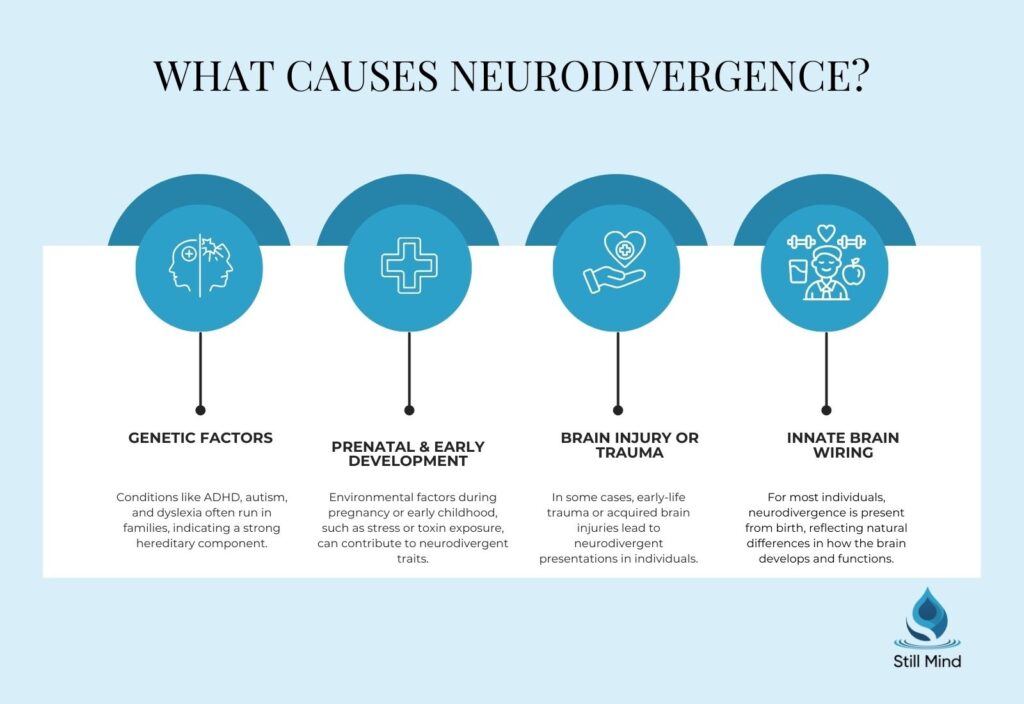
Neurodivergent simply means a brain that diverges from typical neurological development or functioning. This can involve how a person learns, communicates, processes sensory input, manages attention, or regulates emotions.
The opposite of neurodivergent is neurotypical. A neurotypical person’s brain develops and functions within the range considered standard for their age and culture. Neither term implies that one type of brain is superior or inferior to the other.
Neurodivergent vs. Neurotypical: Key Differences
The simplest way to understand the difference is this: neurotypical brains follow expected developmental patterns, while neurodivergent brains follow a different path. That difference is not inherently a problem, but it can create real challenges when systems, schools, workplaces, and social settings are built only with neurotypical functioning in mind.
| Characteristic | Neurotypical | Neurodivergent |
|---|---|---|
| Brain development | Follows expected developmental milestones | Diverges from standard developmental patterns |
| Information processing | Processes sensory and cognitive input in typical ways | May process input differently, faster, slower, or more intensely |
| Social interaction | Generally matches dominant social communication norms | May find certain social environments difficult or overstimulating |
| Strengths | Broad adaptability in mainstream settings | Often includes deep focus, creativity, or pattern recognition |
| Formal diagnosis | Generally no clinical diagnosis of a brain-based condition | May or may not carry a formal clinical diagnosis |
List of Neurodivergent Disorders
There is no single official list of neurodivergent disorders, as the term is not a clinical diagnosis. However, the following conditions are most commonly described as neurodivergent because they reflect significant differences in how the brain develops and functions.
Autism Spectrum Disorder (ASD)
Autism is a neurological and developmental condition that affects how a person communicates, processes sensory input, and engages socially. It presents across a wide spectrum, meaning no two autistic individuals are alike.
Common traits include difficulty reading nonverbal cues, strong focus on specific interests, sensory sensitivities, and preference for routine. Many autistic people also show exceptional skills in areas like pattern recognition, mathematical reasoning, and attention to detail.
Attention Deficit Hyperactivity Disorder (ADHD)
ADHD is one of the most common neurodivergent disorders. It is characterized by difficulties with sustained attention, impulse control, and in some cases, hyperactivity. Many people do not fit the hyperactive stereotype and instead experience ADHD primarily as inattentiveness.
People with ADHD often experience hyperfocus on topics that genuinely interest them. This can lead to remarkable creativity, energy, and problem-solving ability when the right conditions are in place. Understanding the ADHD iceberg helps explain why so many symptoms go unnoticed until adulthood.
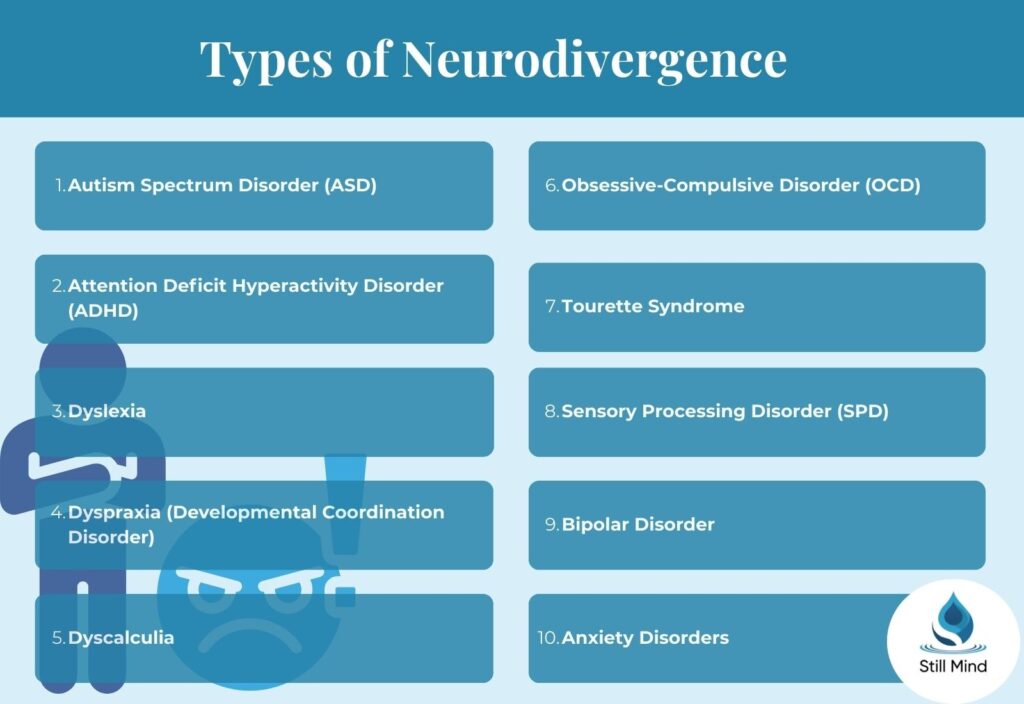
Dyslexia
Dyslexia is a learning difference that affects how the brain processes written language. People with dyslexia may read slowly, reverse letters, struggle with phonics, or have difficulty organizing words into sentences. Research suggests it affects roughly 20 percent of the population.
Dyslexia is not related to intelligence. People with dyslexia typically have strong visual-spatial processing, big-picture thinking, and high creative potential.
Dyspraxia (Developmental Coordination Disorder)
Dyspraxia affects fine and gross motor coordination. People with dyspraxia may struggle with handwriting, balance, and physical coordination. It can also affect planning, sequencing, and organization of daily tasks.
Dyscalculia
Dyscalculia is a learning difference involving difficulty understanding numbers, mathematical operations, and numerical reasoning. It is sometimes called “number dyslexia.” People with dyscalculia may struggle with basic arithmetic, time management, and understanding financial concepts.
Dysgraphia
Dysgraphia affects a person’s ability to write coherently. Challenges may include poor handwriting, inconsistent spacing, difficulty organizing thoughts on paper, and trouble converting spoken language to written form.
Obsessive-Compulsive Disorder (OCD)
OCD is characterized by intrusive, unwanted thoughts (obsessions) and repetitive behaviors or mental acts (compulsions) performed to reduce anxiety. While its classification as neurodivergent is debated, many experts include it because it reflects distinct patterns in how the brain processes threat and uncertainty.
People living with OCD often struggle significantly with daily functioning, and many go undiagnosed for years.
Tourette Syndrome
Tourette syndrome involves repetitive, involuntary movements and vocalizations called tics. It is a neurological condition that begins in childhood and is often accompanied by ADHD or OCD. Tic severity can vary widely and may lessen in adulthood.
Sensory Processing Disorder (SPD)
Sensory processing disorder affects how the brain interprets and responds to sensory input. Some individuals are hypersensitive to sound, light, or touch, while others actively seek intense sensory experiences. SPD frequently co-occurs with autism and ADHD.
Other Conditions Sometimes Included
The neurodivergent umbrella is broad. Other conditions sometimes discussed in this context include bipolar disorder, borderline personality disorder, PTSD, anxiety disorders, and certain intellectual or developmental disabilities. Experts vary on where exactly to draw the boundary.
People with conditions like borderline personality disorder or bipolar disorder often benefit from understanding how neurodivergence shapes their emotional experience.
Common Neurodivergent Symptoms and Traits
Because neurodivergence covers many different conditions, there is no single set of symptoms. However, certain patterns show up frequently across neurodivergent individuals. These traits can be challenges, strengths, or both depending on context.
Common traits and experiences among neurodivergent people include:
- Difficulty concentrating or sustaining focus on tasks that feel unstimulating, while showing intense focus on preferred topics
- Sensory sensitivities such as strong reactions to noise, light, textures, or crowded environments
- Challenges with social communication, including reading body language, understanding sarcasm, or navigating unspoken social rules
- Emotional dysregulation, including intense emotional responses that can feel disproportionate to the situation
- Executive function difficulties, such as trouble planning, organizing, initiating tasks, or managing time
- Strong pattern recognition and the ability to notice details that others typically overlook
- Hyperfixation on specific subjects or interests, often leading to deep expertise in narrow areas
Understanding emotional dysregulation is especially important for neurodivergent individuals, as it is one of the most frequently reported and least discussed challenges across multiple conditions.
Neurodivergent Examples in Everyday Life
Neurodivergence looks different depending on the person, the environment, and the specific condition. Here are a few real-world examples that illustrate how it shows up in daily life.
- At work: An employee with ADHD may struggle to meet deadlines on routine tasks but produce exceptional output when working on a problem that genuinely engages them. With the right structure and clear expectations, they can be among the highest performers on a team.
- In school: A student with dyslexia may read slowly and struggle with written exams but demonstrate deep verbal comprehension and creative thinking when tested orally or through projects.
- Socially: An autistic adult may find small talk exhausting and confusing but develop rich, meaningful relationships when people communicate directly and with patience.
- In daily routine: A person with sensory processing disorder may become overwhelmed in a busy grocery store but function calmly and productively in a quieter, predictable environment.
Is ADHD Neurodivergent?
Yes, ADHD is widely recognized as a neurodivergent condition. It involves a distinctly different pattern of brain development and executive function that diverges from the neurotypical standard. ADHD is one of the most researched and best-documented neurodivergent disorders.
Some people with ADHD qualify for disability accommodations at school or work, especially when the condition significantly impairs daily functioning. Read more about whether ADHD qualifies as a disability and what that means for support options.
Is Autism Neurodivergent?
Yes. Autism spectrum disorder is one of the core examples of neurodivergence and was central to the early development of the neurodiversity framework. Autism involves fundamental differences in how the brain processes social information, sensory input, and communication.
Many autistic self-advocates prefer the identity-first language of “autistic person” rather than “person with autism,” as it reflects the view that autism is an integral part of who they are, not a separate condition to be removed.
How to Tell If You Are Neurodivergent
Neurodivergence is not diagnosed directly. What gets diagnosed are the specific underlying conditions, such as ADHD, autism, or dyslexia. If you suspect you or someone you care for may be neurodivergent, the right starting point is speaking with a healthcare provider or mental health professional.
They may refer you for a comprehensive neurocognitive evaluation. This type of assessment typically includes a clinical interview, testing of memory, attention, and processing speed, a mood evaluation, and a review of medical and developmental history. Results can clarify whether a diagnosable condition is present and guide appropriate support.
Self-diagnosis is common in the neurodivergent community, particularly among adults who were missed during childhood. While formal evaluation is the most accurate route, many people find that understanding the difference between self-diagnosis and clinical diagnosis helps them seek more targeted support.
Neurodivergent and Mental Health
Being neurodivergent does not automatically mean a person has a mental health disorder. However, neurodivergent individuals are at higher risk for co-occurring mental health conditions, including anxiety, depression, and trauma-related disorders. This is often a direct result of living in environments that were not designed with their needs in mind.
For example, a child with undiagnosed ADHD who repeatedly struggles and is criticized for it may develop a deep fear of failure or social withdrawal by adolescence. Identifying and addressing neurodivergence early can prevent secondary mental health challenges from developing.
Conditions like anxiety disorders and depression frequently co-occur with neurodivergent conditions and deserve their own targeted treatment alongside any neurodivergence-related support.
Frequently Asked Questions
What is considered a neurodivergent person?
A neurodivergent person is someone whose brain develops or functions differently from what is considered neurologically typical. This can include people with diagnosed conditions like ADHD, autism, dyslexia, OCD, and Tourette syndrome. The term is not a diagnosis itself but a broader way of describing those whose cognition diverges from the expected norm.
How can I tell if I’m neurodivergent?
The most reliable way is to consult a healthcare provider or mental health specialist who can evaluate for specific conditions. Common signs that prompt people to seek evaluation include lifelong struggles with focus or organization, difficulty in social settings, sensory sensitivities, and learning differences that were never formally identified. A neurocognitive evaluation can provide clarity and guide next steps.
What is an example of neurodiversity?
Neurodiversity refers to the natural variation in human brain function and behavior. A practical example is a classroom with students who learn at different paces, through different modalities, and with different strengths. One student may excel verbally while another grasps complex patterns visually. Neurodiversity embraces this variation rather than labeling differences as deficits.
Is ADHD a neurodivergent condition?
Yes. ADHD is one of the most recognized neurodivergent conditions. It involves distinct differences in brain structure and executive function compared to neurotypical development. ADHD affects attention regulation, impulse control, and in some people, activity levels. It is considered a core example of neurodivergence across both clinical and advocacy communities.
Is being neurodivergent the same as having a disability?
Not automatically. Some neurodivergent people qualify for disability status if their condition substantially limits major life activities. Others function well with minimal or no accommodations. The answer depends on the specific condition, its severity, and the individual’s environment. Disability status can open access to legal protections and formal accommodations in educational and workplace settings.
Can neurodivergence be treated?
Neurodivergence itself is not treated or cured because it reflects how a person’s brain is fundamentally wired. However, the specific challenges associated with neurodivergent conditions often respond well to therapy, behavioral support, medication, and structured accommodations. The goal of treatment is not to make someone neurotypical but to reduce distress and support daily functioning.
Bottom Line
Neurodivergent means having a brain that works differently, and for millions of people, that difference comes with both real challenges and genuine strengths. Identifying neurodivergence is the first step toward getting the right support.
If you or someone you care about is struggling with conditions associated with neurodivergence, Still Mind Florida offers residential mental health treatment for adults navigating complex conditions. Our clinical team specializes in evidence-based care tailored to each individual’s needs. Reach out through our admissions page to learn more.
References
- Singer, J. (1998). Neurodiversity: The birth of an idea. Self-published. [Foundational concept development]
- Cleveland Clinic. (2022). Neurodivergent: What it is, symptoms and types. Cleveland Clinic Health Library.
- National Institute of Mental Health. (2023). Attention-deficit/hyperactivity disorder (ADHD). Retrieved from https://www.nimh.nih.gov/health/topics/attention-deficit-hyperactivity-disorder-adhd
- National Institute of Mental Health. (2023). Autism spectrum disorder. Retrieved from https://www.nimh.nih.gov/health/topics/autism-spectrum-disorders-asd
- Northwestern Medicine. (2023). Understanding neurodiversity. Retrieved from https://www.nm.org/healthbeat/healthy-tips/Understanding-Neurodiversity
- Shaywitz, S. E., & Shaywitz, B. A. (2020). Dyslexia: A new model of this reading disorder emphasizes deficits in the phonological module of the brain. Harvard Education Letter.
- American Psychiatric Association. (2022). Diagnostic and statistical manual of mental disorders (5th ed., text rev.). American Psychiatric Publishing.
- Asasumasu, K. (2000). Origins of the terms neurodivergent and neurodivergence. [Cited in subsequent academic literature on neurodiversity terminology]
- National Institute of Mental Health. (2023). Obsessive-compulsive disorder: When unwanted thoughts or repetitive behaviors take over. Retrieved from https://www.nimh.nih.gov/health/topics/obsessive-compulsive-disorder-ocd