


Self-diagnosing mental illness on social media is one of the fastest-growing behavioral trends in mental health today. Millions of people turn to TikTok, Reddit, and Instagram for answers before ever speaking to a clinician.
The problem is not curiosity about mental health. The problem is that a 60-second video cannot distinguish between an anxiety disorder, burnout, sleep deprivation, or clinical depression. Getting the wrong answer has real consequences.
Key Takeaways
- Nearly one in three Americans report using social media to self-diagnose mental health conditions, yet fewer than half consistently follow up with a professional (LifeStance Health, 2025).
- People are 5 to 11 times more likely to incorrectly self-diagnose through social media than to accurately identify their condition (Harvard Petrie-Flom Center, 2025).
- Approximately 80% of mental health content on TikTok is misleading or clinically inaccurate, based on peer-reviewed research.
- Self-diagnosing frequently delays accurate treatment and misidentifies serious conditions that each require distinct clinical approaches.
- A proper mental health diagnosis requires clinical interviews, standardized assessments, collateral sources, and systematic ruling out of alternative causes. No app or video replicates this.
What Is Self-Diagnosis in Mental Health?
Self-diagnosis is the process of identifying a mental health condition in yourself based on information from outside a clinical setting. This includes symptom checklists, TikTok videos, Reddit threads, or recognizing yourself in someone else’s description of a disorder.
Self-reflection about mental health is not harmful on its own. What has changed is the speed and confidence with which social media now enables diagnostic conclusions. Algorithms serve users an escalating stream of relatable mental health content, building a sense of certainty with no clinical grounding.
Why Are So Many People Self-Diagnosing on Social Media?
Understanding the reasons matters before evaluating the risks. People are not self-diagnosing out of recklessness. They are responding to real gaps that traditional healthcare has consistently failed to close.
- Limited access to professional care. Mental health professionals remain scarce in many communities. Psychiatric evaluation wait times stretch months in some states. Social media fills a vacuum that the healthcare system has not adequately addressed.
- Stigma reduction through online community. Online communities centered on ADHD, autism, depression, and anxiety reduce the shame that prevents many people from seeking help. Community connection often arrives before clinical contact does.
- Recognition of historically missed presentations. Many women, girls, and racial minorities were never diagnosed because their symptoms did not match criteria originally built around white male presentations. Social media has helped these groups recognize themselves in ways formal medicine failed to offer for decades.
- Algorithm-driven reinforcement. Once a user engages with one mental health video, platforms flood their feed with more. This creates an echo chamber that builds conviction without nuance, a dynamic the fear-mongering and mental health content landscape actively amplifies.
- The need for explanation and identity. A diagnostic label, even a self-assigned one, can feel like relief. It frames past struggles, connects current symptoms to a framework, and offers community with others who share similar experiences.
None of these motivations are wrong. The danger lies in what happens when self-identification replaces, rather than prompts, professional evaluation.
The 6 Most Commonly Self-Diagnosed Conditions on Social Media
Social media content focuses heavily on certain conditions because they are relatable, widely discussed, and carry strong community identity. These are the conditions most frequently misidentified through self-diagnosis.
The following are the most commonly self-diagnosed conditions:
1. ADHD
Research found that fewer than 50% of symptoms discussed in top ADHD TikTok content actually matched DSM-5 diagnostic criteria (Karasavva et al., 2025). ADHD-like inattention can also reflect sleep deprivation, depression, anxiety, or a learning disability. The visible behaviors described in adult ADHD content often represent only the surface layer of a far more complex clinical picture.
2. Autism Spectrum Disorder
The rise of late-diagnosis content on TikTok has prompted many adults to self-identify as autistic. Over 70% of popular autism TikTok videos contained inaccurate or overgeneralized information (Aragon-Guevara et al., 2023). Autism shares significant symptom overlap with social anxiety, PTSD, and selective mutism, conditions that look similar on a screen but require entirely different interventions.
3. Depression
Because sadness, fatigue, and low motivation are universally relatable, clinical depression is among the most self-identified conditions online. Clinically, depression requires symptoms persisting at least two weeks with measurable impairment to daily functioning. Temporary sadness or situational grief does not meet that threshold.
4. Anxiety Disorder
Feeling nervous before a presentation is not a disorder. Persistent, uncontrollable worry that consistently disrupts daily functioning, work performance, and relationships is. The anxiety disorder spectrum includes generalized anxiety, panic disorder, social anxiety, and specific phobias. Each requires a different treatment approach that a TikTok video cannot map.
5. OCD
The term has been widely misused on social media to describe organizational preferences. Clinically, obsessive-compulsive disorder involves intrusive, ego-dystonic thoughts and compulsions that cause significant distress and consume at least one hour per day. The casual version shared online differs dramatically from what people with diagnosed OCD actually experience.
6. Borderline Personality Disorder
BPD content on social media focuses on emotional intensity and difficult relationships, which many people find relatable. A proper borderline personality disorder diagnosis requires comprehensive clinical evaluation and has significant overlap with bipolar disorder, PTSD, and ADHD. All four require different treatment frameworks.
Self-Diagnosis vs. Professional Assessment: A Side-by-Side Comparison
| Factor | Social Media Self-Diagnosis | Professional Clinical Assessment |
|---|---|---|
| Time invested | 2 to 10 minutes of video content; instant conclusion | Multiple sessions totaling 2 to 5+ hours over weeks |
| Information sources | Creator content, symptom lists, unvalidated quizzes | Clinical interview, full psychiatric history, family input, validated rating scales |
| Differential diagnosis | None; confirms the featured condition without ruling out alternatives | Systematically rules out all medical, psychiatric, and environmental causes |
| Accuracy | 5 to 11 times more likely to be wrong; 80% of content is misleading | 85 to 95% accuracy using validated tools with trained clinicians |
| Treatment guidance | May lead to self-treatment or avoidance with no clinical input | Personalized treatment plan with monitoring and clinical adjustment |
| Identity risk | Diagnosis becomes online identity before any clinical confirmation | Diagnosis framed as a tool for understanding and treatment, not identity |
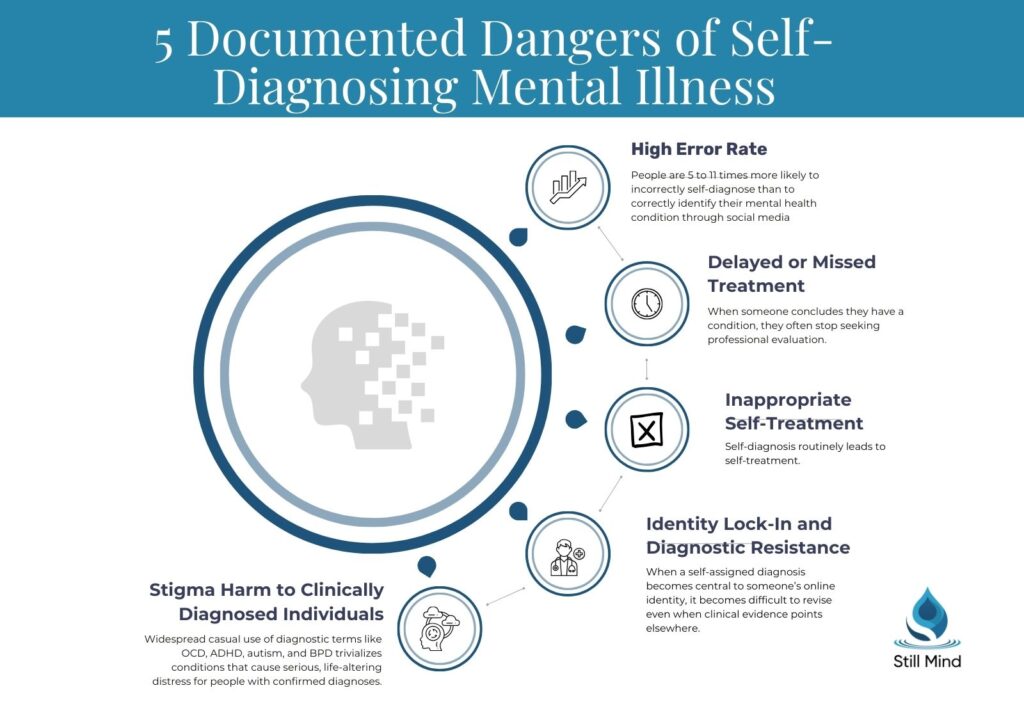
5 Documented Dangers of Self-Diagnosing Mental Illness
1. High Error Rate
People are 5 to 11 times more likely to incorrectly self-diagnose than to correctly identify their mental health condition through social media (Harvard Petrie-Flom Center, 2025). The majority of social media-derived self-diagnoses are clinically wrong. This is not a small margin. It is the dominant outcome.
2. Delayed or Missed Treatment
When someone concludes they have a condition, they often stop seeking professional evaluation. This delays identifying the actual driver of their symptoms. A person who self-diagnoses ADHD may be experiencing depression, a sleep disorder, or a learning disability, each requiring a completely different intervention.
3. Inappropriate Self-Treatment
Self-diagnosis routinely leads to self-treatment. This includes avoiding situations that worsen anxiety, self-medicating with stimulants for an unconfirmed ADHD conclusion, or adopting coping strategies built around a label that does not fit. Wrong treatments do not simply fail. They can actively worsen the underlying condition.
4. Identity Lock-In and Diagnostic Resistance
When a self-assigned diagnosis becomes central to someone’s online identity, it becomes difficult to revise even when clinical evidence points elsewhere. This creates resistance to professional evaluation and rejection of accurate diagnoses that do not match the self-chosen label.
5. Stigma Harm to Clinically Diagnosed Individuals
Widespread casual use of diagnostic terms like OCD, ADHD, autism, and BPD trivializes conditions that cause serious, life-altering distress for people with confirmed diagnoses. It also floods clinical spaces with patients whose concerns, while valid, may not reflect the condition they believe they have. Understanding the role of cognitive biases in symptom interpretation is part of why professional evaluation exists.
What the 5 D’s of Mental Illness Mean and Why Self-Diagnosis Misses Them
The 5 D’s are the clinical framework professionals use to determine whether symptoms rise to the level of a diagnosable disorder. They explain precisely why a relatable video can never substitute for an evaluation.
- Deviance. Thoughts, emotions, or behaviors that deviate significantly from what is typical in the person’s culture and social context.
- Dysfunction. Measurable impairment in daily functioning across work, relationships, self-care, or occupational performance.
- Distress. Significant personal suffering caused by the symptoms, not mild discomfort, preference, or inconvenience.
- Danger. Risk of harm to oneself or others as a direct result of the symptoms or related behaviors.
- Duration. Symptoms that persist long enough to meet diagnostic criteria rather than reflecting temporary responses to stressful life events.
Social media content almost never addresses all five criteria. A 60-second video showing relatable symptoms meets none of them in clinical terms. Validation-seeking behavior through online communities can feel like diagnostic confirmation, but it does not replace the systematic evaluation these five dimensions require.
What a Real Mental Health Diagnosis Actually Involves
A professional diagnostic evaluation is a substantive clinical process.
Here is what it involves.
- Clinical Interview. A licensed clinician conducts a structured interview covering current concerns, symptom onset, duration, and impact on functioning. Family psychiatric history, medical history, medications, substance use, trauma history, and school or work performance are all reviewed.
- Standardized Assessments. Validated rating scales are administered based on the suspected condition. These include the ADHD Rating Scale, PHQ-9 for depression, GAD-7 for anxiety, and autism spectrum instruments. These tools are scientifically validated across large populations and cannot be replicated by an online quiz.
- Collateral Information. For children and teens, clinicians gather input from parents and teachers. For adults, school records, workplace evaluations, and family observations provide critical context. Behavior frequently looks different across settings, and self-reports alone are never sufficient for diagnosis.
- Medical Workup. Depression, anxiety, and attention difficulties can be caused or worsened by thyroid disorders, anemia, sleep apnea, and other medical conditions. A comprehensive assessment always includes medical review, and often lab work, to rule out physiological causes.
- Differential Diagnosis. This is the most critical and least visible step. A clinician systematically considers every other condition that could explain the presented symptoms before arriving at a conclusion. This process is cognitively and clinically impossible through self-evaluation.
- Treatment Planning. A diagnosis begins a process, not ends one. The clinician discusses findings, answers questions, and builds a treatment plan tailored to the actual condition. This may include structured therapies, medication, lifestyle interventions, or school and workplace accommodations based on what the evaluation reveals.
Frequently Asked Questions
What are the 5 D’s of mental illness?
The 5 D’s are deviance, dysfunction, distress, danger, and duration. Clinicians use this framework to determine whether symptoms qualify as a diagnosable disorder. All five are assessed together. Social media content rarely addresses more than one or two dimensions at once, which is a core reason why self-diagnosis error rates are so high.
Is social media a clinical disorder?
Social media use is not classified as a clinical disorder in the DSM-5 or ICD-11. However, compulsive, uncontrollable use that causes significant distress and impairs daily functioning may be evaluated under internet use disorder frameworks. Heavy social media use is consistently linked to worsened depression, anxiety, and body image concerns, particularly in adolescents.
How does social media affect our mental health reality?
Social media distorts mental health reality in two measurable ways. First, it exposes users to selective presentations of both suffering and wellness that do not reflect clinical reality. Second, its algorithms amplify emotionally intense, identity-affirming content rather than clinically accurate information. Neither exposure type builds genuine diagnostic literacy or self-awareness about mental health.
What mental health disorders can you get from social media?
Social media does not independently cause mental health disorders. However, research links heavy use to worsened anxiety, depression, body dysmorphia, and health anxiety. Among adolescents, those who spend more than three hours daily on social media are twice as likely to experience poor mental health outcomes (Pew Research, 2025). Sleep disruption from late-night device use worsens nearly all existing psychiatric conditions.
What do you call someone who self-diagnoses?
There is no formal clinical term for someone who self-diagnoses. In clinical settings, a patient presenting with a strongly held self-diagnosis is noted as arriving with a “diagnosis in mind.” Trained clinicians are instructed to respectfully evaluate, rather than immediately validate or dismiss, these self-assigned labels through structured clinical assessment.
References
- Harvard Petrie-Flom Center. (2025, April 2). Dr. TikTok: The impacts of misinformation on mental health self-diagnosis. Harvard Law School.
- LifeStance Health. (2025, April 15). Navigating mental health in the age of social media. LifeStance Health Inc.
- Armstrong, S., Osuch, E., Wammes, M., Chevalier, O., Kieffer, S., Meddaoui, M., and Rice, L. (2025). Self-diagnosis in the age of social media: A pilot study of youth entering mental health treatment for mood and anxiety disorders. Acta Psychologica, 256, 105015.
- Karasavva, V., et al. (2025). ADHD symptoms discussed on TikTok and alignment with DSM-5 diagnostic criteria. Journal of Attention Disorders.
- Aragon-Guevara, A., et al. (2023). Accuracy of autism-related content on TikTok. Journal of Autism and Developmental Disorders.
- Moulder, L. (2024). TikTok and the reliability of mental health self-diagnosis. Aletheia: Alpha Chi Honor Society Journal, 8.
- Corzine, A., and Roy, A. (2024). Inside the black mirror: Current perspectives on the role of social media in mental illness self-diagnosis. Discover Psychology, 4, 40.
- Centers for Disease Control and Prevention. (2023). Depression prevalence in adolescents and adults, United States, 2013-2023. National Center for Health Statistics Data Brief No. 527. https://www.cdc.gov/nchs/products/databriefs/db527.htm
- Pew Research Center. (2025, April 22). Social media and teens’ mental health: What teens and their parents say.
- Ahuja, P., et al. (2024). Concerns regarding the glorification of mental illness on social media. Cureus, 16(3), e56631.