



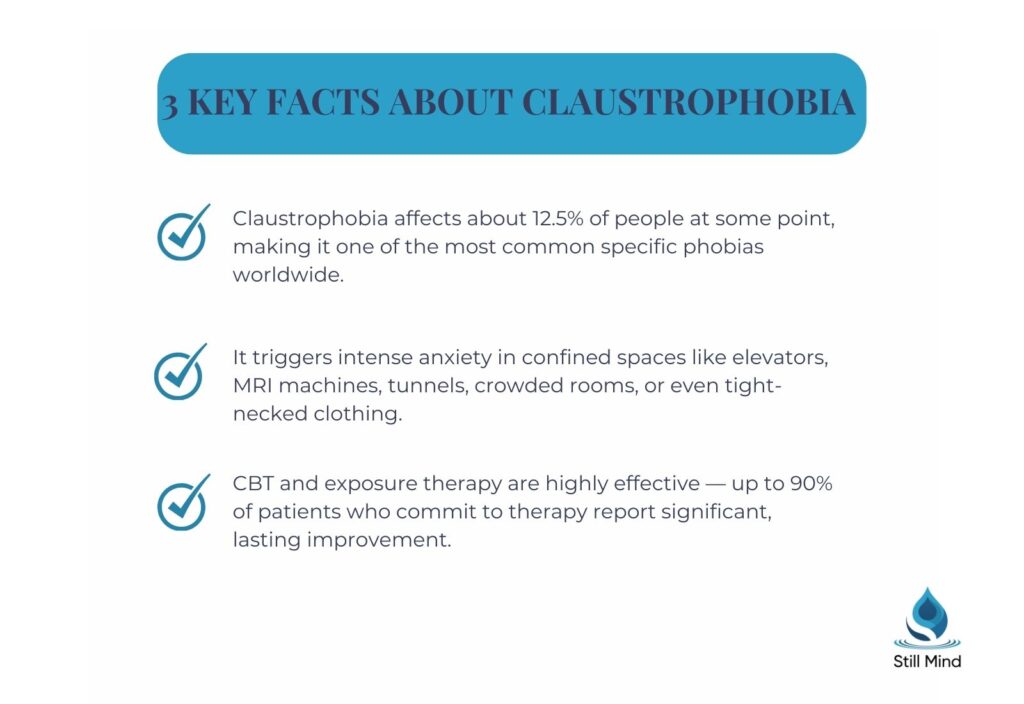
Claustrophobia is an anxiety disorder characterized by an intense, irrational fear of enclosed or confined spaces. It is classified as a specific phobia under the DSM-5-TR and is one of the most common phobias worldwide, affecting an estimated 12.5 percent of the general population.
People with claustrophobia are not simply uncomfortable in tight spaces. Their fear is disproportionate to any actual danger, often triggers a full panic response, and frequently leads to significant avoidance behavior that disrupts daily life. Effective treatments exist and recovery is achievable with the right support.
Highlights
- Claustrophobia affects approximately 12.5 percent of the population and is more commonly diagnosed in women than in men (Cleveland Clinic, 2025).
- Research shows that between 5 and 10 percent of the world population experiences severe claustrophobia, yet only a small fraction seek treatment (StatPearls, NCBI, 2023).
- Claustrophobia has two distinct components: fear of suffocation and fear of restriction. Studies using MRI patients confirm these are separable dimensions, not a single unified fear.
- Exposure therapy and cognitive behavioral therapy (CBT) are the two most evidence-supported treatments for claustrophobia, with strong success rates when treatment is completed.
- Avoidance behavior, while providing short-term relief, consistently worsens claustrophobia over time by reinforcing the brain’s threat response to confined spaces.
What Does Claustrophobia Mean?
The word claustrophobia comes from the Latin claustrum, meaning “a shut-in place,” and the Greek phobos, meaning “fear.” Together, they describe the defining feature of the condition: an intense dread of spaces that feel closed, confined, or escape-limiting.
Claustrophobia is not simply a preference for open spaces or mild discomfort in crowds. It is a clinical anxiety disorder in which the fear response is activated even when no genuine threat exists. A person with claustrophobia may consciously know they are safe in an elevator but still experience racing heart, difficulty breathing, and an overwhelming urge to escape.
Importantly, people with claustrophobia are not afraid of the enclosed space itself. They are afraid of what might happen inside it: running out of air, being unable to escape, losing control, or dying. This distinction matters clinically because treatment targets the catastrophic thought patterns, not just the triggering environment.
Common Triggers of Claustrophobia
Claustrophobia can be triggered by a wide range of environments and situations. Triggers vary by person and depend on the severity of the phobia, but the most commonly reported include:
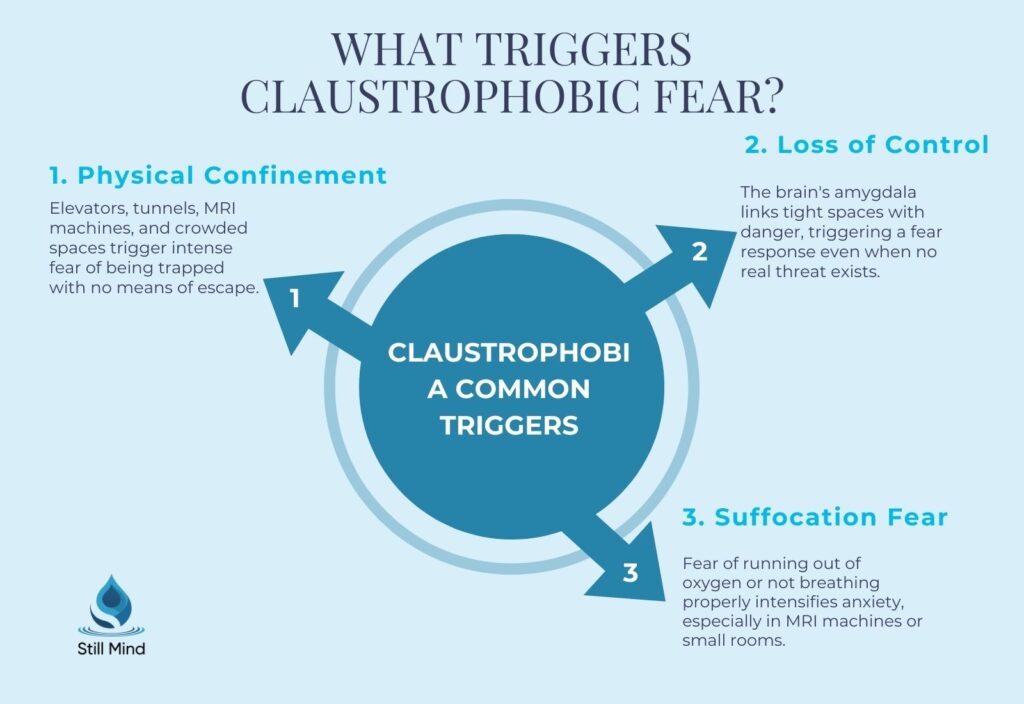
- Elevators and lifts: Particularly crowded or windowless elevators that restrict movement and perceived escape routes.
- MRI and medical imaging machines: One of the most frequently cited triggers due to total physical enclosure, loud noise, and restricted movement for extended periods.
- Airplanes: Confined seating, inability to exit, and the added altitude element combine to trigger intense claustrophobic responses in many people.
- Tunnels: Both road tunnels and subway tunnels, where the absence of visible exits creates a sensation of entrapment.
- Small or windowless rooms: Rooms without natural light or ventilation, particularly those with doors that lock from the outside.
- Crowded public spaces: Concerts, packed subway cars, or packed waiting rooms where movement is physically restricted by other people.
- Tight clothing: Some individuals experience claustrophobic anxiety from high-necked or restrictive clothing that creates a physical sensation of constriction.
- Cars with locked doors: Small vehicles, particularly with windows that cannot be opened, trigger fear of suffocation and inability to escape in some people.
Symptoms of Claustrophobia
Claustrophobia symptoms mirror those of a panic attack and can range from mild unease to a full physical panic response. They typically appear very quickly upon exposure to a trigger, or even when simply anticipating an encounter with a triggering environment.
Physical symptoms
- Rapid or pounding heartbeat (tachycardia)
- Shortness of breath or hyperventilation
- Sweating or trembling
- Tightness or pain in the chest
- Nausea or dizziness
- Dry mouth
- Hot flushes or chills
- Numbness or tingling in the extremities
Emotional and cognitive symptoms
- Overwhelming fear or dread that feels impossible to control.
- Fear of dying or losing consciousness while in the confined space.
- Fear of losing control of physical or mental functioning.
- An intense, urgent need to escape regardless of whether escape is actually necessary.
- Knowing the fear is irrational but being unable to override it.
- Anticipatory anxiety: Significant worry before an expected encounter with a triggering situation, sometimes days in advance.
Symptoms depend heavily on severity. Mild claustrophobia may produce manageable discomfort. Severe claustrophobia can render everyday activities, such as taking public transport, attending medical appointments, or riding in a car, functionally impossible without treatment.
What Causes Claustrophobia?
The exact cause of claustrophobia is not fully understood, but research consistently points to a combination of neurological, genetic, and environmental factors. Most cases develop during childhood or adolescence.
Amygdala dysfunction
The amygdala is the brain region responsible for processing fear. In people with claustrophobia, the amygdala appears to overstimulate in response to enclosed spaces, triggering a threat response that is disproportionate to actual danger. Some studies also suggest a structural reduction in amygdala size may be associated with the condition.
Genetic predisposition
There is a meaningful hereditary component to specific phobias. Researchers have identified a defect in a gene called GPM6A that is believed to increase susceptibility to claustrophobia. Having a parent or close family member with claustrophobia significantly raises the likelihood of developing it yourself.
Traumatic or conditioning experiences
Many adults with claustrophobia report a specific triggering event, often from childhood. Being accidentally locked in a small space, getting stuck in an elevator, experiencing severe turbulence on a flight, or witnessing another person’s panicked reaction to confinement can all create a conditioned fear response that persists into adulthood.
Vicarious learning
Children who grow up observing a parent or caregiver express intense fear of confined spaces may internalize the same fear through observational learning. This does not require the child to have had a direct traumatic experience. The repeated observation that enclosed spaces are dangerous is enough to wire the fear response.
Co-occurring anxiety conditions
Having an existing anxiety disorder significantly increases the risk of developing claustrophobia or other specific phobias. Anxiety lowers the threshold at which the nervous system perceives threat, making phobic responses more likely to develop and harder to extinguish.
Claustrophobia vs. Cleithrophobia: What Is the Difference?
This is one of the most searched questions related to the topic, and the distinction is clinically meaningful.
| Feature | Claustrophobia | Cleithrophobia |
|---|---|---|
| Core fear | Fear of enclosed or small spaces | Fear of being trapped or locked in, regardless of space size |
| Trigger example | Being inside an MRI machine or small elevator | Being locked inside a room, even a large one |
| Space size matters? | Yes. Smaller spaces produce stronger fear responses | No. A large locked room can be as frightening as a small one |
| Primary concern | Suffocation, restriction, running out of air | Inability to escape, loss of freedom and control |
| DSM-5 classification | Specific phobia, situational type | Specific phobia, situational type (less formally studied) |
Some individuals experience both phobias simultaneously. The overlap is significant but the distinction helps therapists identify the specific cognitive focus driving the fear, which informs treatment targeting.
How Is Claustrophobia Diagnosed?
A mental health professional, typically a psychologist, psychiatrist, or licensed therapist, diagnoses claustrophobia through a clinical interview. There is no blood test or brain scan that confirms the diagnosis. The clinician will assess whether all of the following criteria are present, consistent with DSM-5-TR requirements for a specific phobia:
- The fear of enclosed spaces is intense and has persisted for six months or longer.
- The fear or anxiety is consistently triggered by enclosed or confined spaces.
- The person either avoids these situations or endures them with intense fear.
- The level of fear is disproportionate to the actual danger posed.
- The fear causes significant distress or impairment in daily functioning.
- The fear is not better explained by another medical or psychiatric condition.
The clinician will also screen for co-occurring conditions. Depression, generalized anxiety, PTSD, and OCD frequently co-occur with specific phobias and need to be identified for comprehensive treatment planning.
Treatment for Claustrophobia
Claustrophobia is highly treatable. Most people who complete a full course of evidence-based therapy experience significant reduction in symptoms and improved functioning. The key is choosing the right approach and committing to completing treatment, which often involves confronting the feared situation rather than avoiding it.
Exposure therapy
Exposure therapy, also called systematic desensitization, is the gold-standard treatment for specific phobias including claustrophobia. The therapist works with the patient to construct a hierarchy of feared situations from least to most anxiety-provoking. The patient is then guided through gradual, controlled exposure to each level, beginning with imagining a tight space and progressing over sessions to actual physical exposure. Repeated exposure without the feared outcome teaches the brain to deactivate the threat response.
Cognitive behavioral therapy (CBT)
CBT addresses the distorted thought patterns that fuel claustrophobic fear. Common cognitive distortions include catastrophizing (“I will run out of air and die”), overestimating danger, and underestimating one’s ability to cope. CBT teaches patients to identify these thoughts, examine the evidence for and against them, and replace them with more balanced, accurate appraisals. CBT is often combined with exposure therapy for the strongest outcomes.
Virtual reality therapy
Virtual reality (VR) exposure is an emerging and promising treatment for claustrophobia. Computer-generated simulations of elevators, MRI machines, and other triggering environments allow patients to undergo exposure in a controlled, safely escapable digital setting. Research including studies with MRI patients suggests VR can meaningfully reduce claustrophobic anxiety and may be particularly useful for individuals who are too fearful to begin real-world exposure.
Relaxation and mindfulness techniques
Diaphragmatic breathing, progressive muscle relaxation, and mindfulness-based grounding techniques are useful both as standalone coping tools and as preparation for exposure work. When practiced regularly, these techniques reduce baseline anxiety and help the person manage acute fear responses during triggering situations without automatically fleeing.
Medication
Medication is not a first-line treatment for claustrophobia on its own, but can support therapy for people with severe symptoms. Short-acting benzodiazepines are sometimes prescribed for specific situational use, such as before an unavoidable MRI scan. SSRIs or SNRIs may be used when claustrophobia co-occurs with generalized anxiety or depression. Medication is most effective when combined with therapy rather than used as a substitute for it.
How to Manage Claustrophobia in Everyday Situations
While professional treatment is the most effective long-term solution, these strategies can help manage claustrophobic anxiety in the moment:
- Controlled breathing: Slow, deliberate breathing (inhale for four counts, hold for four, exhale for four) activates the parasympathetic nervous system and reduces the physical panic response.
- Grounding techniques: The 5-4-3-2-1 method (naming five things you can see, four you can touch, three you can hear, two you can smell, one you can taste) redirects attention from catastrophic thoughts to present-moment reality.
- Facing triggers gradually: Avoiding confined spaces provides short-term relief but strengthens the phobia over time. Small, voluntary exposures, taking the elevator one floor instead of the stairs, for example, build tolerance incrementally.
- Communicating your needs: Telling a doctor, flight attendant, or MRI technician about your claustrophobia often leads to practical accommodations that make the experience more manageable.
- Distraction during unavoidable exposure: Music, podcasts, or focused conversation during an MRI or flight can reduce the amount of mental bandwidth available for anxious rumination.
How to Overcome Claustrophobia on a Plane
Airplane travel is one of the most common and unavoidable claustrophobia triggers. Seats are small, windows are sealed, and passengers cannot exit during the flight. Strategies that help specifically for air travel include:
- Choosing an aisle seat to preserve a sense of physical freedom and an unobstructed path to movement.
- Boarding early to get settled before the cabin fills and movement becomes restricted.
- Informing a flight attendant at the start of the flight so they can check on you and provide reassurance if needed.
- Using headphones and a calming audio playlist or guided meditation for the duration of the flight.
- Practicing the breathing and grounding techniques described above before and during the flight.
- Speaking with a therapist before planned travel to do brief targeted exposure work focused on the specific features of air travel that are most triggering.
Frequently Asked Questions About Claustrophobia
What does claustrophobia mean?
Claustrophobia is an anxiety disorder defined by an intense, irrational fear of enclosed or confined spaces. The name derives from the Latin word for “shut-in place” and the Greek word for fear. It is classified as a specific phobia in the DSM-5-TR and is one of the most common phobias, affecting roughly 12.5 percent of the population. The fear is not about the space itself, but about what the person fears could happen inside it, such as suffocation, entrapment, or inability to escape.
How do you know that you are claustrophobic?
You may be claustrophobic if you consistently experience intense anxiety, panic symptoms, or an overwhelming urge to escape when in enclosed spaces such as elevators, MRI machines, or small rooms. Key signs include anticipating these situations with significant dread, altering your daily routines to avoid them, and experiencing physical symptoms such as rapid heartbeat or difficulty breathing when confronted with confined environments. If these patterns are persistent and interfering with your life, a clinical evaluation is recommended.
What is the difference between claustrophobia and Cleithrophobia?
Claustrophobia is the fear of small or enclosed spaces, where the size of the space drives the fear. Cleithrophobia is the fear of being trapped or locked in, regardless of the actual size of the space. Someone with cleithrophobia may feel intense panic in a large locked room, while a person with claustrophobia is primarily triggered by the physical smallness of the space. Both are classified as specific phobias and both respond to exposure-based treatment.
How to overcome claustrophobia on a plane?
Practical strategies for managing claustrophobia on a plane include booking an aisle seat, informing a flight attendant of your phobia at boarding, using controlled breathing and grounding techniques during the flight, and using headphones with calming audio to reduce environmental overwhelm. For frequent travelers with severe symptoms, working with a therapist on targeted exposure exercises before travel is the most effective longer-term solution.
Is claustrophobia a mental illness?
Yes, claustrophobia is a diagnosable mental health condition. It is classified as a specific phobia under anxiety disorders in the DSM-5-TR. This classification means it meets clinical criteria for impairment and distress beyond normal fear. However, having claustrophobia does not reflect a character flaw or weakness. It is a recognized anxiety condition with effective treatments and a good prognosis when properly addressed.
Is claustrophobia dangerous?
Claustrophobia itself is not physically dangerous. The physical symptoms it produces, such as rapid heartbeat and hyperventilation, are the body’s stress response and are not medically harmful on their own. However, if left untreated, claustrophobia can significantly impair quality of life by causing avoidance of medical care such as MRI scans, travel, and many everyday environments. It can also worsen over time and contribute to broader anxiety or depression if the avoidance pattern expands.
Bottom Line
Claustrophobia is a common, well-understood anxiety disorder that responds well to treatment. The fear feels overwhelming in the moment, but it is not a permanent condition, and it does not define what you are capable of doing in your daily life.
If claustrophobia is limiting your activities, affecting your medical care, or causing you significant distress, Still Mind Florida offers evidence-based anxiety treatment, including CBT and exposure-based approaches, delivered by experienced clinicians. Visit our admissions page to explore your options and take the first step toward lasting relief.
References
- American Psychiatric Association. (2022). Diagnostic and statistical manual of mental disorders (5th ed., text rev.). American Psychiatric Publishing.
- Cleveland Clinic. (2025). Claustrophobia: What is it, symptoms, causes and treatment.
- Ratnayake, M., & Lakshmi, S. (2023). Claustrophobia. In StatPearls. National Center for Biotechnology Information. https://www.ncbi.nlm.nih.gov/books/NBK542327/
- Ost, L. G. (1996). Long-term effects of behavior therapy for specific phobia. In M. R. Mavissakalian & R. F. Prien (Eds.), Long-term treatments of anxiety disorders. American Psychiatric Press.
- Rachman, S., & Taylor, S. (1993). Analyses of claustrophobia. Journal of Anxiety Disorders, 7(4), 281-291.
- Botella, C., Breton-Lopez, J., Quero, S., Banos, R. M., & Garcia-Palacios, A. (2010). Treating cockroach phobia with augmented reality. Behavior Therapy, 41(3), 401-413.
- National Institute of Mental Health. (2023). Specific phobia. U.S. Department of Health and Human Services. https://www.nimh.nih.gov/health/statistics/specific-phobia
- Craske, M. G., Antony, M. M., & Barlow, D. H. (2006). Mastering your fears and phobias: Therapist guide (2nd ed.). Oxford University Press.
- Wikipedia contributors. (2025, March). Claustrophobia. In Wikipedia.
- Better Health Channel. (2023). Claustrophobia. State Government of Victoria. https://www.betterhealth.vic.gov.au/health/conditionsandtreatments/claustrophobia