


Key Points
- Behavioral therapy focuses on changing unhelpful patterns through action and practice.
- CBT is the most researched and widely used technique worldwide.
- Techniques include exposure, behavioral activation, skills training, and cognitive restructuring.
- They treat anxiety, depression, OCD, PTSD, phobias, and emotional dysregulation.
- Most people see noticeable improvement in 8–16 sessions.
- Skills learned in therapy continue working long after therapy ends.
- Professional guidance maximizes results and prevents common pitfalls.
What Are Behavioral Therapy Techniques?
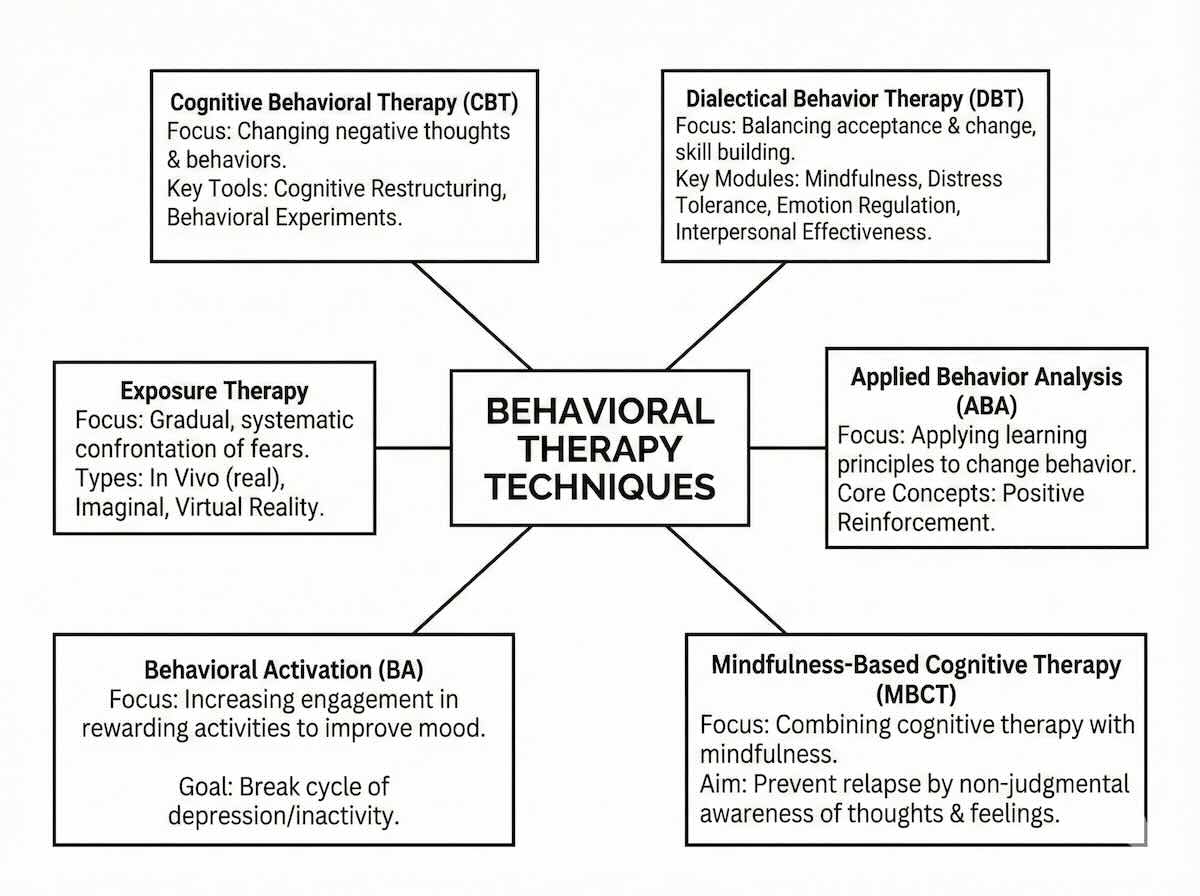
Behavioral therapy techniques are structured, goal-oriented interventions that help people change problematic thoughts, emotions, and behaviors by focusing on the present rather than digging endlessly into the past. Rooted in learning theory, they rest on a simple but powerful idea: behaviors that get rewarded continue, and behaviors that don’t get rewarded eventually fade. Modern approaches blend classic behaviorism with cognition, creating highly effective hybrids like Cognitive Behavioral Therapy (CBT), Dialectical Behavior Therapy (DBT), Acceptance and Commitment Therapy (ACT), and exposure-based treatments. The National Institute for Health and Care Excellence (NICE) and American Psychological Association recognize these methods as first-line treatments for most anxiety disorders, depression, and trauma-related conditions.
Dr. Aaron Beck, founder of CBT, famously said, “Change your thoughts and you change your world.” Behavioral techniques put that principle into daily practice.
1. Cognitive Restructuring (Thought Challenging)
Cognitive restructuring teaches you to spot distorted thinking patterns, catastrophizing, black-and-white thinking, overgeneralization and replace them with balanced, evidence-based thoughts. The process is systematic: identify the triggering situation, notice the automatic thought, evaluate the evidence for and against it, then generate a more realistic alternative. Daily thought records become the main homework tool. Research shows that mastering this skill alone reduces depression relapse by up to 50% and cuts anxiety symptoms dramatically. At Still Mind Florida, we often start CBT with this technique because it gives clients immediate relief and a sense of control over runaway thoughts.
2. Exposure Therapy (Facing Fears Safely)
Exposure therapy is the gold-standard treatment for phobias, PTSD, OCD, and panic disorder. The principle is straightforward: avoiding what you fear strengthens the fear; facing it gradually weakens it. Therapists create a fear hierarchy (0–100 scale) and guide clients through repeated, controlled contact with the feared situation until anxiety naturally drops. Modern variations include imaginal exposure, in-vivo (real-life) exposure, and virtual-reality exposure. Studies consistently show 80–90% success rates for specific phobias and significant improvement in PTSD symptoms. The key is staying in the situation long enough for the brain to learn it’s safe.
3. Behavioral Activation (Re-engaging with Life)
Behavioral activation is especially powerful for depression. When people feel low, they withdraw from activities, which removes natural sources of reward and deepens the depression. This technique reverses the cycle by scheduling small, achievable activities, even getting out of bed and showering counts, then gradually building up to meaningful goals. Activity monitoring charts track mood before and after each task, proving to clients that action precedes motivation, not the other way around. Meta-analyses show behavioral activation works as well as full CBT or antidepressant medication for moderate to severe depression, with longer-lasting effects.
4. Skills Training (DBT and Beyond)
Dialectical Behavior Therapy (DBT) teaches four core skill sets: mindfulness, distress tolerance, emotion regulation, and interpersonal effectiveness. Clients practice skills in individual therapy, group classes, and daily diary cards. These techniques are lifesaving for people with emotional dysregulation, borderline personality traits, or chronic suicidal thoughts. Even outside full DBT programs, individual skills like TIPP (Temperature, Intense exercise, Paced breathing, Paired muscle relaxation) or opposite action can stop emotional spirals in minutes.
5. Mindfulness and Acceptance-Based Techniques
Third-wave behavioral therapies like Acceptance and Commitment Therapy (ACT) and Mindfulness-Based Cognitive Therapy (MBCT) shift the goal from controlling thoughts to changing your relationship with them. Techniques include defusion exercises (“I’m having the thought that…”), values clarification, and mindful breathing. These methods excel at preventing depression relapse and helping with generalized anxiety where traditional thought-challenging feels forced. Clients learn to allow uncomfortable sensations while staying committed to meaningful actions essentially living well even when the mind protests.
How Quickly Do These Techniques Work?
Most people notice some relief within 4–6 sessions, with substantial improvement by 12–16 sessions for straightforward anxiety or depression. Complex cases involving trauma, personality disorders, or long-standing avoidance may take longer, but progress is usually steady and measurable. The beauty of behavioral techniques is that they are skill-based: once learned, you own them for life. Booster sessions or apps can maintain gains years later.
When to Seek Professional Guidance
While books, apps, and worksheets can help with mild issues, professional therapy dramatically improves outcomes for moderate to severe symptoms. A trained therapist creates the right pace for exposure, spots subtle cognitive distortions, and adjusts techniques when progress stalls. At Still Mind Florida, our clinicians specialize in CBT, DBT, exposure therapy, and ACT.
We tailor treatment to your exact needs, whether it’s overcoming a phobia in 8 sessions or rebuilding emotion regulation skills over several months.
Don’t struggle alone.
Real change is closer than you think.
Conclusion
Behavioral therapy techniques are not theoretical. They are practical, science-backed tools that have transformed millions of lives. From challenging distorted thoughts to facing fears head-on, scheduling joy when you feel none, or learning to tolerate distress without self-destruction, these methods work because they change behavior first and let feelings follow. You don’t need endless insight. You need effective action.
At Still Mind Florida, we’ve seen these techniques help people conquer panic disorders, lift years of depression, and finally live according to their values. If you’re ready to stop surviving and start thriving, we’re here to guide you every step of the way. Call (561) 783-5507 today. Your new chapter begins with one conversation.
References
- Beck, A. T. (1979). Cognitive Therapy of Depression. Guilford Press.
- Craske, M. G. (2017). Exposure Therapy for Anxiety. Guilford Press.
- Linehan, M. M. (2014). DBT Skills Training Manual. Guilford Press.
- Hayes, S. C. (2005). Get Out of Your Mind and Into Your Life. New Harbinger.
- Hofmann, S. G., et al. (2012). The Efficacy of Cognitive Behavioral Therapy: A Review of Meta-analyses. Cognitive Therapy and Research.